Brief Report - (2025) Volume 16, Issue 4
Received: 02-Aug-2025, Manuscript No. jvst-26-188039;
Editor assigned: 04-Aug-2025, Pre QC No. P-188039;
Reviewed: 18-Aug-2025, QC No. Q-188039;
Revised: 25-Aug-2025, Manuscript No. R-188039;
Published:
01-Sep-2025
, DOI: 10.37421/2157-7579.2025.16.308
Citation: Laurent, Sophie. ”Livestock Disease Prevention: A
Comprehensive Strategy.” J Vet Sci Techno 16 (2025):308.
Copyright: © 2025 Laurent S. This is an open-access article distributed under the terms of the Creative Commons Attribution License, which permits unrestricted use,
distribution and reproduction in any medium, provided the original author and source are credited.
The prevention and control of diseases within livestock populations are paramount for ensuring animal welfare, food security, and economic stability. A multifaceted approach is required, integrating various strategies to mitigate risks and enhance resilience against infectious agents.
Biosecurity measures form a critical foundation, encompassing farm-level practices designed to prevent the introduction and spread of pathogens. These include stringent access controls, rigorous sanitation protocols, and effective control of rodents and insects, all contributing to a safer farming environment. Complementing biosecurity, vaccination remains a cornerstone of disease prevention, offering protection against numerous economically significant infectious diseases. Advancements in vaccine technology, such as mRNA and subunit platforms, are continuously improving efficacy and safety profiles, offering new avenues for disease control. Genetic improvement of livestock, through selective breeding for enhanced disease resistance, presents a sustainable long-term strategy. By identifying and propagating resistant alleles, the inherent ability of animals to combat diseases can be strengthened, reducing reliance on other interventions. Antimicrobial stewardship is essential for preserving the efficacy of existing treatments and preventing the rise of resistant strains. Judicious use of antimicrobials, coupled with the exploration of alternatives, is crucial for responsible disease management. Nutritional strategies play a vital role in supporting robust immune function. The impact of essential nutrients on animal health and disease resistance is significant, highlighting the importance of scientifically formulated diets tailored to specific needs. Environmental management within livestock facilities directly influences disease transmission. Optimizing housing conditions, ventilation, temperature control, and hygiene can significantly reduce pathogen loads and stress levels in animals. Early detection and rapid containment of infectious diseases are crucial for preventing widespread outbreaks. The application of advanced diagnostic technologies and robust surveillance systems enables timely identification and response to potential threats. Furthermore, the increasing global trade and movement of livestock necessitate robust measures to prevent transboundary disease spread. Effective import/export health certification and international collaboration are vital in this regard. Finally, adopting a One Health approach, which integrates human, animal, and environmental health, provides a comprehensive framework for addressing complex disease challenges, including those affecting livestock and posing risks to human populations.Biosecurity serves as a fundamental pillar in safeguarding livestock health by meticulously preventing the ingress and dissemination of diseases. This involves implementing stringent farm-level management practices such as strict access controls to limit potential pathogen introduction, comprehensive sanitation protocols to eliminate contaminants, and diligent rodent and insect control measures to curb vector-borne transmissions.
The strategic deployment of vaccination remains an indispensable tool for conferring immunity against a broad spectrum of economically damaging infectious diseases in livestock. Ongoing research and development in vaccine design, particularly with novel platforms like mRNA and subunit vaccines, are yielding agents with enhanced efficacy and improved safety characteristics. Genetic enhancement of livestock through selective breeding for inherent disease resistance offers a sustainable and enduring solution for disease prevention. This approach involves identifying and propagating genes associated with resistance, thereby bolstering the animals' natural defense mechanisms against pathogens. Antimicrobial stewardship is critically important for maintaining the therapeutic effectiveness of antimicrobial drugs used in both treatment and prevention of livestock diseases. This necessitates the judicious application of antimicrobials, ensuring accurate diagnoses, appropriate drug selection, and correct administration protocols. Significant attention is also directed towards nutritional strategies aimed at fortifying the immune system and bolstering disease resistance in livestock. A balanced intake of essential nutrients is vital for optimal immune function, and dietary interventions can play a crucial role in enhancing an animal's ability to fend off infections. Environmental management within livestock facilities is recognized as a key factor in curtailing disease transmission. Strategies focusing on improving housing conditions, including optimal ventilation, temperature regulation, and maintaining high standards of hygiene, contribute to reduced pathogen loads and diminished animal stress. Early detection and swift containment of infectious disease outbreaks are crucial for mitigating their impact on livestock populations and preventing broader dissemination. The integration of advanced diagnostic technologies and sophisticated surveillance systems is instrumental in achieving this objective. The globalized nature of livestock production and trade introduces considerable risks of disease introduction and spread across international borders. Effective import/export health certification and rigorous surveillance programs are essential to manage these transboundary threats. Knowledge transfer and effective communication among all stakeholders, from researchers to producers and policymakers, are vital for the successful implementation of disease prevention programs. Collaborative efforts and the dissemination of scientific findings are key to informed decision-making. The adoption of a One Health framework, which acknowledges the interconnectedness of human, animal, and environmental health, provides a holistic approach to tackling complex disease challenges. This integrated perspective is crucial for identifying emerging threats and developing comprehensive prevention strategies that benefit all aspects of the health ecosystem.This collection of research highlights various strategies for preventing and controlling diseases in livestock. Biosecurity measures at the farm level, including access control and sanitation, are fundamental. Vaccination, especially with advanced technologies, offers crucial protection. Genetic selection for disease resistance provides a sustainable, long-term solution. Antimicrobial stewardship and the use of alternatives like probiotics are essential for preserving drug efficacy. Proper nutrition supports robust immune function, while effective environmental management reduces pathogen loads. Early disease detection through advanced diagnostics and surveillance is vital. Preventing transboundary spread via international trade regulations and adopting a One Health approach, which integrates human, animal, and environmental health, are also key components of a comprehensive disease prevention framework.
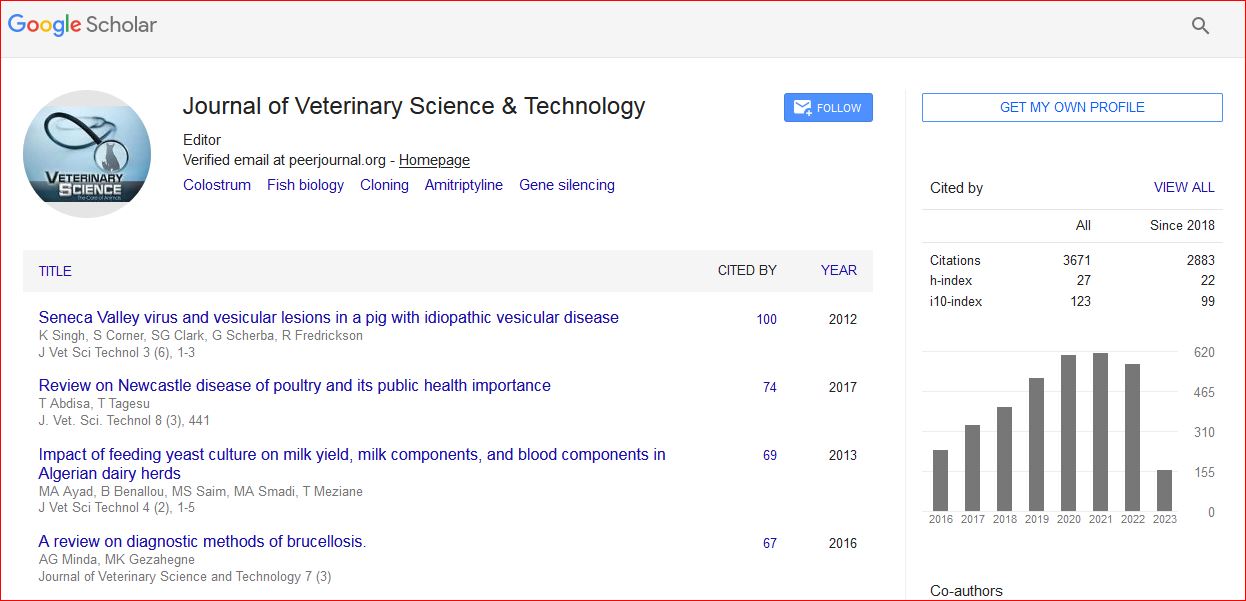
Veterinary Science & Technology received 4472 citations as per Google Scholar report