Perspective - (2025) Volume 16, Issue 5
Received: 01-Sep-2025, Manuscript No. assj-25-174793;
Editor assigned: 03-Sep-0205, Pre QC No. P-174793;
Reviewed: 17-Sep-2025, QC No. Q-174793;
Revised: 22-Sep-2025, Manuscript No. R-174793;
Published:
29-Sep-2025
, DOI: 10.37421/2151-6200.2025.16.687
Citation: Rossi, Emilia. ”Literary Ecologies: Navigating the An thropocene and Coexistence.” Arts Social Sci J 16 (2025):687.
Copyright: © 2025 Rossi E. This is an open-access article distributed under the terms of the Creative Commons Attribution License, which permits unrestricted use, distribution and reproduction in any medium, provided the original author and source are credited
Contemporary literary scholarship stands at a critical juncture, deeply immersed in the urgent conversations surrounding environmental crises and the evolving relationship between humanity and the broader natural world. This field consistently demonstrates literatureâ??s profound capacity to not only reflect but also to actively shape our understanding of ecological challenges. It offers a vital space for critical introspection and for imagining radically different futures for all inhabitants of Earth. The ongoing environmental crises of the Anthropocene have profoundly impacted contemporary fiction, compelling it to grapple with complex issues. This article explores how literature actively engages with these challenges, providing essential critical perspectives and articulating imagined futures that promote human and more-than-human coexistence. Storytelling, in this context, becomes an indispensable tool for comprehending and responding to the ecological predicaments we face [1].
Expanding on this engagement, authors from the Global South are increasingly utilizing speculative fabulation as a powerful means to depict more-than-human ecologies. Their narratives deliberately challenge entrenched anthropocentric viewpoints, offering robust alternative frameworks for conceptualizing environmental justice and fostering relationality, particularly within postcolonial contexts [2].
This approach pushes readers to reconsider dominant narratives and embrace a wider, more inclusive understanding of ecological interdependence. Furthermore, recent Italian literature has embraced a sophisticated intersection of material ecologies and the posthuman turn. This line of inquiry analyzes how literary texts actively engage with non-human agents and intricate material processes, fundamentally reframing the traditional relationship between human culture and the environment [3].
It acknowledges the agency of the non-human and the materiality of existence. Crucially, Indigenous literary ecologies offer profound insights derived from traditional knowledge systems and storytelling. These narratives illuminate multispecies relations in ways that Western thought often overlooks. The work advocates for a deep listening to Indigenous narratives, recognizing them as essential for fundamentally rethinking environmental ethics and paving the way for truly sustainable futures [4].
Their wisdom provides a much-needed counterbalance to prevailing paradigms. The concept of queer ecologies introduces another critical lens, examining how contemporary Anglophone fiction deliberately challenges normative ideas of nature and reproduction. This is achieved through the exploration of non-normative relationships and attachments, suggesting that queer perspectives can significantly deepen our collective understanding of environmental interconnectedness [5].
It broadens the scope of what constitutes natural and valuable relationships. The rise of digital ecologies represents a timely and significant area of study within contemporary literature. This field explores how new media and various digital forms are strategically employed to address pressing environmental justice issues within the Anthropocene. It focuses intensely on the dynamic interplay between technology, innovative literary expression, and the cultivation of broader ecological awareness [6].
This demonstrates how our increasingly digital lives are intertwined with environmental concerns. Another vital dimension of literary ecologies is seen through the lens of discard studies. This approach rigorously examines how literature represents and critiques the pervasive issues of waste, pollution, and widespread environmental degradation. It powerfully argues that a comprehensive understanding of literary depictions of waste is absolutely crucial for effectively addressing the complex web of ecological crises [7].
What we discard and how we represent it speaks volumes about our relationship with the planet. Posthumanist perspectives provide illuminating insights into Arctic literary ecologies. Narratives emerging from this unique region vividly depict the intricate relationships between ice, diverse non-human animals, and resilient Indigenous communities. These stories offer unparalleled insights into both environmental vulnerability and remarkable resilience in a rapidly changing world [8].
The Arctic, a bellwether for global climate change, becomes a focal point for understanding survival and adaptation. Contemporary climate fiction also constructs what are termed 'affective ecologies.' Here, emotions are not merely a backdrop but play a central, active role in shaping human and environmental interactions. This demonstrates how narratives are specifically designed to generate powerful emotional responses, which in turn can profoundly influence readers' engagement with the critical challenges of climate change [9].
Feeling, not just knowing, is essential for action. Finally, the literary imagination extends to urban ecologies, exploring nature's persistent presence and surprising resilience within metropolitan environments. This investigation highlights the complex and often paradoxical human-nature relationships in built landscapes, while also pointing toward the immense potential for green interventions and reimagined urban coexistence [10].
Even in our most constructed spaces, nature finds a way, and literature helps us see it.
Contemporary literature offers a rich and diverse exploration of ecological themes, engaging with the environmental challenges of our time through various lenses and approaches. This broad field delves into how storytelling can provide critical perspectives on the Anthropocene, envisioning new possibilities for human and more-than-human coexistence. It underscores literatureâ??s capacity to articulate environmental crises and foster a deeper understanding of our planetary predicaments. The engagement often transcends traditional human-centric narratives, pushing boundaries to incorporate broader ecological concerns and diverse forms of life [1, 3].
A significant portion of this literary inquiry comes from regions and perspectives historically marginalized. Authors from the Global South, for instance, are leveraging speculative fabulation to articulate more-than-human ecologies, thereby directly challenging anthropocentric narratives. Their work is instrumental in building alternative frameworks that promote environmental justice and emphasize relationality within postcolonial contexts [2]. Parallel to this, Indigenous literary ecologies provide invaluable insights. Through traditional knowledge systems and ancestral storytelling, these narratives reveal profound multispecies relations, advocating for a crucial rethinking of environmental ethics and inspiring sustainable futures rooted in ancient wisdom [4]. The Arctic further exemplifies this, with narratives exploring posthumanist perspectives that highlight intricate relationships between ice, non-human animals, and Indigenous communities, offering unique insights into environmental vulnerability and resilience [8].
Beyond geographical and cultural specificities, contemporary literary ecologies also venture into conceptual and theoretical domains. Queer ecologies, for example, explore how Anglophone fiction actively destabilizes normative ideas of nature and reproduction. By focusing on non-normative relationships and attachments, this approach enriches our understanding of environmental interconnectedness, demonstrating that diverse ways of being can offer fresh insights into ecological thinking [5]. Similarly, discard studies provide a critical framework for examining how literature represents and critiques issues of waste, pollution, and environmental degradation. This focus on "literary ecologies of waste" argues for the necessity of understanding these depictions to effectively address pervasive ecological crises [7].
The interaction of literature with modern technological and built environments forms another crucial area of study. Digital ecologies investigate how new media and digital forms are employed to address environmental justice in the Anthropocene. This research highlights the complex interplay between technology, literary expression, and the cultivation of ecological awareness in an increasingly digital world [6]. Concurrently, urban ecologies within the literary imagination explore nature's surprising presence and persistence in metropolitan settings. These works illuminate the intricate complexities of human-nature relationships in built landscapes, pointing toward the potential for innovative green interventions and more harmonious urban living [10].
Finally, the emotional dimensions of environmental engagement are explored through the concept of 'affective ecologies.' Contemporary climate fiction, in particular, demonstrates how emotions are central to shaping human and environmental interactions. These narratives are designed to generate specific emotional responses that can profoundly influence readers' engagement with the urgent issues of climate change, proving that feelings are as critical as facts in inspiring action [9]. Collectively, these diverse literary engagements underscore the vital role of narrative in mediating our relationship with the environment, offering paths for critical thought, empathy, and transformative action in the face of ecological change.
This collection of studies highlights the multifaceted role of contemporary literature in addressing pressing environmental crises and re-evaluating human relationships with the natural world. Authors actively engage with the Anthropocene, using storytelling to offer critical perspectives and envision new models for coexistence among all species. This literary engagement extends to challenging anthropocentric narratives, especially from the Global South, where speculative fabulation provides alternative frameworks for understanding environmental justice and relationality in postcolonial contexts. Beyond global perspectives, research delves into specific ecological lenses. Material ecologies are explored in Italian literature, analyzing how texts interact with non-human agents and material processes to redefine the cultural-environmental connection. Indigenous literary traditions are recognized for their profound insights into multispecies relations through traditional knowledge systems, advocating for their crucial role in shaping environmental ethics and sustainable futures. The scope broadens to include queer ecologies, which utilize Anglophone fiction to question normative views of nature and reproduction, thereby enriching understanding of environmental interconnectedness. Digital ecologies are also a focus, examining how new media address environmental justice in the Anthropocene, merging technology, literature, and ecological awareness. The overlooked aspect of waste and pollution is tackled through discard studies, where literature critiques environmental degradation. Even distinct geographical areas, like the Arctic, reveal unique posthumanist perspectives on the relationships between ice, animals, and Indigenous communities, highlighting vulnerability and resilience. Finally, the role of emotion in climate fiction is considered, showing how narratives construct 'affective ecologies' to influence reader engagement with climate change, while urban ecologies explore nature's persistence in cities and potential for green interventions.
None
None
Indexed at, Google Scholar, Crossref
Indexed at, Google Scholar, Crossref
Indexed at, Google Scholar, Crossref
Indexed at, Google Scholar, Crossref
Indexed at, Google Scholar, Crossref
Indexed at, Google Scholar, Crossref
Indexed at, Google Scholar, Crossref
Indexed at, Google Scholar, Crossref
Indexed at, Google Scholar, Crossref
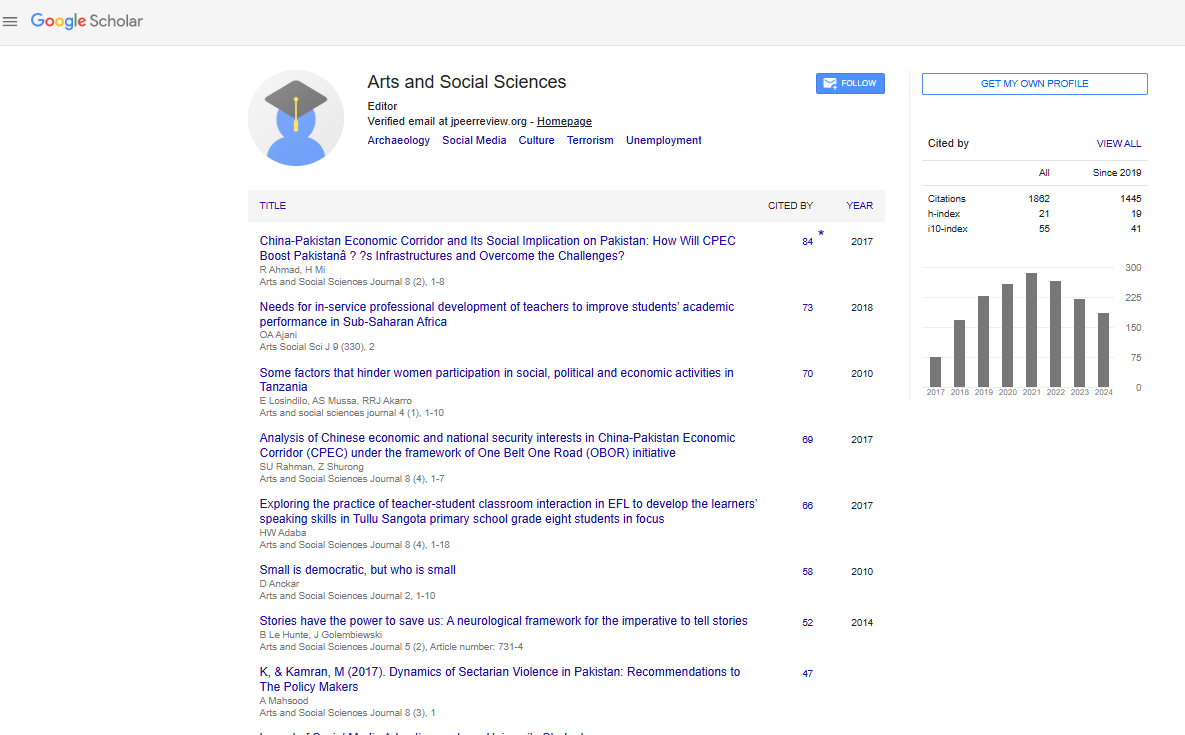
Arts and Social Sciences Journal received 1413 citations as per Google Scholar report