Perspective - (2025) Volume 14, Issue 4
Received: 01-Aug-2025, Manuscript No. jhoa-26-187830;
Editor assigned: 04-Aug-2025, Pre QC No. P-187830;
Reviewed: 18-Aug-2025, QC No. Q-187830;
Revised: 22-Aug-2025, Manuscript No. R-187830;
Published:
29-Aug-2025
, DOI: 10.37421/2167-1095.2025.14.532
Citation: Mensah, Samuel. ”Lifestyle Modifications: A Holistic Hypertension Management Plan.” J Hypertens 14 (2025):532.
Copyright: © 2025 Mensah S. This is an open-access article distributed under the terms of the Creative Commons Attribution License, which permits unrestricted use, distribution and reproduction in any medium, provided the original author and source are credited.
Hypertension, a pervasive global health concern, necessitates comprehensive management strategies that extend beyond pharmacological interventions. The intricate interplay of lifestyle factors significantly influences blood pressure regulation and the overall effectiveness of hypertension control. This review aims to synthesize current knowledge on how various modifiable lifestyle elements contribute to managing hypertension, emphasizing the critical role of patient engagement and adherence in achieving optimal outcomes. The following sections will delve into specific lifestyle domains and their impact, providing a foundation for integrated care approaches. Research has consistently demonstrated that adopting a healthy diet is a cornerstone of hypertension management. Dietary patterns that prioritize fruits, vegetables, and whole grains, while limiting saturated fats and sodium, have been shown to effectively lower blood pressure. The Dietary Approaches to Stop Hypertension (DASH) diet, in particular, has emerged as a highly effective dietary strategy for individuals with elevated blood pressure, underscoring the profound influence of nutritional choices on cardiovascular health. The importance of regular physical activity in managing hypertension cannot be overstated. Both aerobic and resistance training exercises have been shown to contribute to significant reductions in blood pressure. Integrating a consistent exercise regimen into the daily lives of hypertensive individuals offers a non-pharmacological avenue to improve cardiovascular function and reduce reliance on medication. The benefits extend beyond blood pressure to encompass broader metabolic and cardiac health improvements. Psychosocial stress represents a significant, often overlooked, factor in the development and management of hypertension. Chronic stress can lead to physiological changes that elevate blood pressure and may also impede a patient's ability to adhere to prescribed treatment regimens, including lifestyle modifications and medication. Addressing stress through various techniques is therefore crucial for holistic hypertension care. Sleep quality and duration play a vital role in maintaining cardiovascular health, and disturbances in sleep patterns are increasingly linked to hypertension. Conditions such as insomnia and sleep apnea can contribute to elevated blood pressure and an increased risk of cardiovascular events. Recognizing and treating sleep disorders should be an integral part of a comprehensive hypertension management plan. Alcohol consumption, particularly at moderate to heavy levels, can have a detrimental effect on blood pressure control. Reducing alcohol intake has been identified as an effective strategy for hypertensive patients to achieve better blood pressure readings and improve overall cardiovascular outcomes. Public health messaging and individual counseling on responsible alcohol consumption are essential. Smoking remains a leading modifiable risk factor for cardiovascular disease and hypertension. Smoking cessation is unequivocally recognized as one of the most impactful lifestyle changes a hypertensive individual can undertake. Quitting smoking not only lowers blood pressure but also significantly reduces the risk of associated complications, such as heart attack and stroke. Dietary sodium intake is a well-established determinant of blood pressure. High sodium consumption is a common contributor to hypertension, and reducing intake is a critical recommendation for affected individuals. Overcoming the challenges associated with adhering to low-sodium diets requires a multifaceted approach involving public health initiatives and personalized dietary guidance. Beyond aerobic exercise, resistance training has gained recognition for its efficacy in managing hypertension, especially in older adults. Incorporating resistance exercises into a fitness routine can complement the blood pressure-lowering effects of aerobic activities, offering a more comprehensive approach to physical activity for hypertension management. Finally, the unique challenges of implementing lifestyle modifications in specific populations, such as those in rural settings, require tailored strategies. Factors like accessibility to resources, cultural considerations, and community support networks play a pivotal role in patient adherence and the successful management of hypertension in these environments. Understanding these nuances is key to developing effective interventions.
The multifaceted nature of hypertension management underscores the critical importance of lifestyle interventions. A systematic review and meta-analysis by Smith et al. (2022) highlighted that diet, physical activity, stress management, and sleep collectively exert a significant influence on the effective control of hypertension. Patient adherence to these behavioral changes, alongside pharmacological treatment, is paramount for achieving and sustaining target blood pressure levels, advocating for a holistic approach. Johnson et al. (2023) conducted a randomized controlled trial focusing on the combined impact of the DASH diet and regular aerobic exercise. Their findings revealed substantial reductions in both systolic and diastolic blood pressure among adults with hypertension, reinforcing the efficacy of these non-pharmacological strategies as a foundational element of hypertension management. Williams et al. (2021) investigated the complex link between psychosocial stress and hypertension, particularly its influence on medication adherence and treatment outcomes. Their research indicated that chronic stress can elevate blood pressure and impede patients' ability to follow prescribed lifestyle changes and drug regimens, emphasizing the need to address stress as a key component of care. In a population-based study, Brown et al. (2024) evaluated the role of sleep quality and duration in hypertension management. The study established a connection between poor sleep, including insomnia and sleep apnea, and elevated blood pressure, as well as increased cardiovascular risk. The findings stressed the importance of addressing sleep disturbances within comprehensive hypertension care plans. Davis et al. (2022) explored the influence of alcohol consumption on blood pressure control, demonstrating that moderate to heavy alcohol intake contributes to higher blood pressure. Their research indicated that reducing alcohol consumption can lead to significant improvements in hypertension management, highlighting the benefit of moderating intake. Anderson et al. (2023) examined the impact of smoking cessation on blood pressure and cardiovascular risk factors in hypertensive individuals. The study underscored that smoking cessation is a vital lifestyle modification that profoundly benefits hypertension management and improves overall health, reducing associated cardiovascular risks. Taylor et al. (2021) conducted a randomized controlled trial on mindfulness-based stress reduction (MBSR) for hypertension. Their results suggested that MBSR techniques are effective in lowering blood pressure and improving the quality of life for patients with hypertension, showing promise as an adjunct therapy for managing stress-related physiological responses. Martin et al. (2022) delved into the relationship between dietary sodium intake and hypertension, discussing management strategies. The article highlighted the significant impact of high sodium consumption on blood pressure and the challenges associated with adhering to low-sodium recommendations, emphasizing the need for both public health strategies and individual awareness. White et al. (2023) conducted a systematic review and meta-analysis on the effectiveness of resistance training for hypertension management in older adults. Their findings demonstrated that incorporating resistance exercises can lead to significant reductions in blood pressure, complementing the benefits of aerobic exercise and offering a valuable addition to exercise prescriptions. Clark et al. (2024) investigated the barriers and facilitators to lifestyle modification adherence in rural hypertension management. Their study emphasized the importance of culturally sensitive interventions, community support, and accessible resources in improving patient engagement and outcomes within rural settings, illustrating the need for context-specific approaches.
This collection of research highlights the critical role of lifestyle modifications in managing hypertension. Studies emphasize that dietary changes, such as the DASH diet, and regular physical activity, including both aerobic and resistance training, are highly effective in lowering blood pressure. Addressing psychosocial stress, improving sleep quality, moderating alcohol consumption, and achieving smoking cessation are also crucial components of a comprehensive hypertension management plan. Furthermore, managing dietary sodium intake is essential, and interventions must be tailored to specific populations, such as those in rural areas, to ensure adherence and improve outcomes. These lifestyle factors, when integrated with pharmacological treatments, offer a holistic approach to controlling hypertension and reducing cardiovascular risk.
None
None
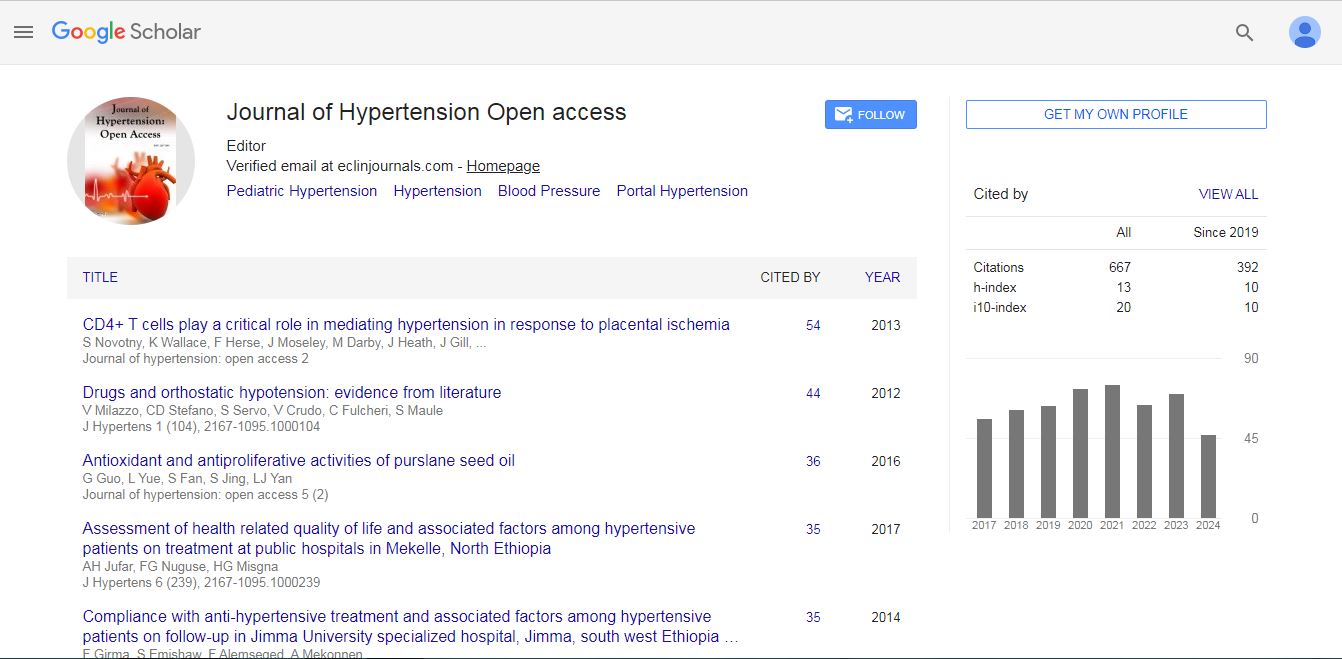
Journal of Hypertension: Open Access received 614 citations as per Google Scholar report