Brief Report - (2025) Volume 14, Issue 6
Received: 01-Dec-2025, Manuscript No. jhoa-26-187881;
Editor assigned: 03-Dec-2025, Pre QC No. P-187881;
Reviewed: 17-Dec-2025, QC No. Q-187881;
Revised: 22-Dec-2025, Manuscript No. R-187881;
Published:
29-Dec-2025
, DOI: 10.37421/2167-1095.2025.14.554
Citation: Okafor, Chinedu. ”Lifestyle Interventions: A Comprehensive Approach to Hypertension.” J Hypertens 14 (2025):554.
Copyright: © 2025 Okafor C. This is an open-access article distributed under the terms of the Creative Commons Attribution License, which permits unrestricted use, distribution and reproduction in any medium, provided the original author and source are credited.
The prevention and management of hypertension remain a critical public health priority, given its widespread prevalence and significant contribution to cardiovascular disease. A comprehensive understanding of the various lifestyle interventions that can influence blood pressure is essential for both individuals and healthcare providers. This review consolidates current research on effective strategies, highlighting their impact and applicability in diverse settings. This article review delves into the critical role of lifestyle interventions in preventing hypertension, emphasizing a multi-faceted approach. It highlights the effectiveness of dietary modifications, particularly the DASH diet, regular physical activity, weight management, and stress reduction techniques. The review underscores that these interventions, when implemented consistently, can significantly lower blood pressure, delay the onset of hypertension, and reduce cardiovascular disease risk. It also points out the importance of personalized strategies and community-based programs for broader impact. The insights are drawn from current research, supporting the integration of these lifestyle changes into primary care for hypertension prevention.[1] Focusing on the impact of physical activity, this research demonstrates that structured exercise programs can effectively reduce systolic and diastolic blood pressure in individuals at risk for hypertension. The study emphasizes that both aerobic and resistance training contribute to these benefits, with greater effects seen at higher intensities and longer durations. It suggests that incorporating regular physical activity into daily routines is a cornerstone of hypertension prevention strategies.[2] This review highlights the critical role of diet, specifically the DASH (Dietary Approaches to Stop Hypertension) diet, in preventing and managing hypertension. It details the components of the DASH diet, emphasizing fruits, vegetables, whole grains, lean proteins, and low-fat dairy, while limiting saturated and total fat, cholesterol, and sodium. The article presents compelling evidence that adherence to the DASH diet can lead to significant reductions in blood pressure, making it a primary lifestyle intervention.[3] The authors investigate the impact of weight loss on blood pressure in overweight and obese individuals. This study provides strong evidence that even modest weight loss, achieved through dietary changes and increased physical activity, can lead to clinically significant reductions in blood pressure. It reinforces the importance of weight management as a fundamental component of hypertension prevention and treatment.[4] This systematic review and meta-analysis explores the effects of sodium restriction on blood pressure. It confirms that reducing sodium intake is a highly effective strategy for lowering blood pressure in both hypertensive and normotensive individuals, contributing significantly to hypertension prevention. The findings support public health recommendations for lower sodium consumption.[5] This article examines the influence of alcohol consumption on blood pressure and hypertension risk. It indicates that excessive alcohol intake is associated with elevated blood pressure, while moderate consumption may have varying effects. The authors recommend limiting alcohol intake as part of a comprehensive strategy for hypertension prevention.[6] The research explores the link between stress and hypertension, proposing that chronic stress can contribute to elevated blood pressure. It discusses various stress management techniques, such as mindfulness, meditation, and relaxation exercises, as valuable adjuncts to other lifestyle interventions for blood pressure control and hypertension prevention.[7] This study evaluates the effectiveness of a comprehensive lifestyle intervention program, including diet, exercise, and behavioral counseling, on blood pressure. The findings suggest that such integrated programs are highly effective in achieving and sustaining blood pressure reduction, highlighting the synergy of multiple lifestyle changes for hypertension prevention.[8] This article focuses on the role of potassium intake in blood pressure regulation and its implications for hypertension prevention. It outlines how adequate potassium consumption, often achieved through increased intake of fruits and vegetables, can help counterbalance the effects of sodium and lower blood pressure.[9] This comprehensive review discusses the challenges and strategies for implementing lifestyle interventions for hypertension prevention in real-world settings, including primary care and community programs. It highlights the importance of patient education, adherence support, and healthcare provider training in effectively translating research findings into practice. The article emphasizes a public health approach to combat hypertension.[10]
Lifestyle interventions represent a cornerstone in the prevention and management of hypertension, offering a potent alternative and adjunct to pharmacological treatments. These approaches encompass a range of behavioral and dietary modifications that can significantly impact cardiovascular health. A multi-faceted strategy, integrating various lifestyle components, has shown the most promising results in clinical practice and research settings. Dietary adjustments, such as adopting the DASH diet, are consistently recognized for their efficacy in lowering blood pressure. Regular physical activity, weight management, and stress reduction techniques further complement these efforts, creating a synergistic effect on blood pressure control. The integration of these strategies into primary care is increasingly emphasized to promote widespread adoption and improve patient outcomes. Personalized approaches and community-based programs are also vital for addressing the diverse needs of populations and enhancing the reach of these interventions.[1] Physical activity plays a pivotal role in the reduction of blood pressure, a key factor in hypertension prevention. Structured exercise programs, encompassing both aerobic and resistance training, have been demonstrated to effectively lower systolic and diastolic blood pressure in individuals who are at risk for developing hypertension. The intensity and duration of exercise are significant determinants of the magnitude of these benefits, suggesting that consistent and challenging physical activity can yield greater improvements. Incorporating regular physical activity into daily routines is thus a fundamental component of any comprehensive hypertension prevention strategy, promoting not only blood pressure control but also overall cardiovascular well-being.[2] Dietary modifications are paramount in the prevention and management of hypertension, with the DASH (Dietary Approaches to Stop Hypertension) diet standing out as a particularly effective strategy. This dietary pattern emphasizes the consumption of fruits, vegetables, whole grains, lean proteins, and low-fat dairy products. Simultaneously, it recommends limiting saturated and total fat, cholesterol, and sodium intake. Extensive research has provided compelling evidence that consistent adherence to the DASH diet can lead to substantial reductions in blood pressure, establishing it as a primary lifestyle intervention for hypertensive individuals and those at risk.[3] Weight management is a critical component in the prevention and treatment of hypertension, particularly for individuals who are overweight or obese. Studies have shown that even a modest reduction in body weight, achieved through a combination of dietary modifications and increased physical activity, can result in clinically significant improvements in blood pressure levels. This highlights the fundamental importance of achieving and maintaining a healthy weight as a foundational element of any strategy aimed at preventing or managing hypertension, contributing to a reduced risk of cardiovascular complications.[4] Sodium restriction has emerged as a highly effective strategy for lowering blood pressure in both individuals with hypertension and those with normal blood pressure. Systematic reviews and meta-analyses of randomized controlled trials have consistently confirmed the significant impact of reducing sodium intake on blood pressure reduction. These findings lend strong support to public health recommendations advocating for lower sodium consumption as a measure to prevent hypertension and reduce the overall burden of cardiovascular disease on a global scale.[5] Alcohol consumption is another lifestyle factor that significantly influences blood pressure and hypertension risk. Research indicates a clear association between excessive alcohol intake and elevated blood pressure levels. While the effects of moderate alcohol consumption can be more varied, the consensus leans towards recommending the limitation of alcohol intake as an essential part of a comprehensive approach to hypertension prevention. Modifying drinking habits can contribute meaningfully to blood pressure management and reduce the likelihood of developing hypertension.[6] Psychological stress has been identified as a significant contributor to the development and exacerbation of hypertension. Chronic stress can lead to sustained elevations in blood pressure through various physiological mechanisms. Consequently, stress management techniques, including mindfulness, meditation, and relaxation exercises, are recognized as valuable adjuncts to other lifestyle interventions. These practices can play a crucial role in controlling blood pressure and preventing hypertension by mitigating the detrimental effects of chronic stress on the cardiovascular system.[7] Comprehensive lifestyle intervention programs that integrate multiple components, such as diet, exercise, and behavioral counseling, have demonstrated remarkable effectiveness in achieving and sustaining blood pressure reductions. These combined approaches leverage the synergistic effects of various lifestyle changes, leading to more robust and lasting improvements in blood pressure compared to single-modality interventions. Such integrated programs are highly effective for hypertension prevention and management, underscoring the importance of a holistic approach.[8] The role of potassium intake in blood pressure regulation is an important consideration for hypertension prevention. Adequate consumption of potassium, often facilitated by an increased intake of fruits and vegetables, plays a crucial role in counterbalancing the hypertensive effects of sodium in the diet. By helping to regulate fluid balance and vascular tone, potassium contributes to lower blood pressure levels, making it an essential nutrient for maintaining cardiovascular health and preventing hypertension.[9] Translating evidence-based lifestyle interventions for hypertension prevention into real-world practice presents both challenges and opportunities. Effective implementation requires strategies that address patient education, adherence support, and healthcare provider training. A public health approach, coupled with tailored interventions in primary care and community settings, is crucial for maximizing the impact of these strategies in combating the widespread burden of hypertension and promoting cardiovascular wellness across populations.[10]
This compilation of research highlights the pivotal role of lifestyle interventions in the prevention and management of hypertension. Key strategies include dietary modifications, such as the DASH diet, regular physical activity encompassing aerobic and resistance training, and weight management through diet and exercise. Reducing sodium intake and moderating alcohol consumption are also crucial. Furthermore, managing psychological stress through techniques like mindfulness and meditation contributes significantly. Comprehensive lifestyle programs integrating diet, exercise, and counseling show high effectiveness. Adequate potassium intake, primarily from fruits and vegetables, is beneficial. The successful implementation of these interventions relies on patient education, adherence support, and a public health approach, often integrated into primary care settings. These multifaceted approaches collectively aim to lower blood pressure, delay hypertension onset, and reduce cardiovascular disease risk.
None
None
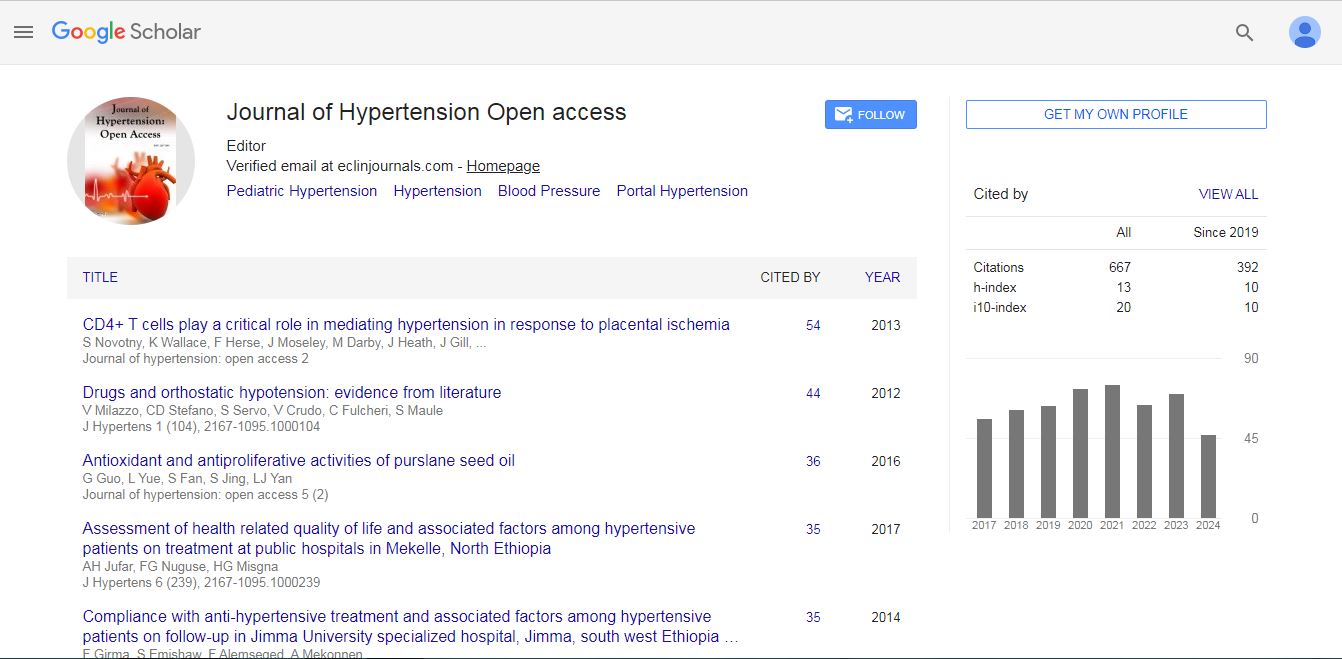
Journal of Hypertension: Open Access received 614 citations as per Google Scholar report