Short Communication - (2025) Volume 14, Issue 4
Received: 01-Jul-2025, Manuscript No. iem-26-179823;
Editor assigned: 03-Jul-2025, Pre QC No. P-179823;
Reviewed: 14-Jul-2025, QC No. Q-179823;
Revised: 22-Jul-2025, Manuscript No. R-179823;
Published:
29-Jul-2025
, DOI: 10.37421/2169- 0316.2025.14.316
Citation: Diop, Fatoumata. âLean Manufacturing: Maximizing Productivity Through Principles and Tools.â J Ind Eng Manag 14 (2025):316.
Copyright: © 2025 Diop F. This is an open-access article distributed under the terms of the Creative Commons Attribution License, which permits unrestricted use, distribution and reproduction in any medium, provided the original author and source are credited.
The strategic implementation of Lean Manufacturing principles has emerged as a pivotal approach for industries aiming to achieve peak productivity and operational excellence. These principles, rooted in the meticulous identification and elimination of waste, aim to streamline processes, enhance efficiency, and ultimately deliver greater value to the customer. Value stream mapping, a cornerstone of Lean methodology, serves as a critical tool for visualizing the flow of materials and information, thereby pinpointing areas ripe for improvement [1].
The foundational tenets of Lean Manufacturing are deeply intertwined with the renowned Toyota Production System (TPS), which introduced concepts like Just-In-Time (JIT) and Jidoka. These elements are instrumental in driving significant productivity gains by ensuring that production is aligned with demand and that quality is built into the process from the outset [2].
Furthermore, the synergy between Lean and Six Sigma methodologies offers a powerful framework for enhancing productivity. By combining Lean's focus on waste reduction with Six Sigma's robust approach to defect elimination and process variation reduction, organizations can achieve substantial improvements in overall equipment effectiveness and output [3].
However, the successful adoption of Lean Manufacturing extends beyond the mere application of tools and techniques. The human element plays a critical role, with engaged employees, effective communication, and strong leadership commitment being essential for sustainable productivity improvements [4].
It is also important to recognize that Lean Manufacturing is not exclusively the domain of large corporations. Its principles are adaptable and highly effective within the context of small and medium-sized enterprises (SMEs), where even limited resources can yield significant productivity boosts through improved workflows and reduced inventory [5].
In the contemporary industrial landscape, the integration of digital technologies further amplifies the benefits of Lean Manufacturing. Innovations such as the Internet of Things (IoT) and artificial intelligence (AI) enable real-time data analytics and automation, accelerating waste identification and optimizing resource allocation for a more agile production system [6].
Value Stream Mapping (VSM) stands out as a foundational tool for Lean implementation, providing a clear roadmap for identifying bottlenecks and designing future states to eliminate waste and enhance process flow. Its systematic approach is crucial for driving productivity growth [7].
Kaizen events, characterized by focused, short-term improvement workshops, have proven to be highly effective in driving operational productivity. By engaging cross-functional teams, these events can generate rapid, sustainable gains by addressing specific challenges and implementing immediate solutions [8].
The integration of Lean principles with supply chain management is another key area for optimizing end-to-end productivity. By reducing lead times, improving inventory visibility, and fostering collaboration, significant enhancements in manufacturing output and responsiveness can be achieved [9].
Finally, the implementation of a pull system is central to maximizing productivity within Lean Manufacturing. This approach ensures that production is directly driven by customer demand, minimizing work-in-progress and preventing overproduction, thereby leading to shorter cycle times and more efficient resource utilization [10].
The strategic implementation of Lean Manufacturing principles is detailed, emphasizing its role in achieving peak productivity within industrial settings. Core elements like value stream mapping, waste reduction (muda), and continuous improvement (kaizen) are highlighted for their contribution to enhancing operational efficiency, employee empowerment, workflow optimization, and a customer-centric approach to eliminating non-value-adding activities [1].
This article explores how the core tenets of the Toyota Production System, such as Just-In-Time (JIT) and Jidoka, can be effectively integrated into modern manufacturing to drive productivity gains. The importance of standardized work and visual management in fostering discipline and continuous problem-solving, leading to reduced lead times and improved quality, is also discussed [2].
A study investigates the impact of Lean Six Sigma methodologies on overall equipment effectiveness (OEE) and productivity in high-volume manufacturing. It demonstrates how combining Lean's waste elimination with Six Sigma's defect reduction statistically improves output and reduces variability, resulting in significant cost savings and enhanced customer satisfaction [3].
The critical role of human factors and organizational culture in the successful adoption of Lean Manufacturing is examined. It is emphasized that sustainable productivity improvements stem from engaged employees, effective communication, and leadership commitment to Lean principles, rather than solely focusing on tools and techniques [4].
This research explores the application of Lean principles in a small and medium-sized enterprise (SME) context, demonstrating that Lean is not exclusive to large corporations. Practical insights into adapting Lean tools for limited resources are provided, highlighting how improved workflow and reduced inventory can significantly boost productivity in smaller manufacturing operations [5].
The article analyzes the influence of digital technologies, such as IoT and AI, on augmenting Lean Manufacturing practices for increased productivity. It discusses how real-time data analytics and automation can accelerate waste identification, optimize resource allocation, and support a more agile and efficient production system [6].
This paper focuses on the application of Value Stream Mapping (VSM) as a foundational tool for implementing Lean Manufacturing and achieving productivity improvements. It provides a step-by-step guide to creating and analyzing VSMs, identifying bottlenecks, and designing future states to eliminate waste and enhance flow within a production process [7].
The article investigates the impact of Kaizen events on improving operational productivity in a service-oriented manufacturing environment. It demonstrates how focused, short-term improvement workshops can generate rapid, sustainable gains by engaging cross-functional teams to tackle specific productivity challenges and implement immediate solutions [8].
This research explores the integration of Lean principles with supply chain management to optimize end-to-end productivity. It highlights how reducing lead times, improving inventory visibility, and fostering collaboration across the supply chain can lead to significant enhancements in overall manufacturing output and responsiveness [9].
The article discusses the importance of a pull system in Lean Manufacturing for maximizing productivity by ensuring production is driven by actual customer demand. It explains how minimizing work-in-progress (WIP) and preventing overproduction leads to shorter cycle times, reduced inventory costs, and a more efficient use of resources [10].
This collection of articles explores various facets of Lean Manufacturing aimed at maximizing productivity. Key themes include the strategic implementation of Lean principles such as value stream mapping and waste reduction, and their integration with systems like the Toyota Production System. The synergy of Lean with Six Sigma is examined for its impact on operational effectiveness and defect reduction. The critical role of human factors, organizational culture, and leadership commitment in successful Lean adoption is underscored. The applicability of Lean to SMEs is highlighted, along with the augmenting influence of digital technologies like IoT and AI. Specific Lean tools like Value Stream Mapping and Kaizen events are detailed for their efficacy in identifying bottlenecks and driving improvements. Furthermore, the integration of Lean principles within supply chain management and the implementation of pull systems to align production with customer demand are discussed as crucial strategies for enhancing overall manufacturing output and efficiency.
None
None
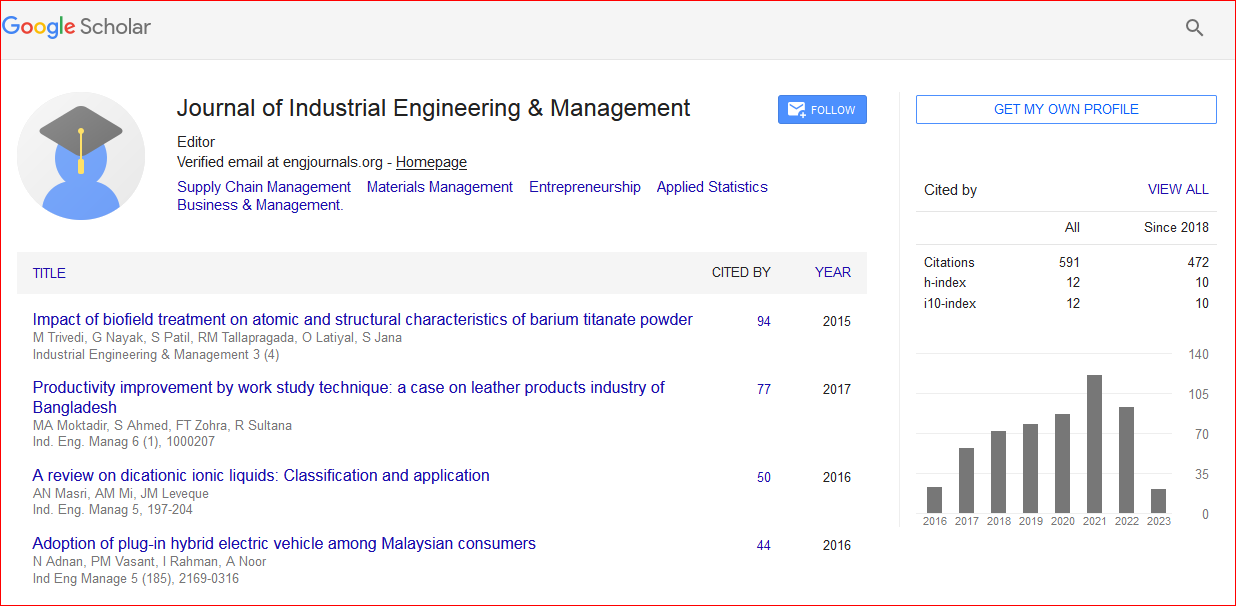
Industrial Engineering & Management received 739 citations as per Google Scholar report