Commentary - (2025) Volume 14, Issue 3
Received: 01-May-2025, Manuscript No. iem-26-179778;
Editor assigned: 04-May-2025, Pre QC No. P-179778;
Reviewed: 14-May-2025, QC No. Q-179778;
Revised: 21-May-2025, Manuscript No. R-179778;
Published:
29-May-2025
, DOI: 10.37421/2169- 0316.2025.14.301
Citation: Tanaka, Hiroshi. Lean Manufacturing: Eliminating Waste for Operational Efficiency. J Ind Eng Manag 14 (2025):301.
Copyright: © 2025 Tanaka H. This is an open-access article distributed under the terms of the Creative Commons Attribution License, which permits unrestricted use,
distribution and reproduction in any medium, provided the original author and source are credited.
Lean manufacturing principles offer a robust framework for optimizing industrial processes, with a primary focus on the systematic identification and elimination of waste. This approach is fundamental to achieving higher levels of efficiency and cost-effectiveness in production environments. Methodologies such as Kaizen and Value Stream Mapping are instrumental in dissecting processes to uncover non-value-adding activities, thereby paving the way for streamlined operations [1].
The integration of Six Sigma with Lean manufacturing has emerged as a powerful synergy, enhancing operational performance by addressing both defect reduction and process streamlining. This combined approach effectively minimizes various forms of waste by leveraging structured problem-solving with flow optimization techniques, leading to comprehensive waste elimination [2].
A critical, often overlooked, aspect of successful Lean implementation is the active involvement and comprehensive training of the workforce. Empowering employees to identify and resolve issues at their source is paramount for achieving sustainable waste reduction. Human capital, therefore, plays a vital role in the success of any Lean transformation initiative [3].
Just-In-Time (JIT) inventory management serves as a quintessential Lean strategy, specifically targeting overproduction and excess inventory waste. By synchronizing production with actual demand, JIT significantly reduces lead times and associated storage costs, making it a potent tool for waste minimization in material handling [4].
Within the Lean framework, Poka-Yoke, or mistake-proofing techniques, are crucial for eradicating defects and the costly rework they entail. Implementing simple, built-in error prevention mechanisms dramatically improves product quality and conserves both material and labor resources, underscoring the value of proactive quality control [5].
The 5S methodology—Sort, Set in Order, Shine, Standardize, and Sustain—is a foundational element for waste reduction by fostering an organized and efficient workplace. A clean and orderly environment minimizes time wasted searching, reduces safety risks, and cultivates a culture conducive to continuous improvement [6].
Value Stream Mapping (VSM) stands out as a critical Lean tool for visualizing and analyzing the complex flow of materials and information. VSM enables the identification of bottlenecks, excessive lead times, and other non-value-adding steps, providing a holistic view for targeted waste reduction efforts [7].
Implementing Lean manufacturing principles for waste reduction in small and medium-sized enterprises (SMEs) presents unique challenges and success factors. Adapting Lean principles to resource-constrained environments necessitates careful planning and execution, highlighting the need for tailored strategies to effectively address waste in these settings [8].
Kaizen, the philosophy of continuous improvement, is the bedrock of Lean manufacturing for achieving sustainable waste reduction. A culture that champions ongoing, incremental improvements, driven by all employees, is essential for the perpetual identification and elimination of waste over time, reinforcing that Lean is a journey, not a destination [9].
Andon systems play a significant role in Lean manufacturing by providing visual cues of production status and signaling abnormalities in real-time. This immediate feedback loop allows for quick issue resolution, preventing minor problems from escalating and mitigating waste associated with downtime and defects through proactive intervention [10].
The application of Lean manufacturing principles is explored in depth, with a particular emphasis on waste reduction within industrial settings. The article details various methodologies, including Kaizen and Value Stream Mapping, which are crucial for identifying and eliminating non-value-adding activities. This systematic approach is fundamental to optimizing production processes, leading to enhanced efficiency and cost savings [1].
This paper investigates the impact of integrating Six Sigma and Lean manufacturing, demonstrating how their synergy enhances operational performance. The combined methodologies are shown to be effective in reducing defects and streamlining processes, thereby minimizing diverse forms of waste. The key takeaway is the synergistic power of structured problem-solving and flow optimization for comprehensive waste elimination [2].
The article highlights the indispensable role of employee involvement and training in the successful implementation of Lean principles for waste reduction. It underscores that empowering the workforce to identify and resolve problems at their origin is critical for achieving long-term waste elimination, emphasizing that human capital is a vital component of Lean transformation [3].
Just-In-Time (JIT) inventory management is examined as a core Lean strategy to combat waste stemming from overproduction and excess inventory. The research emphasizes the benefits of aligning production schedules with demand, which effectively reduces lead times and lowers storage expenses. This strategy is presented as a powerful means to minimize waste associated with surplus materials [4].
The implementation of Poka-Yoke, or mistake-proofing techniques, within a Lean manufacturing context is investigated for its role in eliminating defects and rework. The article provides examples of how simple error-prevention mechanisms can significantly improve product quality and reduce waste related to materials and labor, reinforcing the efficacy of proactive error prevention over reactive quality control [5].
This study examines the contribution of the 5S methodology—Sort, Set in Order, Shine, Standardize, and Sustain—to waste reduction by promoting an organized and efficient workplace. It demonstrates that a clean and orderly environment minimizes time spent searching for tools and materials, reduces safety hazards, and cultivates a culture of continuous improvement, making workplace organization a foundational element for Lean waste reduction [6].
Value Stream Mapping (VSM) is explored as a critical Lean tool for visualizing and analyzing material and information flow to pinpoint waste. The article explains how VSM aids in identifying bottlenecks, excessive lead times, and other non-value-adding steps in the production process, providing a holistic view essential for targeted waste reduction efforts [7].
This research delves into the challenges and success factors associated with implementing Lean manufacturing principles for waste reduction in small and medium-sized enterprises (SMEs). It highlights that while Lean offers substantial benefits, adapting its principles to environments with limited resources requires careful planning and execution, emphasizing the need for tailored strategies for SMEs to effectively address waste [8].
The role of Kaizen, or continuous improvement, as a cornerstone of Lean manufacturing for sustained waste reduction is explored. The paper emphasizes that fostering a culture of ongoing, incremental improvements, driven by all employees, is essential for consistently identifying and eliminating waste over time, underscoring that Lean is a continuous journey rather than a one-time project [9].
This article examines the application of Andon systems within Lean manufacturing to enhance the visualization of production status and signal abnormalities. By enabling real-time visual control, these systems empower operators to quickly address issues, thereby reducing waste related to downtime and defects and ensuring proactive intervention for immediate waste mitigation [10].
This collection of research explores various facets of Lean manufacturing, with a central theme of waste reduction. Key methodologies discussed include Kaizen, Value Stream Mapping, Six Sigma integration, Just-In-Time inventory, Poka-Yoke for defect prevention, and the 5S system for workplace organization. The importance of employee involvement and tailored strategies for SMEs are also highlighted. The overarching insight is that a systematic, continuous approach to identifying and eliminating waste through these principles leads to significant improvements in operational efficiency and cost savings.
None
None
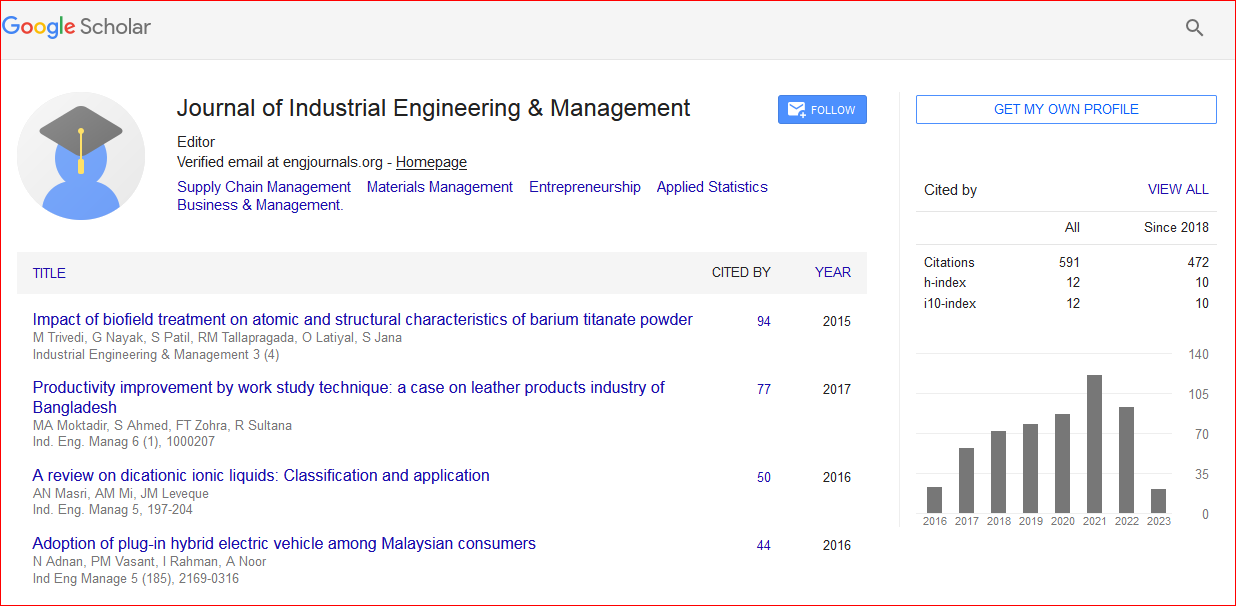
Industrial Engineering & Management received 739 citations as per Google Scholar report