Opinion - (2025) Volume 10, Issue 2
Received: 01-Apr-2025, Manuscript No. jomp-26-185079;
Editor assigned: 03-Apr-2025, Pre QC No. P-185079;
Reviewed: 17-Apr-2025, QC No. Q-185079;
Revised: 22-Apr-2025, Manuscript No. R-185079;
Published:
29-Apr-2025
, DOI: 10.37421/2576-3857.2025.10.298
Citation: Chen, Mei Ling. ”KRAS Mutations Guide Colorectal Cancer Treatment.” J Oncol Med and Pract 10 (2025):298.
Copyright: © 2025 Chen L. Mei This is an open-access article distributed under the terms of the Creative Commons Attribution License, which permits unrestricted use,
distribution and reproduction in any medium, provided the original author and source are credited.
KRAS mutations represent a pivotal factor in determining the efficacy of targeted therapies within the landscape of colorectal cancer (CRC) treatment. While historically linked to less favorable prognoses, a nuanced understanding of specific KRAS variants, such as G12C and G12D, coupled with their co-mutational profiles, is paramount for accurately predicting the response to novel inhibitors and conventional chemotherapy [1].
The advent of KRAS G12C inhibitors has notably transformed treatment paradigms for a specific segment of CRC patients, with extensive clinical trial data and real-world evidence underscoring their therapeutic benefits [2].
However, beyond the G12C mutation, other KRAS alterations, including G12D and G12V, continue to pose significant therapeutic challenges in CRC management [3].
The intricate interplay between KRAS mutations and the tumor microenvironment also profoundly influences treatment outcomes, suggesting potential synergies between KRAS-targeted agents and immunotherapies [4].
Furthermore, the presence of co-occurring mutations alongside KRAS alterations can substantially modulate the sensitivity to various therapeutic interventions, necessitating comprehensive genomic profiling to dissect these complex genomic landscapes [5].
The dynamic monitoring of KRAS mutational status and treatment response through less invasive means, such as liquid biopsies utilizing circulating tumor DNA (ctDNA), is emerging as a promising strategy for guiding therapeutic adjustments and predicting clinical trajectories [6].
Despite advancements, the emergence of resistance to KRAS-targeted therapies remains a considerable clinical hurdle, driven by various molecular mechanisms that require careful investigation and strategic countermeasures [7].
In the context of neoadjuvant therapy for CRC, KRAS mutational status is also recognized for its ability to predict treatment response, particularly in locally advanced rectal cancer where it informs decisions regarding chemotherapy and chemoradiotherapy [8].
The inherent heterogeneity of KRAS mutations, both within a single tumor and across different patient populations, presents a multifaceted challenge to the successful application of targeted therapies [9].
Consequently, the prognostic and predictive value of KRAS mutations in patients receiving first-line chemotherapy for metastatic CRC is a critical area of research, as specific variants demonstrably influence survival and treatment effectiveness [10].
KRAS mutations are recognized as critical determinants influencing patient responses to targeted therapies in colorectal cancer (CRC). Differentiating between specific KRAS variants, such as G12C and G12D, and understanding their associated co-mutations are essential for predicting the effectiveness of new inhibitors and chemotherapy regimens, thereby guiding treatment selection and improving patient outcomes [1].
The introduction of KRAS G12C inhibitors has marked a significant advancement in CRC treatment, offering substantial benefits for a defined patient subgroup. Clinical trial data and real-world observations confirm the efficacy of these targeted agents, while ongoing research addresses mechanisms of resistance and strategies to overcome them, highlighting the importance of identifying G12C-mutated tumors for personalized medicine [2].
The therapeutic landscape for KRAS-mutated CRC extends beyond the G12C variant, with mutations like G12D and G12V presenting ongoing challenges. Current research is focused on understanding these less targetable mutations and developing novel therapeutic strategies, including combination therapies and new drug development, to broaden treatment options for a larger patient population [3].
The tumor microenvironment plays a crucial role in modulating treatment responses in KRAS-mutated CRC. Studies are exploring how KRAS status affects immune cell infiltration and immune checkpoint expression, paving the way for potential synergistic effects when combining KRAS-targeted therapies with immunotherapy, thus opening new therapeutic avenues [4].
Co-occurring genetic alterations with KRAS mutations can significantly alter treatment sensitivity in CRC. Research is actively examining common co-mutations, such as those involving TP53 and PIK3CA, and their impact on the efficacy of both chemotherapy and targeted agents, emphasizing the need for sophisticated genomic profiling to refine patient stratification [5].
Liquid biopsies, particularly the analysis of circulating tumor DNA (ctDNA), offer a non-invasive method for monitoring KRAS mutational status and assessing treatment response in CRC. This approach holds promise for dynamically guiding treatment modifications and predicting clinical outcomes [6].
Acquired resistance to KRAS-targeted therapies represents a significant clinical challenge. Investigations are delving into the molecular mechanisms driving this resistance, including the activation of bypass signaling pathways and the acquisition of secondary mutations, with the goal of developing strategies to delay or overcome resistance [7].
The role of KRAS mutational status in predicting response to neoadjuvant therapy in CRC is being evaluated, especially for locally advanced rectal cancer. Studies are assessing the impact of KRAS mutations on the efficacy of neoadjuvant chemotherapy and chemoradiotherapy, providing valuable insights for treatment planning [8].
Intratumoral heterogeneity of KRAS mutations within a tumor and across different patient cohorts complicates the application of targeted therapies. Research is exploring this heterogeneity and its implications for therapeutic response and resistance, underscoring the necessity of comprehensive genomic profiling to capture the full complexity of KRAS alterations [9].
KRAS mutational status has also been investigated for its prognostic and predictive value in patients receiving first-line chemotherapy for metastatic CRC. Meta-analyses aim to clarify how specific KRAS variants influence survival outcomes and the overall efficacy of chemotherapy, contributing to a better understanding of its role in standard treatment settings [10].
KRAS mutations are critical for predicting treatment response in colorectal cancer (CRC). While G12C mutations are targeted by specific inhibitors, other variants like G12D and G12V remain challenging. Understanding co-mutations and the tumor microenvironment's interaction with KRAS status is vital for personalized medicine. Liquid biopsies offer non-invasive monitoring of KRAS mutations and treatment response. Resistance to KRAS inhibitors is a significant issue driven by molecular mechanisms. KRAS status also influences neoadjuvant therapy response and heterogeneity poses challenges for treatment. Overall, precise molecular profiling is essential for optimizing CRC treatment strategies.
None
None
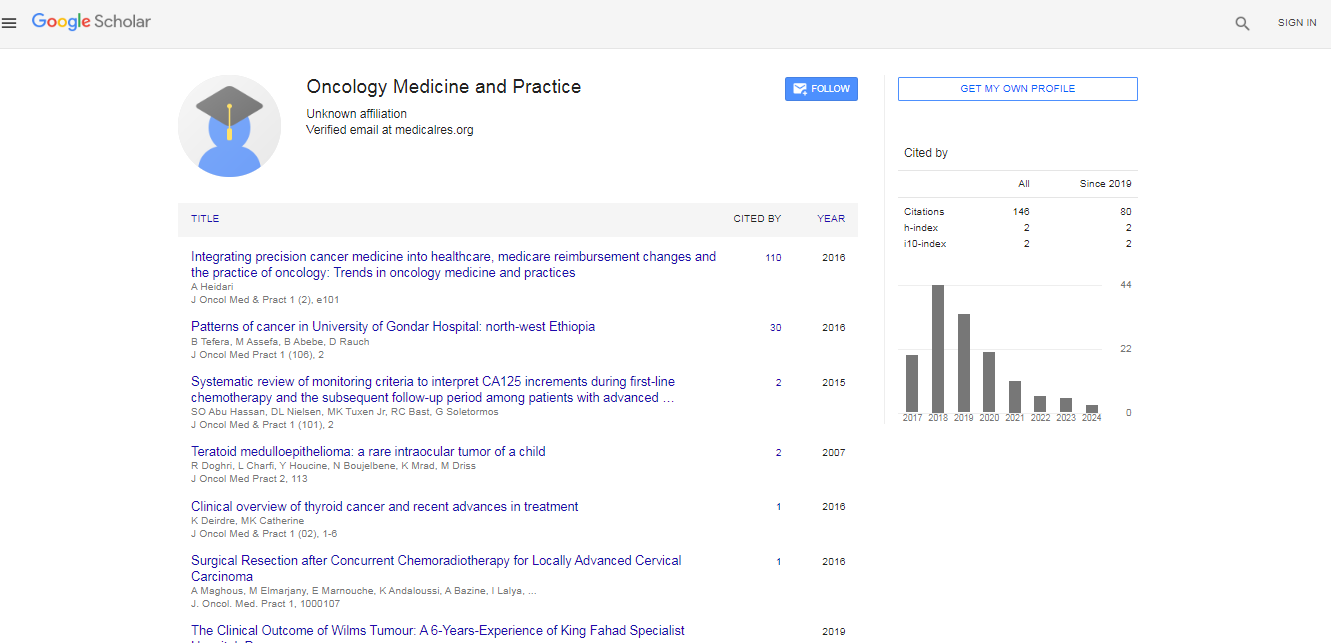
Journal of Oncology Medicine & Practice received 142 citations as per Google Scholar report