Brief Report - (2025) Volume 14, Issue 6
Received: 02-Nov-2025, Manuscript No. iem-26-179843;
Editor assigned: 04-Nov-2025, Pre QC No. P-179843;
Reviewed: 16-Nov-2025, QC No. Q-179843;
Revised: 23-Nov-2025, Manuscript No. R-179843;
Published:
30-Dec-2025
, DOI: 10.37421/2169- 0316.2025.14.317
Citation: Silva, Diego. ”Just-in-Time Production: Costs, Challenges, and Success.” J Ind Eng Manag 14 (2025):317
Copyright: © 2025 Silva D. This is an open-access article distributed under the terms of the Creative Commons Attribution License, which permits unrestricted use, distribution and reproduction in any medium, provided the original author and source are credited.
Just-in-Time (JIT) production is a manufacturing philosophy centered on producing goods only when they are needed. This approach significantly reduces inventory costs and minimizes waste, leading to enhanced operational efficiency [1].
The successful implementation of JIT, however, is heavily reliant on the robustness of supply chains and internal processes to preemptively address potential disruptions [1].
While JIT promises increased efficiency and responsiveness, its inherent sensitivity to external factors and the demanding requirement for precise coordination present considerable challenges [1].
To effectively optimize JIT systems, sophisticated inventory management techniques and a profound understanding of demand variability are essential. The tangible benefits, such as reduced lead times and improved product quality, are substantial, yet these are contingent upon accurate demand forecasting and strong supplier collaboration [2].
The inherent complexity in managing a JIT system often necessitates the integration of advanced technological solutions [2].
When JIT is integrated with other lean manufacturing principles, such as Total Productive Maintenance (TPM), its effectiveness is notably amplified. This synergistic approach leads to higher equipment uptime and fewer production stoppages, which are critical for maintaining the continuous flow that JIT demands [3].
Nevertheless, the successful integration of such systems requires significant organizational commitment and comprehensive employee training [3].
The exploration of JIT adoption within small and medium-sized enterprises (SMEs) reveals distinct challenges. These often stem from resource constraints and a greater dependency on suppliers. Despite the appealing potential benefits of reduced inventory and improved efficiency, SMEs encounter significant hurdles in achieving the requisite levels of supplier integration and process control [4].
The impact of JIT on labor practices and overall workforce management is a crucial aspect demanding careful consideration. While JIT often fosters the development of more flexible and multi-skilled workforces, it simultaneously intensifies pressure on employees to maintain high productivity and immediate response times [5].
To mitigate potential adverse effects on employee morale, effective training programs and clear communication strategies are paramount [5].
Supply chain disruptions, which are inherently amplified by the lean nature of JIT, underscore the critical need for robust risk management strategies. The advantage of reduced inventory can be overshadowed by increased vulnerability to unpredictable events such as natural disasters or supplier failures [6].
Therefore, the development of comprehensive contingency plans and the diversification of supply sources are indispensable for the sustained viability of JIT systems [6].
The influence of JIT principles extends beyond the manufacturing floor to encompass product design and development processes. A strategic focus on simpler designs, standardization, and modularity can significantly facilitate the JIT flow by reducing complexity and shortening lead times throughout the product realization cycle [7].
This level of integration necessitates proactive cross-functional collaboration from the earliest stages of product development [7].
Quality control is intrinsically interwoven with the JIT philosophy. The absence of buffer stock means that any detected defects must be identified and rectified immediately to avert production line stoppages [8].
This imperative cultivates a culture of 'quality at the source' and requires stringent process monitoring alongside empowered employees capable of effective problem-solving [8].
The financial advantages derived from JIT, particularly the reduction in working capital tied up in inventory, serve as a primary motivator for its adoption. However, the initial investment required for process enhancements, technological upgrades, and the cultivation of strong supplier relationships can be substantial, demanding meticulous financial planning and rigorous justification [9].
Digitalization and Industry 4.0 technologies present novel opportunities for augmenting JIT systems. Real-time data analytics, the Internet of Things (IoT), and artificial intelligence (AI) can significantly enhance demand sensing capabilities, improve supply chain visibility, and refine process control, thereby mitigating some of the inherent risks associated with JIT [10].
The primary challenge lies in effectively integrating these advanced technologies with established JIT frameworks [10].
The core tenet of Just-in-Time (JIT) production revolves around minimizing inventory by producing goods only as they are required for the next stage of production or for customer orders. This strategic approach directly targets the reduction of holding costs, obsolescence, and waste, thereby enhancing overall operational efficiency [1].
However, the efficacy of JIT is critically dependent on the establishment of highly reliable supply chains and the implementation of robust internal processes that can withstand and prevent disruptions [1].
While JIT offers significant advantages in terms of efficiency and responsiveness, its inherent vulnerability to external shocks and the stringent need for precise logistical coordination pose substantial implementation challenges [1].
Optimizing JIT systems necessitates the application of sophisticated inventory management techniques and a profound understanding of demand patterns and their inherent variability. The promised benefits, including shorter lead times and improvements in product quality, are considerable but are fundamentally contingent on the accuracy of demand forecasting and the strength of supplier relationships [2].
The inherent complexity associated with managing such a tightly controlled system often compels organizations to integrate advanced technological solutions to ensure smooth operations [2].
The synergistic integration of JIT with other lean manufacturing principles, most notably Total Productive Maintenance (TPM), serves to amplify its positive impact. This combined approach results in increased equipment uptime and a significant reduction in unscheduled production stoppages, both of which are vital for sustaining the continuous flow characteristic of JIT systems [3].
Nevertheless, the successful deployment of these integrated systems requires a deep-seated organizational commitment and substantial investment in employee training programs [3].
Investigations into the adoption of JIT within small and medium-sized enterprises (SMEs) reveal a unique set of challenges. These often relate to limitations in financial and human resources, as well as a heightened dependency on external suppliers. Although the prospective benefits of reduced inventory and enhanced efficiency are attractive, SMEs frequently struggle to achieve the necessary levels of supplier integration and rigorous process control required for JIT success [4].
The implications of JIT implementation for labor practices and workforce management are a critical area of focus. While JIT typically encourages the development of a more adaptable and multi-skilled workforce, it concurrently places increased pressure on employees to sustain high levels of productivity and respond instantaneously to production demands [5].
To effectively mitigate any potential negative impacts on employee morale and well-being, the provision of comprehensive training and clear communication channels is indispensable [5].
Supply chain disruptions, which are inherently more impactful in lean JIT environments, highlight the critical importance of implementing robust risk management strategies. The advantage gained from reduced inventory levels can be significantly counteracted by increased vulnerability to unforeseen events, such as natural disasters or the failure of key suppliers [6].
Consequently, the development of thorough contingency plans and the active diversification of supply sources are paramount for ensuring the long-term sustainability of JIT manufacturing [6].
The influence of the JIT philosophy extends beyond the immediate confines of the production line to encompass critical aspects of product design and development. A strategic emphasis on simpler designs, greater standardization, and modular product architectures can substantially facilitate the JIT flow by reducing overall complexity and shortening lead times throughout the entire product realization process [7].
This level of integration necessitates close and consistent collaboration among different functional teams from the initial stages of conceptualization [7].
Quality control is fundamentally and inextricably linked to the successful operation of JIT systems. The absence of substantial buffer stock means that any identified product defects must be addressed and rectified immediately to prevent the propagation of errors and avoid production line stoppages [8].
This operational imperative fosters a pervasive culture of 'quality at the source' and demands meticulous process monitoring coupled with the empowerment of employees for prompt and effective problem-solving [8].
The financial advantages associated with JIT, particularly the significant reduction in working capital that is no longer tied up in inventory, represent a primary driver for its widespread adoption. However, it is crucial to acknowledge that the initial investment required for process improvements, technological advancements, and the establishment of strong supplier relationships can be substantial, necessitating careful financial planning and robust business case justification [9].
Digitalization and the technologies associated with Industry 4.0 offer promising new avenues for enhancing the performance and resilience of JIT systems. The application of real-time data analytics, the Internet of Things (IoT), and artificial intelligence (AI) can lead to improved demand sensing, greater supply chain visibility, and more precise process control, thereby effectively mitigating some of the inherent risks traditionally associated with JIT [10].
The key challenge in this domain lies in the seamless integration of these advanced digital technologies with existing JIT frameworks and operational structures [10].
Just-in-Time (JIT) production is a strategy focused on producing goods only when needed to reduce inventory costs and waste. Its successful implementation requires highly reliable supply chains and robust internal processes, presenting challenges due to sensitivity to external factors and the need for precise coordination. Optimizing JIT involves advanced inventory management and demand forecasting, contingent on supplier collaboration. Integrating JIT with Total Productive Maintenance (TPM) enhances effectiveness by increasing equipment uptime. SMEs face unique challenges with JIT due to resource constraints and supplier dependency. JIT impacts workforces by fostering flexibility but increasing pressure, necessitating strong training and communication. Supply chain disruptions are amplified in JIT, requiring robust risk management and contingency plans. JIT influences product design towards simplicity and standardization. Quality control is critical, demanding immediate defect resolution and a culture of 'quality at the source'. Financial benefits include reduced working capital, but initial investments can be substantial. Digitalization and Industry 4.0 technologies offer potential to enhance JIT through real-time analytics and improved visibility, though integration remains a challenge.
None
None
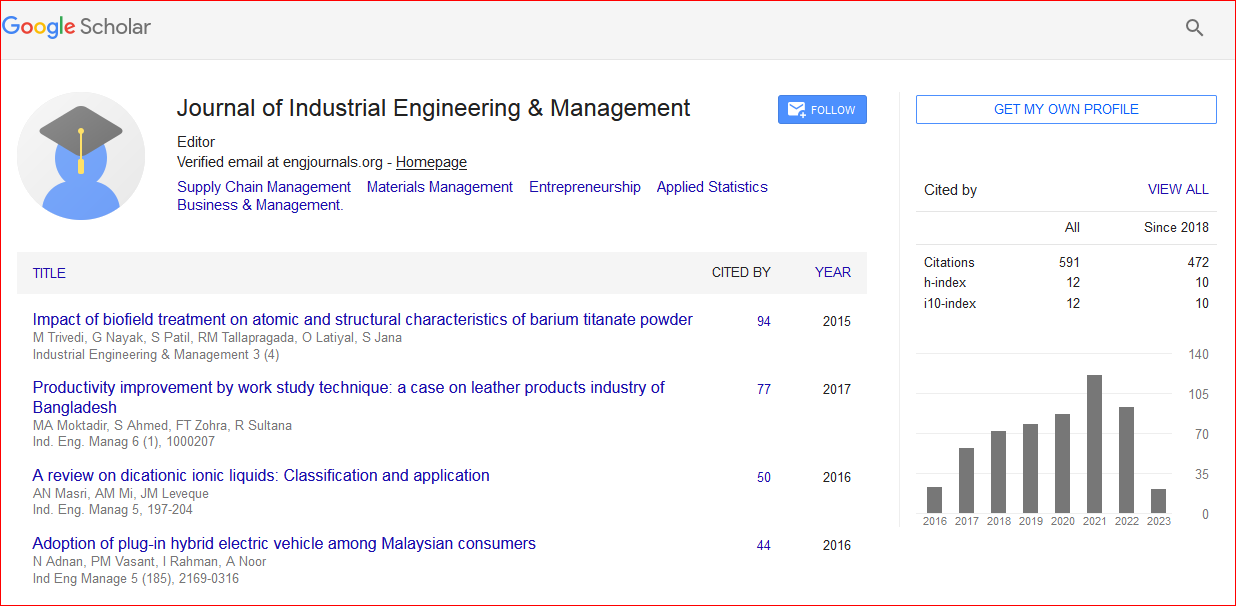
Industrial Engineering & Management received 739 citations as per Google Scholar report