Short Communication - (2025) Volume 14, Issue 3
Received: 01-Jun-2025, Manuscript No. idse-26-182819;
Editor assigned: 03-Jun-2025, Pre QC No. P-182819;
Reviewed: 17-Jun-2025, QC No. Q-182819;
Revised: 23-Jun-2025, Manuscript No. R-182819;
Published:
30-Jun-2025
, DOI: 10.37421/2168-9768.2025.14.496
Citation: Ruiz, Patricia Gomez. ”Irrigation Engineering: Salinity
Management and Sustainable Agriculture.” Irrigat Drainage Sys Eng 14
(2025):496.
Copyright: © 2025 Ruiz G. Patricia This is an open-access article distributed under the terms of the Creative Commons Attribution License, which permits unrestricted use,
distribution and reproduction in any medium, provided the original author and source are credited.
This article delves into the intricate field of advanced irrigation engineering, with a strong emphasis on optimizing water management and effectively controlling salinity in agricultural settings. It underscores the pivotal role that subsurface drainage systems play in averting waterlogging and preventing the detrimental accumulation of salts within the root zone, thereby fostering enhanced crop yields and promoting robust soil health. The research further explores pioneering methodologies for real-time monitoring of soil moisture and salinity levels, which are instrumental in facilitating the implementation of precision irrigation strategies. The synergistic benefits derived from integrated approaches, which meticulously combine hydraulic design principles with diligent water quality management, are particularly emphasized to champion the cause of sustainable agricultural practices. [1]
The subsequent investigation meticulously examines the efficacy of diverse subsurface drainage configurations in alleviating soil salinization, particularly within arid and semi-arid climatic zones. It systematically presents a comparative analysis of various drainage spacings and depths, carefully correlating these parameters with the efficiency of salt leaching and demonstrable improvements in crop yield. The presented findings strongly indicate that optimal drainage configurations can significantly minimize water consumption while simultaneously maximizing salt removal, thereby making substantial contributions to the advancement of more sustainable irrigation methodologies. [2] This paper meticulously evaluates the multifaceted impact of employing drip irrigation systems on both water use efficiency and the dynamic behavior of soil salinity. A core focus is placed on understanding the spatial and temporal distribution of salts throughout the soil profile under varying irrigation frequencies and specific emitter discharge rates. The research critically highlights how the precise application of water characteristic of drip irrigation can significantly aid in salinity management when contrasted with more traditional irrigation methods, thereby underscoring the paramount importance of meticulously planned system design and conscientious management. [3] The research critically examines the strategic role of conjunctive water use, which involves the integrated management of both surface and groundwater resources, as a vital strategy for achieving sustainable irrigation and effective salinity management. It undertakes a comprehensive analysis of the hydraulic and salt balance implications associated with employing different conjunctive use strategies within a defined river basin. The study unequivocally demonstrates how the judicious and strategic allocation of water resources from various sources can effectively mitigate existing salinity problems and substantially improve the overall sustainability of water resource utilization. [4] This article thoroughly discusses the practical application of remote sensing and Geographic Information System (GIS) technologies for the precise mapping and continuous monitoring of soil salinity within irrigated agricultural areas. It systematically presents well-defined methodologies that are specifically designed for accurately identifying salt-affected zones and for rigorously assessing the effectiveness of various drainage and irrigation interventions that have been implemented. The findings derived from this research strongly underscore the profound utility of these advanced technological tools for enabling well-informed and data-driven decision-making processes within comprehensive salinity control programs. [5] The research conducted herein investigates the significant impact that the application of different mulching materials can have on both soil moisture conservation and the resultant salinity build-up under various irrigated agricultural conditions. It provides a detailed comparative analysis of the effectiveness of both organic and plastic mulches in their capacity to reduce surface evaporation, and consequently, their subsequent influence on salt accumulation within the topsoil layer. This study offers valuable insights into the practical implementation of simple yet highly effective agronomic practices that can contribute significantly to effective salinity management. [6] This paper offers a focused examination of the hydraulic design principles and the operational performance of open drainage ditches, specifically in the context of achieving salinity control within irrigated deltaic regions. It meticulously analyzes the efficiency of these drainage systems in effectively lowering the water table and facilitating the flushing of accumulated salts, taking into careful consideration significant variations in flow rates and hydraulic gradients. The study ultimately provides practical and actionable guidance for the rational design and essential maintenance of open drainage networks. [7] The study rigorously investigates the implications of utilizing treated wastewater for irrigation purposes and its subsequent effects on both soil salinity levels and overall crop health. It presents a detailed assessment of the salt load present in treated wastewater and critically examines effective management strategies for its application in irrigated fields, alongside a thorough evaluation of potential risks and discernible benefits. The research provides well-substantiated recommendations for the safe and highly effective reuse of treated wastewater within agricultural contexts. [8] This paper thoroughly explores the complex and increasingly critical impact of ongoing climate change on the availability of irrigation water and the exacerbation of salinity issues, particularly within coastal agricultural regions. It systematically analyzes projected changes in key climatic variables, including precipitation patterns, evaporation rates, and the phenomenon of sea-level rise, and critically evaluates their combined and synergistic effects on vital water resources and the resultant soil salinity. The study forcefully emphasizes the urgent and indispensable need for the development and implementation of adaptive strategies within irrigation engineering to effectively address these pressing environmental challenges. [9] The research conducted herein rigorously evaluates the comparative efficiency of various irrigation scheduling methods specifically tailored for the effective management of soil salinity in crops that exhibit high sensitivity to salt stress. It undertakes a detailed comparison of the effectiveness of traditional time-based, volume-based, and more advanced sensor-based irrigation scheduling approaches, focusing on their impact on salt leaching dynamics and overall crop performance. The findings derived from this study unequivocally highlight the crucial importance of implementing crop-specific irrigation management practices to systematically minimize salinity-induced stress and promote optimal plant growth. [10]This article meticulously explores advanced irrigation engineering techniques, focusing intently on the critical aspects of efficient water management and robust salinity control within agricultural lands. It specifically highlights the indispensable role that properly designed subsurface drainage systems play in effectively preventing waterlogging and the detrimental accumulation of salts in the vital root zone, thereby leading to significant enhancements in crop productivity and overall soil health. Furthermore, the research delves into the development and application of innovative methods for the real-time monitoring of crucial soil moisture and salinity parameters, which collectively enable the implementation of highly precise and data-driven irrigation strategies. The inherent benefits associated with adopting integrated approaches, which seamlessly combine sophisticated hydraulic design principles with comprehensive water quality management practices, are strongly emphasized as foundational elements for achieving truly sustainable agriculture. [1]
The subsequent investigation meticulously examines the effectiveness of various subsurface drainage designs in mitigating the pervasive issue of soil salinization, with a particular focus on arid and semi-arid regions where water scarcity and salinity are major challenges. It presents a detailed comparative analysis of different drainage spacings and depths, systematically correlating these design parameters with the efficiency of salt leaching processes and observed improvements in crop yield. The findings from this study strongly suggest that the implementation of optimized drainage configurations can lead to a significant reduction in overall water usage while simultaneously maximizing the efficacy of salt removal, thereby making a substantial contribution to the adoption of more sustainable irrigation practices. [2] This paper provides a comprehensive evaluation of the impact that drip irrigation systems have on key metrics such as water use efficiency and the dynamics of soil salinity. The research places a specific emphasis on understanding the spatial and temporal distribution of salts within the soil profile under various irrigation frequencies and different emitter discharge rates, which are critical factors in salinity management. The study effectively highlights how the precise and controlled water application characteristic of drip irrigation can significantly assist in managing salinity when compared to more traditional irrigation methods, thus underscoring the critical importance of meticulous system design and diligent operational management. [3] The research conducted herein critically examines the significant role of conjunctive water use, which involves the integrated management of both surface and groundwater resources, as a cornerstone strategy for achieving sustainable irrigation and effective salinity management. It presents an in-depth analysis of the hydraulic and salt balance implications that arise from employing different conjunctive use strategies within the context of a river basin. The study conclusively demonstrates how the strategic and well-planned allocation of water resources from diverse sources can effectively address and mitigate existing salinity problems, thereby substantially improving the overall sustainability of water resource management and utilization. [4] This article thoroughly discusses the practical application and utility of remote sensing and Geographic Information System (GIS) technologies for the accurate mapping and continuous monitoring of soil salinity levels in irrigated agricultural areas. It systematically presents well-defined methodologies designed for the precise identification of salt-affected zones and for the rigorous assessment of the effectiveness of various drainage and irrigation interventions that have been implemented. The findings derived from this research strongly underscore the profound utility and indispensable value of these advanced technological tools for facilitating well-informed and data-driven decision-making processes within comprehensive and ongoing salinity control programs. [5] The research presented in this paper investigates the impact of employing different types of mulching materials on critical aspects of soil moisture conservation and the resultant build-up of soil salinity under various irrigated agricultural conditions. It offers a detailed comparative analysis of the effectiveness of both organic and plastic mulches in their capacity to reduce surface evaporation, and consequently, their subsequent influence on the accumulation of salts within the topsoil layer. This study provides valuable and practical insights into the implementation of simple yet highly effective agronomic practices that can contribute significantly to successful salinity management strategies. [6] This paper focuses specifically on the hydraulic design principles and the operational performance of open drainage ditches, with the primary objective of achieving effective salinity control in irrigated deltaic regions. It meticulously analyzes the efficiency of these traditional drainage systems in lowering the water table and facilitating the flushing of accumulated salts from the soil profile, while carefully considering the impact of variations in flow rates and hydraulic gradients. The study ultimately offers practical and actionable guidance for the rational design and essential maintenance of open drainage networks, ensuring their continued effectiveness. [7] The study conducted herein rigorously investigates the implications of utilizing treated wastewater for irrigation purposes and its subsequent effects on both soil salinity levels and overall crop health. It presents a detailed assessment of the salt load typically found in treated wastewater and critically examines effective management strategies for its application in irrigated fields, alongside a thorough evaluation of potential risks and discernible benefits associated with its use. The research provides well-substantiated recommendations aimed at ensuring the safe and highly effective reuse of treated wastewater within agricultural systems. [8] This paper thoroughly explores the complex and increasingly critical impact of ongoing climate change on the availability of irrigation water and the exacerbation of salinity issues, particularly within vulnerable coastal agricultural regions. It systematically analyzes projected changes in key climatic variables, including precipitation patterns, evaporation rates, and the phenomenon of sea-level rise, and critically evaluates their combined and synergistic effects on vital water resources and the resultant soil salinity. The study forcefully emphasizes the urgent and indispensable need for the development and implementation of adaptive strategies within irrigation engineering to effectively address these pressing environmental challenges and ensure future agricultural sustainability. [9] The research presented in this paper evaluates the comparative efficiency of different irrigation scheduling methods specifically tailored for the effective management of soil salinity in crops that exhibit high sensitivity to salt stress. It undertakes a detailed comparison of the effectiveness of traditional time-based, volume-based, and more advanced sensor-based irrigation scheduling approaches, focusing on their impact on salt leaching dynamics and overall crop performance. The findings derived from this study unequivocally highlight the crucial importance of implementing crop-specific irrigation management practices to systematically minimize salinity-induced stress and promote optimal plant growth and productivity. [10]This collection of research explores various facets of irrigation engineering focused on salinity management in agriculture. Studies investigate the efficacy of advanced techniques like subsurface drainage systems for waterlogging and salt control, and precision irrigation enabled by real-time monitoring. The impact of drip irrigation on water use efficiency and soil salinity dynamics is examined, alongside the benefits of conjunctive water use for sustainable resource management. Technologies such as remote sensing and GIS are highlighted for their role in mapping and monitoring soil salinity. Agronomic practices like mulching are assessed for their contribution to moisture conservation and salinity reduction. The hydraulic design of open drainage ditches for salinity control in deltaic regions is discussed, as is the use of treated wastewater for irrigation and its implications on salinity and crop health. Furthermore, the research addresses the critical impact of climate change on irrigation water availability and salinity in coastal areas, emphasizing the need for adaptive strategies. Finally, the importance of crop-specific irrigation scheduling for managing salinity in salt-sensitive crops is underscored.
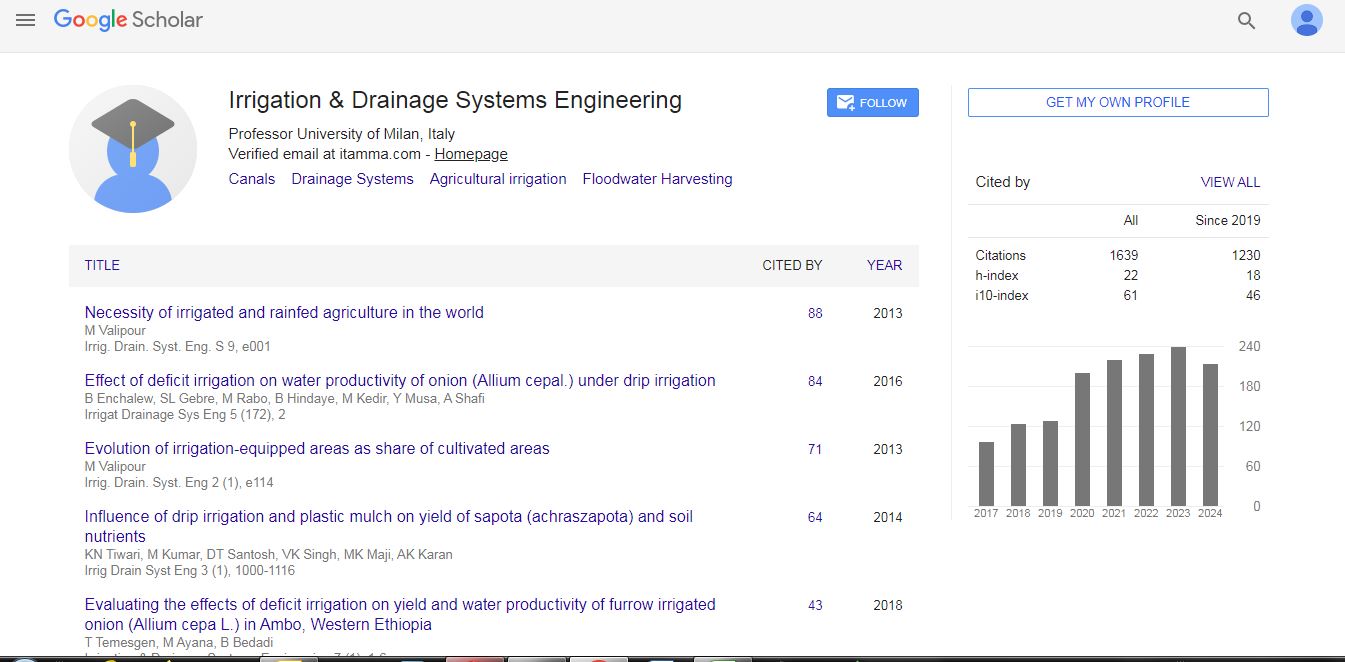
Irrigation & Drainage Systems Engineering received 835 citations as per Google Scholar report