Short Communication - (2025) Volume 14, Issue 5
Received: 01-Oct-2025, Manuscript No. idse-26-183629;
Editor assigned: 03-Oct-2025, Pre QC No. P-183629;
Reviewed: 17-Oct-2025, QC No. Q-183629;
Revised: 22-Oct-2025, Manuscript No. R-183629;
Published:
29-Oct-2025
, DOI: 10.37421/2168-9768.2025.14.516
Citation: Zadeh, Hassan Ali. ”Irrigation Drainage: Design, Analysis,
and Sustainable Management.” Irrigat Drainage Sys Eng 14 (2025):516.
Copyright: © 2025 Zadeh A. Hassan This is an open-access article distributed under the terms of the Creative Commons Attribution License, which permits unrestricted use,
distribution and reproduction in any medium, provided the original author and source are credited.
The intricate design and analysis of irrigation drainage networks are paramount for optimizing water management in agricultural landscapes. These systems play a crucial role in ensuring efficient water conveyance, mitigating the adverse effects of waterlogging, and preventing soil salinization, thereby supporting sustainable agricultural productivity. Accurate hydraulic modeling forms the bedrock of effective drainage network design, allowing for the assessment of performance under diverse hydrological conditions and the implementation of strategies for enhanced operational efficiency [1].
The dynamic simulation of water flow within complex irrigation drainage systems is essential for a comprehensive understanding of network behavior. Employing dynamic wave routing models allows for the accurate capture of transient flow conditions, which are often overlooked in traditional steady-state analyses. This approach is critical for understanding the responsiveness of drainage networks to rainfall events and irrigation schedules, enabling more effective flood management and water resource allocation [2].
Different design parameters significantly influence the efficiency of open drainage channels in agricultural areas. Numerical modeling provides valuable insights into factors such as channel geometry, slope, and roughness coefficient. Optimizing these parameters enhances drainage capacity, reduces sedimentation, and improves overall system performance, which is vital for sustainable agricultural practices [3].
The challenges and solutions associated with the design and management of subsurface drainage systems in waterlogged agricultural lands are multifaceted. Hydraulic principles governing groundwater table control and salinity management are central to these systems. Evaluating different drainage materials and installation methods offers practical guidance for improving soil conditions and crop productivity in affected areas [4].
Geographic Information Systems (GIS) and remote sensing offer powerful tools for the analysis and design of irrigation drainage networks. These technologies facilitate the delineation of watershed boundaries, identification of suitable locations for drainage structures, and the modeling of water flow, thereby supporting efficient planning and management of large-scale drainage systems [5].
The hydraulic modeling of drainage pumping stations within irrigation networks is a critical component of system design. Comprehensive analysis of pump performance, energy consumption, and system reliability is necessary for designing efficient and cost-effective pumping systems that ensure optimal drainage operations, particularly in low-lying agricultural areas [6].
The impact of climate change on the design and operation of irrigation drainage networks necessitates adaptive strategies. Utilizing climate projection data allows for the assessment of potential changes in precipitation patterns and their effects on drainage water demand and flood risk. Developing resilient drainage systems is crucial for coping with future hydrological extremes [7].
A comparative analysis of different hydraulic modeling software is instrumental for engineers and researchers. Evaluating the accuracy, computational efficiency, and ease of use of various tools guides the selection of appropriate software, leading to more reliable and efficient network designs and analyses [8].
Artificial intelligence and machine learning are emerging as transformative technologies in the hydraulic analysis of irrigation drainage systems. Their application in predicting flow rates, optimizing control strategies, and detecting anomalies holds significant potential for improving the efficiency and responsiveness of drainage network management [9].
Sediment transport and deposition within irrigation drainage networks pose significant challenges to channel capacity and operational efficiency. Investigating the factors influencing sediment load and developing effective management strategies are crucial for maintaining the hydraulic performance and longevity of the drainage system [10].
The research presented in C001 delves into the intricate hydraulic design and analysis of irrigation drainage networks, providing a comprehensive framework for optimizing water management. It underscores the critical importance of accurate modeling for efficient water conveyance, minimizing waterlogging, and preventing salinization, emphasizing the application of advanced hydraulic principles and computational tools to assess network performance under various hydrological conditions and proposing strategies for enhanced operational efficiency and sustainability of agricultural lands [1].
C002 introduces a novel approach to simulating flow dynamics within complex irrigation drainage systems by focusing on the use of dynamic wave routing models to accurately capture transient flow conditions, often overlooked in traditional steady-state analyses. The findings are crucial for understanding the responsiveness of drainage networks to rainfall events and irrigation schedules, enabling more effective flood management and water resource allocation [2].
In C003, the study investigates the impact of different design parameters on the efficiency of open drainage channels in agricultural areas, employing numerical modeling to assess factors such as channel geometry, slope, and roughness coefficient. This research provides valuable insights for optimizing channel design to enhance drainage capacity, reduce sedimentation, and improve overall system performance, thereby supporting sustainable agricultural practices [3].
C004 explores the challenges and solutions associated with the design and management of subsurface drainage systems in waterlogged agricultural lands. It examines the hydraulic principles governing groundwater table control and salinity management through subsurface drainage, including an evaluation of different drainage materials and installation methods, offering practical guidance for improving soil conditions and crop productivity [4].
The study in C005 investigates the application of Geographic Information Systems (GIS) and remote sensing for the analysis and design of irrigation drainage networks. It demonstrates how these technologies can be utilized to delineate watershed boundaries, identify suitable locations for drainage structures, and model water flow, offering a powerful tool for efficient planning and management of large-scale drainage systems [5].
C006 focuses on the hydraulic modeling of drainage pumping stations within irrigation networks, presenting a comprehensive analysis of pump performance, energy consumption, and system reliability. The research provides essential data for designing efficient and cost-effective pumping systems to ensure optimal drainage operations, especially in low-lying agricultural areas [6].
The research in C007 investigates the impact of climate change on the design and operation of irrigation drainage networks. It uses climate projection data to assess potential changes in precipitation patterns and their effect on drainage water demand and flood risk, offering insights into developing adaptive and resilient drainage systems to cope with future hydrological extremes [7].
C008 presents a comparative analysis of different hydraulic modeling software for irrigation drainage networks, evaluating their accuracy, computational efficiency, and ease of use. The findings are instrumental in guiding engineers and researchers in selecting appropriate software for their design and analysis needs, leading to more reliable and efficient network designs [8].
The research in C009 explores the role of artificial intelligence and machine learning in the hydraulic analysis of irrigation drainage systems, demonstrating how these techniques can be applied to predict flow rates, optimize control strategies, and detect anomalies. The study highlights the potential of AI to significantly improve the efficiency and responsiveness of drainage network management [9].
C010 focuses on the sediment transport and deposition within irrigation drainage networks, investigating the factors influencing sediment load and their impact on channel capacity and operational efficiency. The research proposes methods for managing sediment accumulation to maintain the hydraulic performance and longevity of the drainage system [10].
This collection of research addresses critical aspects of irrigation drainage network design, analysis, and management. Studies explore hydraulic principles for optimizing water conveyance, salinity control, and waterlogging prevention through both subsurface and open channel systems. Advanced techniques such as dynamic wave routing, GIS, remote sensing, and artificial intelligence are investigated for their utility in improving accuracy and efficiency. The impact of factors like climate change and sediment transport on drainage system performance is also examined, with a focus on developing resilient and sustainable solutions. The research highlights the importance of accurate modeling, appropriate software selection, and effective management strategies for ensuring the long-term functionality of agricultural drainage infrastructures.
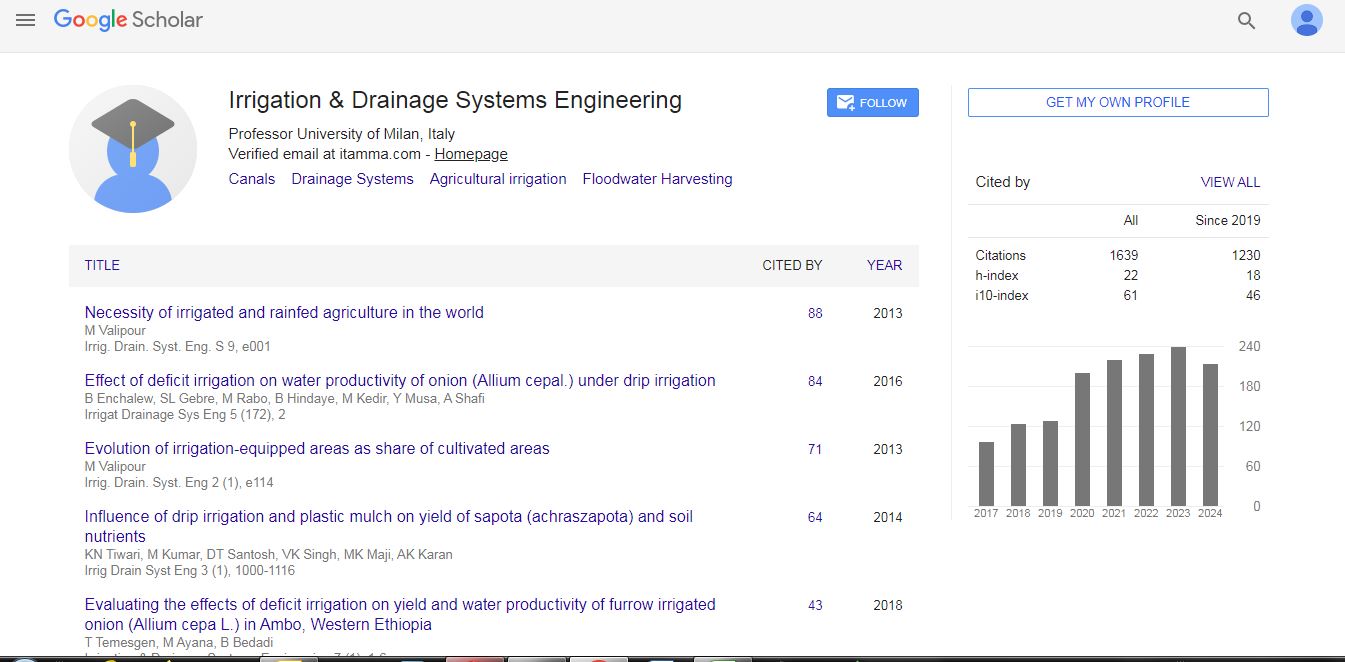
Irrigation & Drainage Systems Engineering received 835 citations as per Google Scholar report