Opinion - (2025) Volume 14, Issue 5
Received: 01-Oct-2025, Manuscript No. idse-26-183625;
Editor assigned: 03-Oct-2025, Pre QC No. P-183625;
Reviewed: 17-Oct-2025, QC No. Q-183625;
Revised: 22-Oct-2025, Manuscript No. R-183625;
Published:
29-Oct-2025
, DOI: 10.37421/2168-9768.2025.14.512
Citation: Meer, Koen Van der. ”Irrigation and Drainage:
Sustainable Agriculture and Water Management.” Irrigat Drainage Sys Eng 14
(2025):512.
Copyright: © 2025 Meer d. Van Koen This is an open-access article distributed under the terms of the Creative Commons Attribution License, which permits unrestricted use,
distribution and reproduction in any medium, provided the original author and source are credited.
This review delves into the critical domain of irrigation and drainage system design, a cornerstone of modern agricultural productivity and environmental stewardship. The intricate relationship between these systems and water resource management is paramount, especially in an era of increasing water scarcity and climate variability. Advanced modeling techniques are increasingly employed to understand and predict the performance of these systems under diverse hydrological scenarios, thereby enabling more informed design choices and operational strategies [1].
The impact of subsurface drainage on soil health, particularly in arid and semi-arid regions prone to salinization, is a significant area of research. Hydrological modeling provides a powerful tool to assess the effectiveness of various drainage configurations in mitigating salt accumulation in the root zone, which is crucial for maintaining long-term agricultural viability and preventing land degradation [2].
Surface irrigation techniques, such as furrow irrigation, continue to be widely used, but their efficiency is highly dependent on careful design and management. Evaluating performance metrics like water application uniformity and deep percolation losses is essential for optimizing these systems and minimizing water wastage, particularly under varying water availability conditions [3].
Pressurized irrigation systems, especially drip irrigation, offer significant advantages for horticultural crops by enabling precise water and nutrient delivery directly to the root zone. Hydraulic design principles and emitter selection are key to ensuring uniformity and efficiency, leading to water savings, reduced energy consumption, and improved crop yield and quality [4].
Integrating modern technologies like remote sensing and Geographic Information Systems (GIS) is revolutionizing the management of irrigation and drainage. These tools facilitate real-time monitoring of crop water status, soil moisture, and waterlogging, enabling targeted interventions and more efficient water allocation, ultimately enhancing water productivity and sustainability [5].
The modernization of existing irrigation infrastructure is a critical pathway towards sustainable agriculture. This involves transitioning from less efficient traditional methods to advanced systems like sprinkler or drip irrigation. A thorough economic and environmental evaluation, considering water savings, energy costs, yield improvements, and pollution reduction, is vital for guiding these transitions [6].
Addressing water scarcity necessitates the adoption of strategic deficit irrigation approaches. These methods involve controlled reductions in irrigation, applied at critical growth stages, to maintain acceptable crop yields while significantly conserving water. Evaluating different deficit irrigation levels and timing across various crops is crucial for developing effective water-saving practices [7].
The hydrological implications of agricultural drainage on water quality are a growing concern. Designing drainage systems to minimize the transport of nutrients and pesticides to receiving water bodies is essential for protecting aquatic ecosystems. Management practices, including the use of constructed wetlands, can further enhance water quality outcomes [8].
In rainfed agricultural areas, integrating water harvesting techniques with irrigation systems can significantly bolster crop production and resilience. Designing small-scale water harvesting structures to improve soil moisture availability and supplement crop water supply offers a sustainable approach to enhance water productivity and yield gains [9].
Smart irrigation systems, leveraging real-time data from soil moisture sensors and weather stations, represent the future of precision agriculture. These IoT-based solutions optimize irrigation scheduling, reduce water application, and enhance water use efficiency, contributing to more sustainable agricultural water management practices [10].
The advancement of irrigation and drainage system design is profoundly influenced by the pursuit of optimized water use efficiency and environmental sustainability. Sophisticated modeling techniques are instrumental in analyzing system performance under a spectrum of hydrological conditions. Integrated approaches that consider crop water requirements alongside the ecological impact on downstream ecosystems are proposed for effective agricultural water resource management, emphasizing data-driven decision-making and adaptive strategies [1].
Subsurface drainage systems play a pivotal role in managing soil salinization and enhancing crop yield, particularly within arid and semi-arid agricultural landscapes. The application of hydrological modeling enables a thorough assessment of how different drainage configurations can effectively leach salts from the root zone. This underscores the critical importance of judicious drainage design in preventing land degradation and ensuring sustained agricultural productivity, offering practical guidance for system implementation and ongoing maintenance [2].
Surface irrigation methods, with furrow irrigation as a prominent example, are subject to rigorous performance evaluation concerning water availability. Comprehensive analyses focus on water application uniformity, the extent of deep percolation losses, and crop water productivity. The recalibration of design parameters and the refinement of management strategies are put forth as essential steps to boost efficiency and mitigate water wastage, providing a foundation for both optimizing existing systems and designing new ones [3].
Pressurized irrigation systems, with a specific emphasis on drip irrigation, are being meticulously designed and evaluated for their application in horticultural crop cultivation. Key considerations include the adherence to hydraulic design principles, judicious emitter selection, and layout optimization to guarantee uniform delivery of both water and nutrients. The evaluation criteria encompass water savings, energy expenditure, and the consequential impact on crop yield and overall quality, thereby offering valuable direction for the adoption of efficient irrigation technologies [4].
A novel methodology for the integrated management of irrigation and drainage systems is presented, harnessing the capabilities of remote sensing and GIS technologies. This approach demonstrates the utility of satellite imagery in monitoring crop water status, soil moisture content, and the prevalence of waterlogging, facilitating timely and targeted interventions. The framework supports efficient water allocation and refined drainage system operation, contributing to augmented water productivity and a reduced environmental footprint [5].
The economic and environmental ramifications of modernizing existing irrigation systems are explored in detail. The research quantifies the costs and benefits associated with transitioning from conventional surface irrigation to more efficient methods, such as sprinkler or drip irrigation. The evaluation encompasses crucial factors like water conservation, energy consumption, improvements in crop yield, and the reduction of environmental pollution, offering a clear cost-benefit perspective for informed decision-making processes [6].
In the face of escalating water scarcity, the design and performance evaluation of deficit irrigation strategies become critically important. These strategies investigate how strategically timed reductions in irrigation can preserve acceptable crop yields while achieving significant water conservation. The study assesses various deficit irrigation levels for a range of crops through simulation models and field experiments, culminating in recommendations for water-saving irrigation practices [7].
The hydrological consequences of agricultural drainage on water quality, particularly concerning the transport of nutrients and pesticides, are thoroughly examined. The design of drainage systems is analyzed with the objective of minimizing pollutant loads that reach adjacent water bodies. The study also evaluates different drainage design configurations and management practices, such as the implementation of constructed wetlands, for their efficacy in achieving improved water quality outcomes [8].
The effectiveness of water harvesting techniques when integrated with existing irrigation systems is assessed as a means to enhance agricultural resilience in rainfed regions. The focus is on the design of small-scale water harvesting structures and their influence on soil moisture availability and the supply of water to crops. The research provides an evaluation of yield enhancements and gains in water productivity achieved through these integrated water management approaches [9].
A smart irrigation system, incorporating real-time soil moisture sensors and weather data, is studied for its design and performance. The analysis focuses on the system's capacity to optimize irrigation scheduling, reduce water application volumes, and improve crop water use efficiency. This research highlights the significant potential of IoT-based solutions for achieving precision irrigation and promoting sustainable water management within agricultural contexts [10].
This collection of research explores various facets of irrigation and drainage systems critical for sustainable agriculture. Studies examine advanced design techniques for optimizing water use efficiency and environmental sustainability, the impact of subsurface drainage on soil salinization and crop yield in arid regions, and performance evaluations of surface irrigation methods like furrow irrigation. The benefits of pressurized systems such as drip irrigation for horticulture are detailed, alongside the integration of remote sensing and GIS for enhanced management. Economic and environmental evaluations of modernizing irrigation systems are presented, along with strategies for water conservation through deficit irrigation and the mitigation of water quality impacts from agricultural drainage. Finally, the research highlights the effectiveness of water harvesting integration and the potential of smart, IoT-based irrigation systems for precision water management.
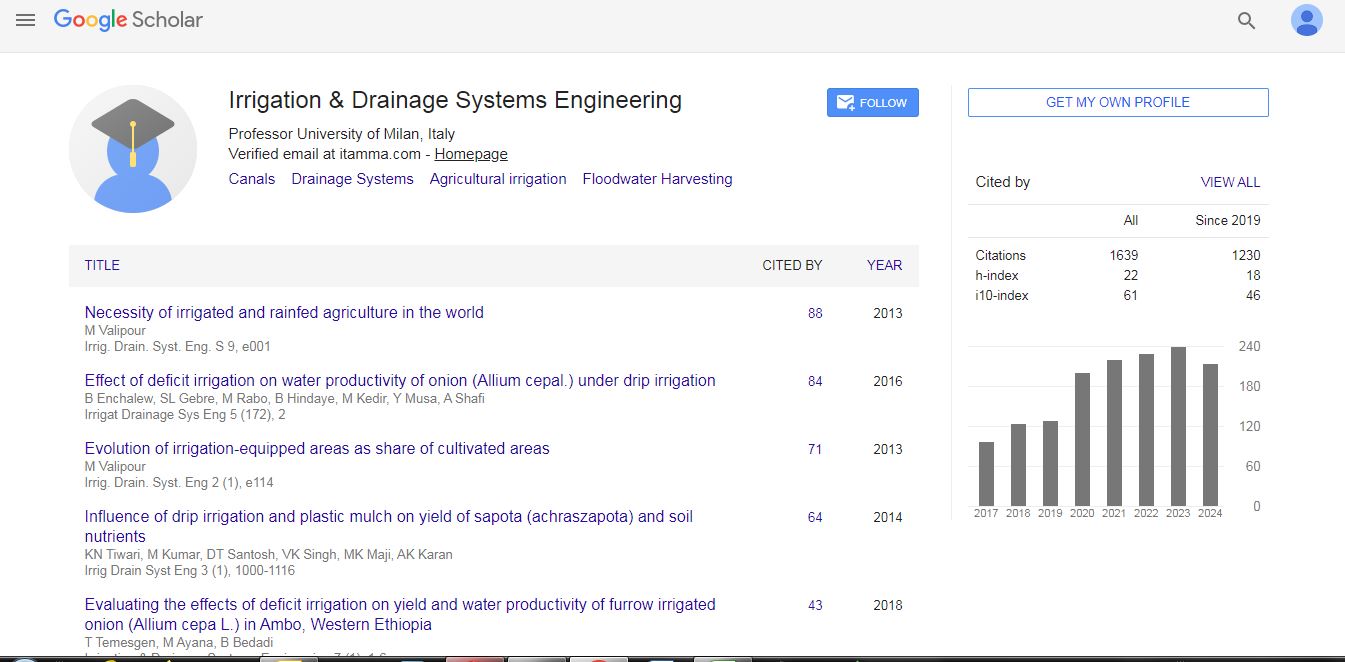
Irrigation & Drainage Systems Engineering received 835 citations as per Google Scholar report