Brief Report - (2025) Volume 14, Issue 6
Received: 01-Dec-2025, Manuscript No. idse-26-183630;
Editor assigned: 03-Dec-2025, Pre QC No. P-183630;
Reviewed: 17-Dec-2025, QC No. Q-183630;
Revised: 22-Dec-2025, Manuscript No. R-183630;
Published:
29-Dec-2025
, DOI: 10.37421/2168-9768.2025.14.517
Citation: Matos, Oliveira. "Irrigation and Drainage: Design, Management,
and Optimization." Irrigat Drainage Sys Eng 14 (2025):517.
Copyright: © 2025 Matos O. This is an open-access article distributed under the terms of the Creative Commons Attribution License, which permits unrestricted use, distribution
and reproduction in any medium, provided the original author and source are credited.
The design of effective irrigation and drainage systems is fundamentally rooted in established engineering principles, emphasizing the intricate interplay between soil, water, and plant relationships, along with the critical consideration of hydraulics and hydrological processes [1].
The optimization of irrigation networks involves advanced techniques aimed at maximizing water distribution efficiency and minimizing losses during conveyance, often leveraging computational fluid dynamics and Geographic Information Systems for enhanced performance [2].
Subsurface drainage plays a pivotal role in agricultural land management, particularly in regions susceptible to waterlogging and salinity, with design considerations focusing on pipe spacing, depth, and slope informed by soil and hydrological data [3].
The study of irrigation scheduling strategies in arid and semi-arid regions reveals that modern techniques, such as drip irrigation and micro-sprinklers, significantly improve water use efficiency and crop yield by responding to real-time monitoring of soil moisture [4].
Surface irrigation systems, including furrow and border irrigation, are analyzed through their hydraulic principles to ensure uniform water application, minimize runoff, and manage infiltration rates for efficient water delivery [5].
Managed aquifer recharge (MAR) systems are explored as a strategic approach to augment groundwater resources and manage irrigation water supply, addressing engineering challenges and benefits for drought resilience [6].
The design of drainage systems for saline and sodic soils is crucial for improving soil health and crop productivity, focusing on salt leaching and the hydraulic design of tile and surface drainage to enhance soil structure [7].
Pressurized irrigation systems, such as drip and micro-sprinkler systems, undergo performance evaluation and design optimization, with a focus on factors like emitter clogging and water distribution uniformity to maximize water productivity [8].
The integration of remote sensing and artificial intelligence offers advanced capabilities for optimizing irrigation system management, enabling crop water stress detection and precise irrigation scheduling through data-driven insights [9].
Agricultural drainage network design is underpinned by a comprehensive understanding of hydrological and hydraulic principles, encompassing both surface and subsurface drainage to ensure effective water removal and prevent waterlogging [10].
The foundational engineering principles for irrigation and drainage systems highlight the necessity of understanding soil-water-plant dynamics, hydraulics, and hydrology to achieve system efficiency, promote water conservation, and integrate sustainable practices that minimize environmental impact [1].
Advanced research in irrigation network design and management focuses on optimizing water distribution and reducing conveyance losses through the application of computational fluid dynamics (CFD) and Geographic Information Systems (GIS), thereby enhancing system performance and lowering operational costs [2].
The critical function of subsurface drainage in agricultural land management, especially in areas affected by waterlogging and salinity, is detailed through design considerations such as pipe spacing, depth, and slope, which are determined by soil characteristics and hydrological data to improve soil aeration and nutrient uptake [3].
Investigations into irrigation scheduling strategies in arid and semi-arid environments demonstrate that precision irrigation, based on real-time soil moisture and crop needs monitoring, significantly reduces water consumption while maintaining or improving crop productivity, a vital aspect for sustainable agriculture in water-scarce areas [4].
Detailed engineering design of surface irrigation systems, encompassing furrow and border irrigation, analyzes the hydraulic principles governing water flow and distribution, stressing the importance of uniform application, runoff minimization, and infiltration rate management for efficient irrigation [5].
The engineering design and application of managed aquifer recharge (MAR) systems are examined as a method to augment groundwater resources and manage irrigation water, considering various MAR techniques and their suitability based on hydrogeological conditions for drought resilience and sustainable water management [6].
Drainage systems for saline and sodic soils are engineered with a focus on principles of salt leaching and hydraulic design of tile and surface drainage to remove excess salts and improve soil structure, emphasizing integrated approaches with irrigation management and soil amendments for effective salinity control [7].
Performance evaluation and design optimization of pressurized irrigation systems, including drip and micro-sprinkler systems, consider factors influencing emitter clogging, pressure regulation, and water distribution uniformity to ensure efficient and reliable water application, thereby maximizing water productivity [8].
Remote sensing and artificial intelligence are explored for their potential in optimizing irrigation system management by providing tools for crop water stress detection, yield prediction, and precise irrigation scheduling, ultimately enhancing water use efficiency and supporting sustainable agricultural practices through data-driven insights [9].
The hydrological and hydraulic principles that govern the design of agricultural drainage networks, including aspects of surface and subsurface drainage, flow estimation, and channel and pipe network layout, are crucial for effective water removal, prevention of waterlogging, and maintenance of optimal soil conditions for agricultural production [10].
This collection of research examines various facets of irrigation and drainage system design and management. It covers fundamental engineering principles, advanced computational tools for optimizing water distribution, and the specific needs of subsurface drainage for waterlogged and saline soils. The impact of different irrigation scheduling strategies, including precision irrigation, is analyzed, alongside the engineering of surface and pressurized irrigation systems. Furthermore, the role of managed aquifer recharge in augmenting water resources and the application of remote sensing and artificial intelligence in enhancing system efficiency are explored. Hydrological and hydraulic principles form the basis for designing effective drainage networks to ensure optimal soil conditions for agricultural productivity.
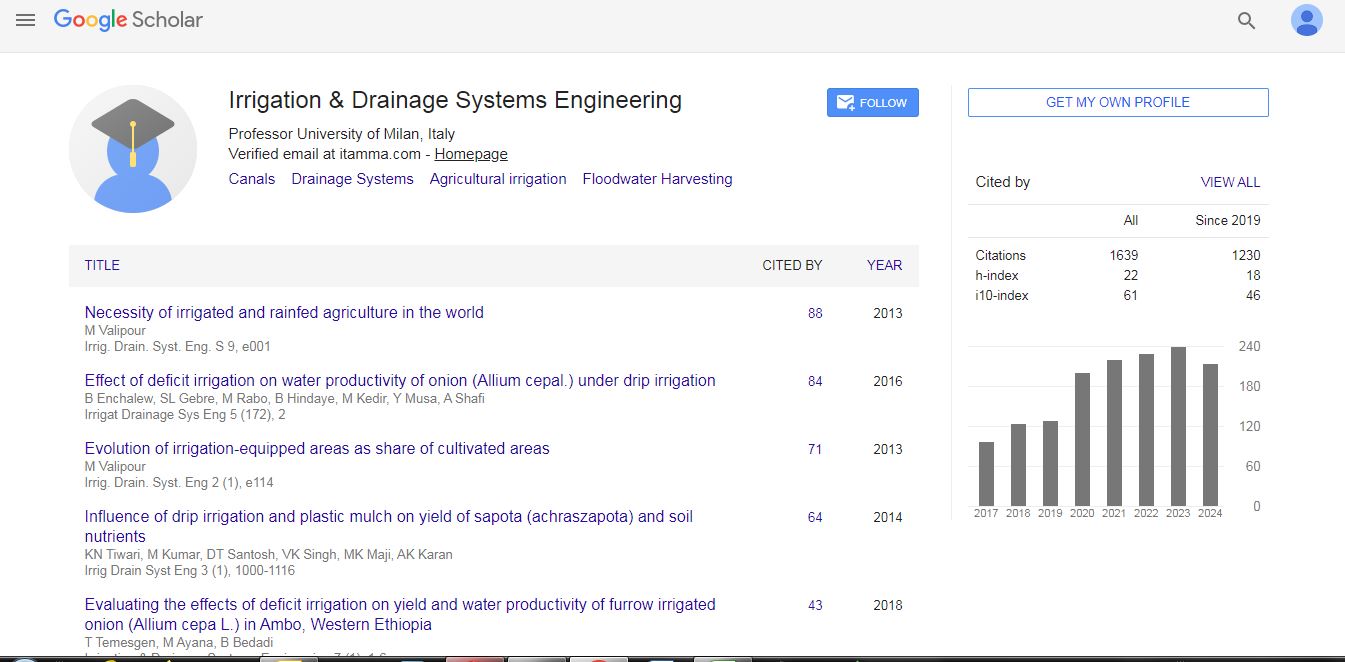
Irrigation & Drainage Systems Engineering received 835 citations as per Google Scholar report