Commentary - (2025) Volume 16, Issue 3
Received: 03-May-2025, Manuscript No. jhmi-26-178829;
Editor assigned: 05-May-2025, Pre QC No. P-178829;
Reviewed: 19-May-2025, QC No. Q-178829;
Revised: 23-May-2025, Manuscript No. R-178829;
Published:
30-May-2025
, DOI: 10.37421/2157-7420.2025.16.587
Citation: Alvarez, Carlos M.. ”IoMT: Revolutionizing Healthcare Through Secure Connectivity.” J Health Med Informat 16 (2025):587.
Copyright: © 2025 Alvarez M. Carlos This is an open-access article distributed under the terms of the Creative Commons Attribution License, which permits unrestricted use, distribution and reproduction in any medium, provided the original author and source are credited.
The Internet of Medical Things (IoMT) is fundamentally reshaping the healthcare landscape by integrating medical devices, sensors, and software to enhance patient monitoring, diagnostics, and treatment modalities. Its intricate architecture typically encompasses the acquisition of data from a multitude of devices, followed by robust data processing and analysis, culminating in a user interface designed for both healthcare professionals and patients. Key applications span a wide spectrum, from remote patient monitoring and sophisticated wearable health trackers to intelligent hospital systems and the burgeoning field of telemedicine. However, the extensive proliferation of IoMT devices concurrently introduces significant security vulnerabilities, including the critical risks of data breaches, malicious device tampering, and disruptive denial-of-service attacks, thereby necessitating the development and implementation of strong security frameworks and effective privacy-preserving mechanisms. [1] The foundational architecture of IoMT is characterized by distinct layers, including device layers, network layers, and application layers, all working in concert to facilitate seamless healthcare operations. This architecture critically relies on the advanced capabilities of cloud computing and edge computing paradigms for the efficient management and processing of the immense volumes of data generated by these connected medical devices. The article further explores diverse applications, ranging from the management of chronic diseases to sophisticated emergency response systems, strongly underscoring IoMT's profound potential to significantly improve healthcare accessibility and overall efficiency. A paramount aspect discussed is the critical importance of robust cybersecurity measures within IoMT ecosystems, with a specific focus on prevalent threats such as unauthorized access and the compromising of data integrity, alongside the proposal of effective mitigation strategies. [2] The complex architecture of IoMT systems is meticulously detailed, with a keen focus on the dynamic interplay between embedded devices, diverse connectivity protocols, and sophisticated cloud platforms. Applications, such as real-time patient monitoring for chronic conditions like cardiovascular diseases and diabetes, are thoroughly discussed, vividly demonstrating IoMT's substantial impact on the advancement of proactive healthcare. Security concerns, encompassing essential aspects like authentication, authorization, and the crucial implementation of data encryption, are critically examined. The paper strongly emphasizes the imperative need for standardized security protocols to effectively safeguard sensitive patient health information and to ensure the overall reliability and trustworthiness of IoMT deployments. [3] This work offers a comprehensive overview of the layered architecture inherent in IoMT systems, starting from the foundational sensing and data acquisition layer and extending to the advanced application and service layer. It highlights a variety of critical applications, including the use of smart inhalers designed for respiratory patients and advanced wearable devices tailored for elderly care. The article particularly stresses the critical security challenges that arise, such as the inherent vulnerability of medical devices to various forms of malware and unauthorized access, and consequently proposes a well-defined framework aimed at secure IoMT communication that fundamentally prioritizes patient privacy and the integrity of data. [4] The architectural components that constitute IoMT systems, including edge devices, vital gateways, and the overarching cloud infrastructure, are subjected to thorough analysis. The paper effectively showcases diverse applications, particularly in the domains of remote diagnostics and the development of personalized medicine, thereby emphasizing the significant potential for achieving improved patient outcomes. A substantial portion of the discussion is dedicated to an in-depth exploration of prevalent security threats, such as device spoofing and insidious man-in-the-middle attacks, and subsequently outlines a comprehensive defense-in-depth strategy specifically designed for securing the complex IoMT ecosystem. [5] This research thoroughly examines the layered architecture characteristic of IoMT and its significant contributions to advancements in telemedicine and remote health monitoring. Applications focused on managing chronic conditions and enhancing the quality of care for the elderly are explored in detail. The article identifies several key security vulnerabilities, including critical issues such as weak authentication mechanisms and the widespread use of unsecured data transmission channels, and consequently proposes innovative blockchain-based solutions aimed at significantly enhancing data security and privacy within IoMT networks. [6] The paper presents an in-depth examination of the IoMT architecture, extending from the initial sensor nodes to sophisticated data analytics platforms. It meticulously discusses a range of applications, such as smart insulin pens and continuous glucose monitors, prominently highlighting their transformative impact on the effective management of diabetes. Security issues, including critical device vulnerabilities and sensitive data privacy concerns, are thoroughly analyzed, accompanied by concrete recommendations for the implementation of secure communication protocols and robust access control measures. [7] This work places a strong emphasis on the architectural design principles of IoMT systems, underscoring the paramount importance of achieving both interoperability and scalability across diverse healthcare settings. Applications specifically in the areas of hospital automation and comprehensive remote patient monitoring are detailed. The article critically evaluates the existing security landscape within IoMT, directly addressing pressing threats like unauthorized data access and the potential for device hijacking, and subsequently proposes a novel secure framework that effectively incorporates advanced AI-driven intrusion detection systems. [8] The architectural considerations essential for IoMT systems, encompassing critical aspects like device connectivity, efficient data management, and advanced analytics capabilities, are systematically presented. Applications within the realms of personalized medicine and sophisticated advanced diagnostics are thoroughly discussed. The paper prominently highlights the significant security challenges that persist, such as the risks of data integrity breaches and confidentiality violations, and consequently proposes an innovative framework designed for secure data exchange leveraging advanced federated learning techniques. [9] This study diligently examines the IoMT architecture, tracing its journey from initial sensor deployment through to data transmission and subsequent analysis within various healthcare settings. Applications focused on wearable health monitoring and intelligent smart hospital management are detailed. The article unequivocally emphasizes the critical security issues that are prevalent, including threats such as malware infections, unauthorized access incidents, and significant data privacy concerns, and therefore strongly advocates for the widespread adoption of a multi-layered security approach to ensure the development of truly robust and resilient IoMT systems. [10]
The Internet of Medical Things (IoMT) is characterized by an architecture that typically involves distinct stages: data acquisition from connected medical devices and sensors, followed by rigorous data processing and analysis, and finally, the presentation of insights through a user interface accessible to healthcare professionals and patients. This sophisticated structure enables a wide array of applications, including remote patient monitoring, the use of wearable health trackers, the implementation of smart hospital systems, and the expansion of telemedicine services. Despite its transformative potential, the rapid increase in IoMT devices introduces substantial security vulnerabilities. These risks encompass potential data breaches, unauthorized device tampering, and denial-of-service attacks, underscoring the urgent need for robust security frameworks and effective privacy-preserving mechanisms to mitigate these threats and ensure patient safety. [1] The foundational architecture of IoMT is meticulously structured across several key layers: the device layer, the network layer, and the application layer, which collectively facilitate the seamless flow of medical data. Central to managing the colossal amounts of data generated by these devices are the critical roles played by cloud computing and edge computing technologies, offering scalable and efficient processing capabilities. The article delves into the diverse applications of IoMT, highlighting its potential in areas such as chronic disease management and advanced emergency response systems, thereby underscoring its capacity to enhance both the accessibility and operational efficiency of healthcare services. Furthermore, it emphasizes the paramount importance of cybersecurity within the IoMT domain, addressing significant threats like unauthorized access and data integrity issues, and proposing strategic mitigation approaches. [2] IoMT systems feature an intricate architecture that intricately links embedded medical devices, various connectivity protocols, and sophisticated cloud platforms. The applications discussed, such as real-time patient monitoring for conditions like cardiovascular diseases and diabetes, clearly demonstrate IoMT's profound impact on enabling more proactive and personalized healthcare interventions. A critical examination of security concerns is undertaken, focusing on essential elements such as authentication, authorization, and data encryption. The paper strongly advocates for the establishment and widespread adoption of standardized security protocols to ensure the protection of sensitive health information and to guarantee the reliability and trustworthiness of IoMT deployments. [3] This contribution provides a thorough overview of the layered architecture that defines IoMT, beginning with the sensing and data acquisition layer and extending through to the application and service layer. It highlights a variety of significant applications, including the innovative use of smart inhalers for managing respiratory conditions and advanced wearable devices designed for the care of elderly individuals. The article places considerable emphasis on the critical security challenges that arise, such as the inherent vulnerability of medical devices to malware and unauthorized access, and consequently proposes a comprehensive framework aimed at securing IoMT communications while prioritizing patient privacy and the integrity of data. [4] The architectural components that form the backbone of IoMT systems, such as edge devices, gateways, and the overarching cloud infrastructure, are subject to detailed analysis. The paper showcases diverse applications, particularly in the fields of remote diagnostics and the advancement of personalized medicine, thereby underscoring the significant potential for improving patient outcomes. A substantial portion of the discussion is dedicated to exploring prevalent security threats, including device spoofing and man-in-the-middle attacks, and subsequently outlines a strategic defense-in-depth approach designed to secure the entirety of the IoMT ecosystem. [5] This research specifically examines the layered architecture of IoMT and critically assesses its contribution to the advancement of telemedicine and remote health monitoring services. Applications relevant to the management of chronic conditions and the improvement of elderly care are thoroughly explored. The article identifies several key security vulnerabilities that are of significant concern, such as the prevalence of weak authentication mechanisms and the use of unsecured data transmission channels, and consequently proposes innovative blockchain-based solutions as a means to substantially enhance data security and privacy within IoMT networks. [6] The paper presents an in-depth analysis of the IoMT architecture, covering all aspects from the initial sensor nodes to the sophisticated data analytics platforms used in healthcare. It details a variety of applications, including smart insulin pens and continuous glucose monitors, prominently emphasizing their considerable impact on the effective management of diabetes. Security issues, encompassing critical device vulnerabilities and sensitive data privacy concerns, are subjected to thorough analysis, leading to the provision of concrete recommendations for implementing secure communication protocols and robust access control mechanisms. [7] This work centers on the architectural design of IoMT systems, with a strong emphasis on the crucial factors of interoperability and scalability. Applications related to hospital automation and comprehensive remote patient monitoring are presented in detail. The article critically evaluates the current security landscape within IoMT, directly addressing significant threats such as unauthorized data access and the potential for device hijacking, and proposes a novel secure framework that effectively integrates advanced AI-driven intrusion detection systems to enhance overall security. [8] The architectural considerations vital for IoMT systems, including device connectivity, efficient data management strategies, and sophisticated analytics capabilities, are systematically laid out. Applications in the domains of personalized medicine and advanced diagnostics are discussed. The paper highlights the significant security challenges that continue to pose a risk, such as the potential for data integrity and confidentiality breaches, and consequently proposes an innovative framework designed to facilitate secure data exchange by leveraging advanced federated learning techniques. [9] This study meticulously examines the IoMT architecture, following its progression from sensor deployment through data transmission and subsequent analysis within diverse healthcare contexts. Specific applications, such as wearable health monitoring and smart hospital management systems, are detailed. The article strongly emphasizes the critical security issues that are prevalent, including malware threats, unauthorized access, and significant data privacy concerns, advocating for the essential adoption of a comprehensive multi-layered security approach to ensure the development of highly robust and secure IoMT systems. [10]
The Internet of Medical Things (IoMT) is revolutionizing healthcare by connecting medical devices for improved patient care, diagnostics, and treatment. Its architecture typically involves data acquisition, processing, and user interfaces. Key applications include remote monitoring, wearables, smart hospitals, and telemedicine. However, the widespread use of IoMT devices introduces significant security vulnerabilities like data breaches and device tampering. Addressing these challenges requires robust security frameworks and privacy measures. IoMT architectures are layered, incorporating cloud and edge computing for data management. Applications range from chronic disease management to emergency response, enhancing healthcare accessibility. Cybersecurity is paramount, focusing on unauthorized access and data integrity. Standardization of security protocols is crucial for safeguarding sensitive health information and ensuring system reliability. Secure communication protocols, access control, and AI-driven intrusion detection are proposed mitigation strategies. Blockchain and federated learning are explored as advanced solutions for enhancing security and privacy.
None
None
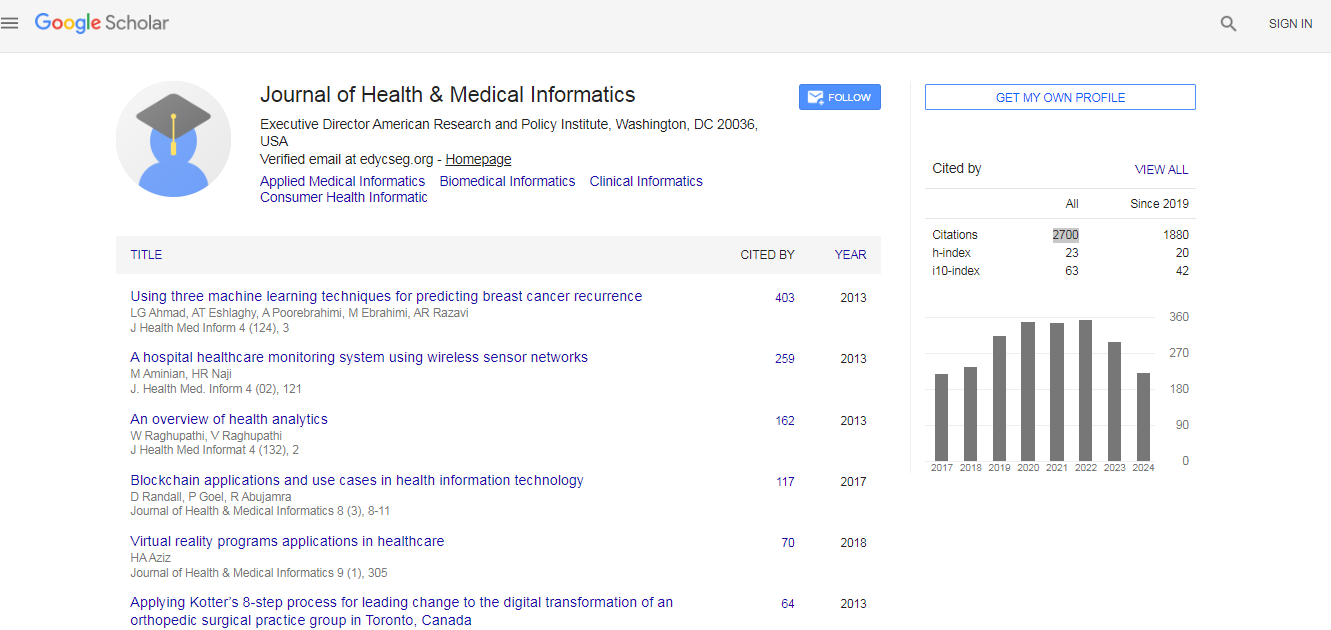
Journal of Health & Medical Informatics received 2700 citations as per Google Scholar report