Short Communication - (2025) Volume 16, Issue 4
Received: 01-Jul-2025, Manuscript No. jhmi-26-178862;
Editor assigned: 03-Jul-2025, Pre QC No. P-178862;
Reviewed: 17-Jul-2025, QC No. Q-178862;
Revised: 22-Jul-2025, Manuscript No. R-178862;
Published:
29-Jul-2025
, DOI: 10.37421/2157-7420.2025.16.607
Citation: Laurent, Anne-Sophie. ”Interoperability: Better Health Through Data Exchange.” J Health Med Informat 16 (2025):607.
Copyright: © 2025 Laurent A. This is an open-access article distributed under the terms of the Creative Commons Attribution License, which permits unrestricted use, distribution and reproduction in any medium, provided the original author and source are credited.
Interoperability in health information systems stands as a cornerstone for achieving seamless data exchange across diverse systems, ultimately enhancing patient care, advancing research endeavors, and bolstering public health initiatives. This necessitates the adoption of standardized terminologies, data formats, and communication protocols to foster a connected healthcare ecosystem [1].
The implementation of FHIR (Fast Healthcare Interoperability Resources) has markedly improved the capacity of health information systems to exchange data efficiently. This standard offers a flexible and robust set of resources for representing common healthcare concepts, thereby simplifying integration and application development efforts [2].
Semantic interoperability, which pertains to the meaning of exchanged data, represents a crucial layer beyond mere syntactic interoperability. Standards such as SNOMED CT and LOINC are indispensable for ensuring that healthcare data is interpreted consistently across various systems and by different users, thereby preventing misinterpretations and refining clinical decision-making processes [3].
The security and privacy of health information are of paramount importance when enabling interoperability. The deployment of stringent authentication, authorization, and encryption mechanisms is vital to safeguard sensitive patient data from unauthorized access or breaches, while simultaneously permitting authorized information exchange [4].
Obstacles to health information system interoperability frequently arise from proprietary vendor-specific systems, a lack of clear governance structures, and inherent resistance to change within healthcare organizations. Addressing these challenges requires strong leadership, well-defined policy frameworks, and collaborative engagements among all relevant stakeholders [5].
The utilization of APIs (Application Programming Interfaces) has become instrumental in facilitating interoperability, enabling different software applications to communicate and share data with remarkable efficiency. Standards like RESTful APIs, often employed in conjunction with FHIR, serve to simplify data access and integration for developers [6].
Patient engagement in managing their health data is increasingly recognized as a significant catalyst for interoperability. Empowering patients to access, control, and share their health information through patient portals and personal health records inherently demands robust and interoperable systems that support these functionalities [7].
The integration of artificial intelligence (AI) and machine learning (ML) into health information systems presents novel opportunities for leveraging interoperable data. AI/ML technologies can analyze extensive volumes of exchanged health data to discern trends, predict patient outcomes, and tailor treatments, thereby underscoring the critical need for standardized data formats [8].
Interoperability standards are fundamental to the successful implementation of electronic health records (EHRs) and their capacity to connect with other healthcare applications and services. In the absence of standardized approaches, EHR data can become siloed, thereby limiting its potential for population health management and the coordination of patient care [9].
The global impetus towards interoperable health information systems is fueled by the acknowledgment that enhanced data exchange can lead to improved patient outcomes, reduced healthcare expenditures, and more effective public health interventions. This objective necessitates a coordinated international endeavor to harmonize standards and promote their widespread adoption [10].
Interoperability in health information systems is paramount for seamless data exchange, enhancing patient care, research, and public health [1].
This involves standardizing terminologies, data formats, and communication protocols, though aligning stakeholder needs and legacy systems with new frameworks presents a significant challenge [1].
FHIR (Fast Healthcare Interoperability Resources) has significantly advanced health information exchange capabilities by providing a flexible set of resources for common healthcare concepts, simplifying integration and development [2].
Despite its advantages, widespread adoption and the creation of comprehensive implementation guides are ongoing efforts [2].
Beyond syntactic interoperability, semantic interoperability focuses on the meaning of exchanged data. Standards like SNOMED CT and LOINC are vital for ensuring consistent interpretation of healthcare data across systems and users, preventing misinterpretations and improving clinical decision-making [3].
Ensuring the security and privacy of health information is a critical prerequisite for interoperability. Robust authentication, authorization, and encryption mechanisms are essential to protect sensitive patient data from unauthorized access while facilitating authorized exchange [4].
Challenges to interoperability often stem from proprietary vendor systems, inadequate governance, and organizational resistance to change. Overcoming these barriers requires strong leadership, clear policies, and collaborative efforts among stakeholders [5].
APIs (Application Programming Interfaces) play a crucial role in enabling interoperability by allowing efficient communication and data sharing between software applications. Standards such as RESTful APIs, frequently used with FHIR, streamline data access and integration for developers [6].
Patient engagement in their health data is a growing driver for interoperability. Empowering patients to access, manage, and share their health information through portals and personal health records necessitates robust, interoperable systems [7].
AI and machine learning integration in health information systems opens new avenues for utilizing interoperable data. These technologies can analyze health data to identify trends, predict outcomes, and personalize treatments, highlighting the need for standardized data formats [8].
Interoperability standards are fundamental for the effective implementation and utilization of electronic health records (EHRs). Without them, EHR data remains siloed, limiting its contribution to population health management and coordinated care [9].
The global drive for interoperable health information systems is motivated by the potential for improved patient outcomes, reduced costs, and more effective public health responses. This requires a concerted international effort to harmonize and adopt standards [10].
Interoperability in health information systems is crucial for seamless data exchange, improving patient care, research, and public health. Key advancements include the adoption of standardized terminologies, data formats, and communication protocols like FHIR, which offers a flexible resource set for healthcare concepts. Semantic interoperability, supported by standards such as SNOMED CT and LOINC, ensures consistent data interpretation. Security and privacy are paramount, requiring robust protective measures. Challenges like proprietary systems and resistance to change are being addressed through strong leadership and collaboration. APIs, especially RESTful APIs used with FHIR, facilitate efficient data sharing. Patient engagement and the integration of AI/ML further underscore the importance of interoperable systems for personalized medicine and data analysis. Ultimately, a global effort is needed to harmonize and adopt these standards to achieve better health outcomes and cost efficiencies.
None
None
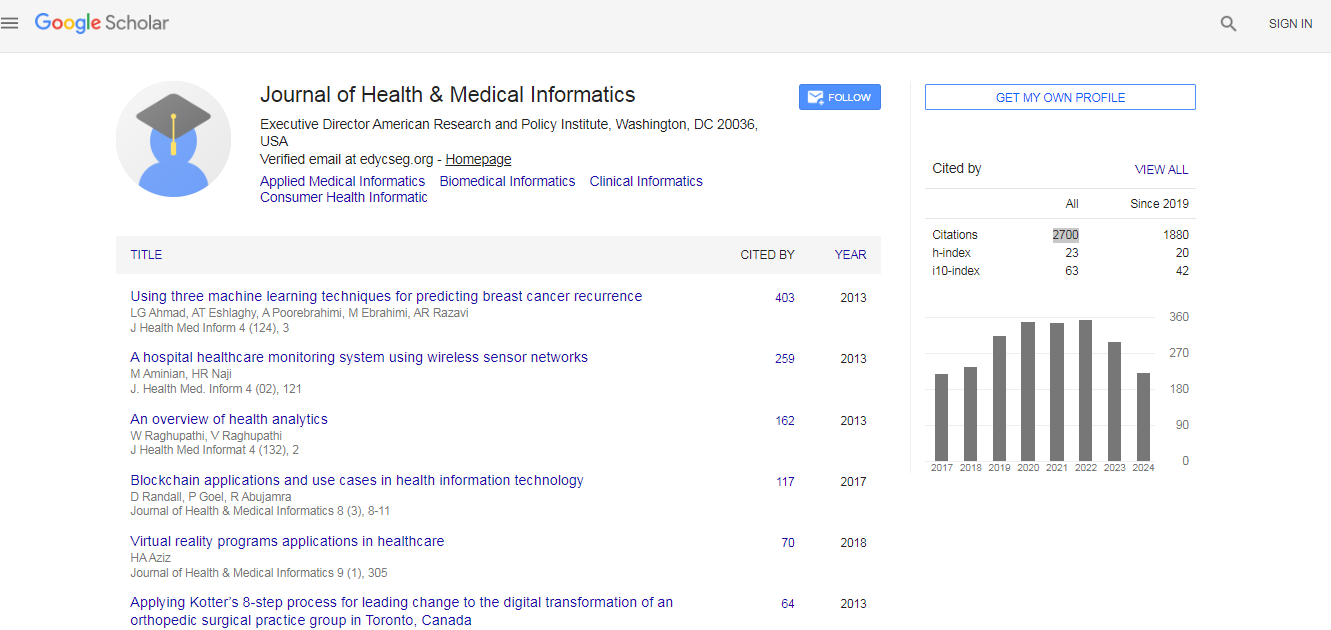
Journal of Health & Medical Informatics received 2700 citations as per Google Scholar report