Short Communication - (2025) Volume 14, Issue 6
Received: 03-Nov-2025, Manuscript No. mcce-26-190199;
Editor assigned: 05-Nov-2025, Pre QC No. P-190199;
Reviewed: 19-Nov-2025, QC No. Q-190199;
Revised: 24-Nov-2025, Manuscript No. R-190199;
Published:
29-Nov-2025
, DOI: 10.37421/2470-6965.2025.14.433
Citation: Rahman, Leila. ”Integrated Vector Management for Malaria Elimination.” Malar Contr Elimination 14 (2025):433.
Copyright: © 2025 Rahman L. This is an open-access article distributed under the terms of the Creative Commons Attribution License, which permits unrestricted use, distribution and reproduction in any medium, provided the original author and source are credited.
The global fight against malaria necessitates a paradigm shift towards integrated vector management (IVM), moving beyond single-intervention strategies to a comprehensive, multi-pronged approach that combines chemical, biological, and environmental control methods. This holistic framework is crucial for effective and sustainable malaria elimination efforts, recognizing the complex nature of vector-borne diseases. The importance of community participation and robust larval source management is paramount, alongside the exploration of novel tools that can revolutionize vector control. Sophisticated surveillance systems are also indispensable for monitoring and adapting strategies in real-time. These advancements aim to create resilient and effective programs capable of overcoming the persistent challenges posed by malaria transmission. The integration of chemical, biological, and environmental control methods within a unified strategy forms the bedrock of successful IVM. This approach acknowledges that no single intervention is sufficient and that a combination of tactics is required to disrupt the malaria parasite's life cycle and transmission pathways. The authors emphasize the critical need for moving beyond isolated actions to a coordinated effort that leverages the strengths of various control modalities. This comprehensive strategy is designed to be adaptable and responsive to the dynamic nature of vector populations and their interactions with human communities, thereby enhancing the overall effectiveness of malaria control programs. The authors highlight the importance of community participation, larval source management, and novel tools like gene drives and sophisticated surveillance systems for sustainable malaria control [1].
The application of novel technologies within existing IVM programs presents both significant challenges and unprecedented opportunities for enhancing malaria control. The potential of advanced tools such as spatial-temporal modeling and big data analytics offers a pathway to optimize intervention targeting and resource allocation, ensuring that control efforts are directed where they will have the greatest impact. This data-driven approach allows for a more precise and efficient deployment of resources, thereby maximizing the effectiveness of IVM strategies. Furthermore, the ongoing monitoring of insecticide resistance and the continuous development of alternative insecticides are vital components of maintaining the efficacy of chemical control methods. These efforts are essential to prevent the widespread failure of insecticides, which could severely undermine progress in malaria elimination. The review also touches on the importance of insecticide resistance monitoring and the development of alternative insecticides [2].
Community engagement is recognized as a cornerstone for the success and sustainability of integrated vector management (IVM) initiatives. Understanding local perceptions of disease, socio-cultural factors influencing behavior, and empowering communities to actively participate in decision-making processes are critical for the widespread adoption and adherence to vector control interventions. When communities are involved as active partners, rather than passive recipients of interventions, the effectiveness and sustainability of vector control efforts are significantly enhanced. This collaborative approach fosters ownership and ensures that control strategies are tailored to the specific context and needs of the population, leading to better outcomes. This study delves into the crucial aspect of community engagement in IVM [3].
The role of biological control agents as a vital component of IVM programs is increasingly recognized. Various bio-larvicides, including Bacillus thuringiensis israelensis (Bti) and Bacillus sphaericus, have demonstrated efficacy and safety in reducing mosquito populations at their larval stages. These agents offer an environmentally friendly alternative to conventional chemical insecticides, aligning with the principles of sustainable vector control. Their integration into IVM strategies can complement other control methods, providing a diversified approach to mosquito population management and contributing to the overall reduction of disease transmission. The paper discusses the role of biological control agents as a component of IVM [4].
Insecticide resistance in vector populations poses a significant threat to the long-term effectiveness of integrated vector management (IVM) strategies for malaria control. The continuous evolution of resistance mechanisms necessitates robust monitoring systems to track the emergence and spread of resistant populations. Strategic rotation of insecticides and the development of new chemical classes are essential to preserve the efficacy of available tools. Responsible insecticide use, including adherence to recommended dosages and application protocols, is paramount to slow down the development of resistance and ensure the continued utility of these critical interventions. This research examines the challenges posed by insecticide resistance in vector populations and its implications for IVM [5].
The application of spatial modeling and Geographic Information Systems (GIS) within IVM frameworks offers powerful tools for optimizing the targeting and efficiency of vector control programs. By identifying high-risk areas for vector breeding and disease transmission, these technologies enable the precise and efficient deployment of control interventions. This data-driven approach allows public health officials to allocate resources more effectively, focus on specific hotspots, and adapt strategies based on spatial patterns of risk, thereby enhancing the overall impact of IVM efforts. The article explores the potential of spatial targeting and geographic information systems (GIS) within IVM frameworks [6].
Gene drive technologies represent a potentially transformative tool within the IVM landscape, offering novel avenues for vector control. Gene drives have the theoretical capacity to significantly reduce vector populations or alter their ability to transmit pathogens, thereby offering a powerful new method for combating diseases like malaria. However, the deployment of such potent technologies necessitates careful consideration of ethical implications, potential ecological impacts, and the need for robust regulatory frameworks. Open public discourse and comprehensive risk assessments are essential before widespread implementation. This paper introduces the concept of gene drive technologies as a potential game-changer for vector control within IVM [7].
Larval source management (LSM) is a fundamental and essential strategy within integrated vector control programs, addressing mosquito populations at their origin. Various LSM techniques, including habitat modification, water management, and the judicious use of larvicides, are effective in reducing mosquito breeding sites and subsequently diminishing adult vector populations. By targeting larvae before they mature and become capable of disease transmission, LSM plays a critical role in preventing the buildup of vector populations and reducing the overall transmission potential of diseases like malaria. The authors highlight the importance of larval source management (LSM) as a foundational element of IVM [8].
The integration of novel surveillance technologies into IVM is revolutionizing our ability to monitor and respond to vector-borne disease threats. Tools such as remote sensing and molecular diagnostics provide real-time data on vector distribution, abundance, and pathogen carriage. This advanced data capability allows for more responsive, adaptive, and targeted vector control strategies, enabling public health programs to anticipate and mitigate outbreaks more effectively. Smart surveillance systems enhance the precision and efficiency of IVM efforts by providing timely and actionable information. This article focuses on the integration of novel surveillance technologies, such as remote sensing and molecular diagnostics, into IVM [9].
An economic perspective is crucial for the successful implementation and scaling of integrated vector management (IVM) strategies. Understanding the economic feasibility and cost-effectiveness of different IVM approaches, including chemical, biological, and environmental methods, is essential for evidence-based resource allocation. By analyzing the financial implications of various interventions, health economists can guide decision-makers in prioritizing strategies that yield the greatest impact on malaria control and elimination goals. This ensures that limited resources are utilized efficiently to maximize public health benefits and achieve ambitious public health targets. The authors examine the economic feasibility and cost-effectiveness of different IVM approaches [10].
Integrated Vector Management (IVM) stands as a critical framework for the effective combatting of malaria, advocating for a comprehensive strategy that transcends single-intervention approaches. This multi-pronged methodology synergistically combines chemical, biological, and environmental control methods to disrupt the malaria transmission cycle. A key tenet of IVM is the active engagement of communities, recognizing that local knowledge and participation are vital for the success and sustainability of vector control efforts. Furthermore, robust larval source management (LSM) is emphasized as a foundational element, targeting mosquitoes at their breeding sites to prevent adult emergence. The exploration and integration of novel tools, such as gene drives, alongside sophisticated surveillance systems, are also highlighted as essential components for modern IVM. These advanced technologies offer the potential to enhance precision, efficiency, and adaptability in vector control programs, ultimately contributing to malaria elimination goals. This integrated approach is designed to be adaptable and responsive to the dynamic nature of vector populations and their interactions with human communities, thereby enhancing the overall effectiveness of malaria control programs. The authors discuss the importance of community participation, larval source management, and novel tools like gene drives and sophisticated surveillance systems for sustainable malaria control [1].
The integration of novel technologies into IVM programs presents both challenges and opportunities. Spatial-temporal modeling and big data analytics are powerful tools for optimizing intervention targeting and resource allocation, ensuring that control efforts are focused and efficient. By leveraging these advanced analytical capabilities, public health officials can make more informed decisions regarding the deployment of resources, thereby maximizing the impact of IVM strategies. The monitoring of insecticide resistance is also a critical aspect, as resistance can significantly compromise the effectiveness of chemical control methods. The development of alternative insecticides and the strategic rotation of existing ones are crucial for preserving the efficacy of these vital tools. This review also touches on the importance of insecticide resistance monitoring and the development of alternative insecticides [2].
Community engagement is a crucial factor in the success and sustainability of IVM. Understanding local perceptions, socio-cultural contexts, and empowering communities to participate in decision-making processes are essential for ensuring the widespread adoption and adherence to vector control interventions. When communities are actively involved, vector control efforts become more effective and are better tailored to local needs and conditions, leading to improved outcomes. This collaborative approach fosters a sense of ownership and responsibility, which is vital for the long-term success of malaria control programs and the achievement of elimination goals. This study delves into the crucial aspect of community engagement in IVM [3].
Biological control agents, such as Bacillus thuringiensis israelensis (Bti) and Bacillus sphaericus, are increasingly recognized as key components of IVM. These bio-larvicides offer an environmentally friendly alternative to chemical insecticides, effectively targeting mosquito larvae in their breeding sites. Their integration into IVM strategies complements other control methods, contributing to a diversified and sustainable approach to vector population management. By reducing the reliance on chemical insecticides, biological control agents help to mitigate issues such as insecticide resistance and environmental contamination, thereby enhancing the overall sustainability of vector control programs. The paper discusses the role of biological control agents as a component of IVM [4].
Insecticide resistance is a major threat to IVM strategies. Robust monitoring systems are essential to detect and track resistance in vector populations, enabling timely adjustments to control programs. The strategic rotation of insecticides and the development of new chemical classes are vital for preserving the efficacy of current tools. Responsible use of insecticides, including adherence to recommended practices, is crucial to slow the development of resistance and maintain their effectiveness. This research examines the challenges posed by insecticide resistance in vector populations and its implications for IVM [5].
Spatial modeling and Geographic Information Systems (GIS) are valuable tools for optimizing IVM programs. These technologies enable the identification of high-risk areas for vector breeding and disease transmission, facilitating the precise and efficient deployment of control interventions. By providing a spatial understanding of vector distribution and disease risk, GIS and spatial modeling allow for targeted interventions, leading to more effective and resource-efficient vector control efforts. This enhances the ability of public health programs to focus their efforts on areas where they are most needed. The article explores the potential of spatial targeting and geographic information systems (GIS) within IVM frameworks [6].
Gene drive technologies hold significant promise as a novel tool for vector control within IVM. These technologies can potentially reduce vector populations or alter their pathogen-carrying capacity. However, their deployment requires careful consideration of ethical implications, ecological impacts, and the establishment of robust regulatory frameworks. Public discourse and comprehensive risk assessments are crucial before widespread implementation to ensure responsible and safe use. This paper introduces the concept of gene drive technologies as a potential game-changer for vector control within IVM [7].
Larval source management (LSM) is an essential strategy within IVM, focusing on eliminating mosquito breeding sites. Techniques such as habitat modification, water management, and the use of larvicides are effective in reducing larval populations, thereby preventing the emergence of adult mosquitoes capable of disease transmission. LSM is a foundational element of integrated vector control, contributing significantly to the reduction of vector abundance and the overall burden of vector-borne diseases. The authors highlight the importance of larval source management (LSM) as a foundational element of IVM [8].
Novel surveillance technologies, including remote sensing and molecular diagnostics, are enhancing IVM by providing real-time data on vector populations and disease transmission. These advanced tools enable more responsive and adaptive vector control strategies, allowing for rapid identification of hotspots and targeted interventions. Smart surveillance systems improve the precision and efficiency of IVM efforts by providing timely and actionable information, leading to better control outcomes. This article focuses on the integration of novel surveillance technologies, such as remote sensing and molecular diagnostics, into IVM [9].
Cost-effectiveness analysis is critical for the successful implementation of IVM strategies. Evaluating the economic feasibility of various interventions, including chemical, biological, and environmental methods, guides resource allocation decisions. Evidence-based resource allocation ensures that IVM programs are efficient and maximize their impact on malaria control and elimination goals. This ensures that limited public health budgets are used to achieve the greatest public health benefit and achieve ambitious public health targets. The authors examine the economic feasibility and cost-effectiveness of different IVM approaches [10].
This collection of research emphasizes the critical need for Integrated Vector Management (IVM) to effectively combat malaria. IVM advocates for a multi-pronged strategy combining chemical, biological, and environmental control methods, moving beyond single interventions. Key to its success are community participation, robust larval source management, and the integration of novel technologies like gene drives and advanced surveillance systems. Spatial modeling and GIS are highlighted for optimizing intervention targeting, while biological control agents offer environmentally friendly alternatives. The challenge of insecticide resistance necessitates careful monitoring and strategic rotation of chemicals. Economic feasibility and cost-effectiveness analyses are crucial for informed resource allocation, ensuring maximum impact on malaria elimination goals. Overall, IVM provides a comprehensive and adaptable framework for sustainable vector control.
None
None
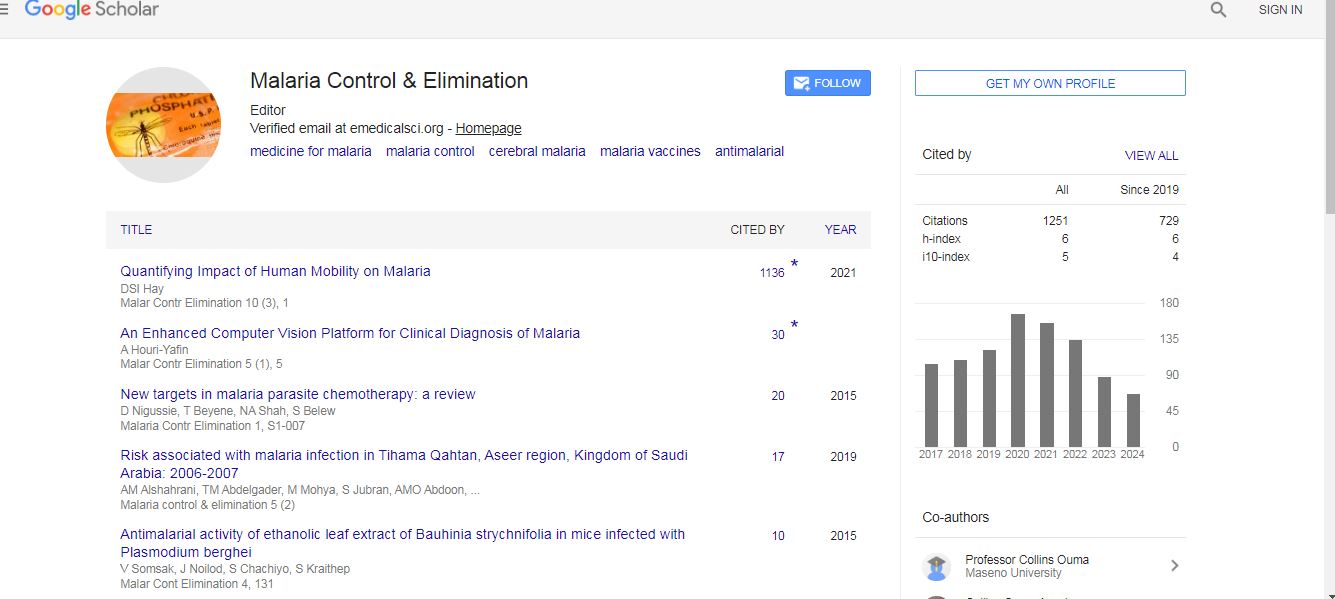
Malaria Control & Elimination received 1187 citations as per Google Scholar report