Brief Report - (2025) Volume 16, Issue 4
Received: 01-Aug-2025, Manuscript No. jmbd-26-179429;
Editor assigned: 04-Aug-2025, Pre QC No. P-179429;
Reviewed: 14-Aug-2025, QC No. Q-179429;
Revised: 21-Aug-2025, Manuscript No. R-179429;
Published:
28-Aug-2025
, DOI: 10.37421/2155-9929.2025.16.710
Citation: Kowalska, Maria. ”Integrated Biomarkers Revolutionize Early Disease Detection.” J Mol Biomark Diagn 16 (2025):710.
Copyright: © 2025 Kowalska M. This is an open-access article distributed under the terms of the Creative Commons Attribution License, which permits unrestricted use,
distribution and reproduction in any medium, provided the original author and source are credited.
Biomarker panels are rapidly emerging as powerful tools for the early detection of a wide spectrum of diseases, including various forms of cancer and chronic conditions. The integration of multiple biomarkers into a single panel significantly enhances diagnostic accuracy and prognostic prediction when compared to the analysis of single markers alone. This multifaceted approach offers substantial promise in identifying individuals who are at a higher risk for developing certain diseases, thereby facilitating timely and targeted interventions and enabling more effective monitoring of disease progression over time. Early detection is paramount in improving patient outcomes, and biomarker panels are at the forefront of this revolution in personalized medicine. Circulating tumor DNA (ctDNA) analysis represents a significant breakthrough with immense potential for the early detection of cancer and the monitoring of minimal residual disease. Advances in next-generation sequencing technologies have dramatically improved our ability to detect low-frequency mutations present in ctDNA, which is paving the way for the development of non-invasive screening strategies. The ongoing development of multi-cancer early detection (MCED) tests aims to identify multiple types of cancer simultaneously, offering a more comprehensive approach to early cancer diagnosis. MicroRNAs (miRNAs), which are small non-coding RNA molecules, play fundamental roles in gene regulation and are intricately involved in the pathogenesis of numerous diseases, notably cancer. Aberrant expression profiles of these miRNAs can serve as highly valuable biomarkers for the early diagnosis and prognosis of various conditions. The establishment and adherence to standardized methodologies for miRNA detection are critically important for their successful translation into clinical practice. Proteomic profiling provides a comprehensive methodology for identifying disease-specific protein signatures. The application of mass spectrometry-based proteomics, in conjunction with sophisticated bioinformatics analysis, allows for the discovery of novel biomarkers that are crucial for the early detection of cancers and chronic conditions such as cardiovascular disease and diabetes. A significant ongoing challenge in this field is the successful translation of these promising proteomic findings into robust and reliable clinical assays. Metabolomics offers a sensitive approach to revealing altered metabolic pathways that are intrinsically associated with early disease states. The identification of specific metabolic signatures within biofluids, such as blood and urine, provides a highly sensitive means for the early detection of cancers and various chronic metabolic disorders. Standardization and rigorous validation of metabolomic assays are essential prerequisites for their successful clinical application and widespread adoption. The integration of diverse data types, encompassing genomics, epigenomics, transcriptomics, proteomics, and metabolomics, into a singular biomarker panel represents a holistic strategy for early disease detection. This comprehensive multi-omics approach has the capability to capture subtle yet complex biological changes that might be overlooked by single-platform methodologies, ultimately leading to substantial improvements in both the sensitivity and specificity of diagnostic tests. Epigenetic modifications, including crucial processes like DNA methylation and histone modifications, function as critical regulators of gene expression and can serve as early indicators of various disease states. Aberrant DNA methylation patterns observed in circulating cell-free DNA are currently being extensively explored as promising non-invasive biomarkers for the effective detection of cancer. The development and refinement of robust assay technologies are fundamental to the reliable detection and precise quantification of biomarker panels. Technologies such as microarrays, PCR-based methods, and next-generation sequencing are essential for this purpose. Ensuring the high sensitivity, specificity, and reproducibility of these assays is a critical factor for their successful clinical translation and subsequent widespread adoption in healthcare settings. Significant challenges persist within the field of biomarker development, including the pressing need for large-scale, meticulously characterized longitudinal cohorts essential for rigorous biomarker validation. Furthermore, the establishment of standardized protocols across different laboratories and the development of effective methods for the interpretation of complex multi-biomarker data are crucial. Addressing these multifaceted challenges will undoubtedly accelerate the clinical implementation of advanced biomarker panels for the critical purpose of early disease detection. The integration of artificial intelligence (AI) and machine learning (ML) algorithms is profoundly transforming the landscape of biomarker panel analysis. These advanced computational approaches possess the remarkable capability to identify intricate patterns and subtle interactions among a vast number of biomarkers, thereby leading to more accurate and highly personalized risk predictions for the early detection of both cancer and chronic diseases.
Biomarker panels are emerging as powerful tools for the early detection of cancer and chronic diseases. Integrating multiple biomarkers can improve diagnostic accuracy and prognostic prediction compared to single markers. This approach holds promise for identifying individuals at high risk, facilitating timely intervention, and monitoring disease progression. The comprehensive nature of multi-biomarker panels allows for a more nuanced understanding of complex disease biology, leading to earlier and more accurate diagnoses. Such advancements are crucial for improving patient outcomes and managing the growing burden of non-communicable diseases globally. Circulating tumor DNA (ctDNA) analysis shows significant potential for early cancer detection and minimal residual disease monitoring. Advances in next-generation sequencing have enabled the detection of low-frequency mutations, paving the way for non-invasive screening strategies. Multi-cancer early detection (MCED) tests are being developed to identify multiple cancer types simultaneously. The ability to detect cancer from a simple blood draw represents a paradigm shift in oncological diagnostics, making screening more accessible and less invasive. MicroRNAs (miRNAs) are small non-coding RNAs that play critical roles in gene regulation and are implicated in various diseases, including cancer. Aberrant miRNA expression profiles can serve as valuable biomarkers for early diagnosis and prognosis. Standardized methodologies for miRNA detection are crucial for clinical translation. The regulatory functions of miRNAs make them sensitive indicators of cellular dysfunction, allowing for early detection of disease processes before overt symptoms appear. Proteomic profiling offers a comprehensive approach to identify disease-specific protein signatures. Mass spectrometry-based proteomics coupled with bioinformatics analysis can uncover novel biomarkers for early detection of cancers and chronic conditions such as cardiovascular disease and diabetes. The challenge lies in translating these findings into robust clinical assays. Proteins, as the workhorses of the cell, can reflect the physiological state of an organism more directly than nucleic acids in some contexts. Metabolomics can reveal altered metabolic pathways associated with early disease states. Identifying specific metabolic signatures in biofluids like blood and urine provides a sensitive means for early detection of cancers and chronic metabolic disorders. Standardization and validation of metabolomic assays are key for clinical application. Metabolites are downstream products of biological processes, and their changes can signal metabolic perturbations indicative of early disease. The integration of multiple data types, such as genomics, epigenomics, transcriptomics, proteomics, and metabolomics, into a single biomarker panel offers a holistic approach to early disease detection. This multi-omics strategy can capture complex biological changes that are missed by single-platform approaches, leading to improved sensitivity and specificity. By combining information from different biological layers, researchers can build more robust and comprehensive diagnostic models. Epigenetic modifications, including DNA methylation and histone modifications, are crucial regulators of gene expression and can serve as early indicators of disease. Aberrant DNA methylation patterns in circulating cell-free DNA are being explored as non-invasive biomarkers for cancer detection. Epigenetic changes are dynamic and can occur early in disease development, often preceding genetic mutations, making them valuable early warning signals. The development of robust assay technologies, such as microarrays, PCR-based methods, and next-generation sequencing, is essential for the reliable detection and quantification of biomarker panels. Ensuring assay sensitivity, specificity, and reproducibility is critical for clinical translation and widespread adoption. Technological innovation is a key enabler for translating biomarker research into clinical practice, ensuring that tests are accurate and reliable. Challenges in the field include the need for large-scale, well-characterized longitudinal cohorts for biomarker validation, the development of standardized protocols, and the interpretation of complex multi-biomarker data. Addressing these challenges will accelerate the clinical implementation of biomarker panels for early disease detection. Overcoming these hurdles is essential for realizing the full potential of biomarker-based diagnostics. The integration of artificial intelligence and machine learning algorithms is revolutionizing biomarker panel analysis. These computational approaches can identify complex patterns and interactions among numerous biomarkers, leading to more accurate and personalized risk prediction for early detection of cancer and chronic diseases. AI and ML are powerful tools for dissecting the complexity of multi-biomarker data and extracting clinically actionable insights.
Biomarker panels, integrating multiple molecular indicators, are revolutionizing early disease detection for cancers and chronic conditions. Techniques like circulating tumor DNA (ctDNA) analysis, microRNA profiling, proteomic and metabolomic studies, and epigenetic analysis offer sensitive and specific approaches. Multi-omics strategies, combining data from genomics, epigenomics, transcriptomics, proteomics, and metabolomics, provide a holistic view of disease states. Advances in assay technologies and the application of artificial intelligence and machine learning are crucial for improving diagnostic accuracy, risk prediction, and clinical translation. Despite challenges in validation and standardization, these integrated biomarker approaches hold significant promise for personalized medicine and improved patient outcomes.
None
None
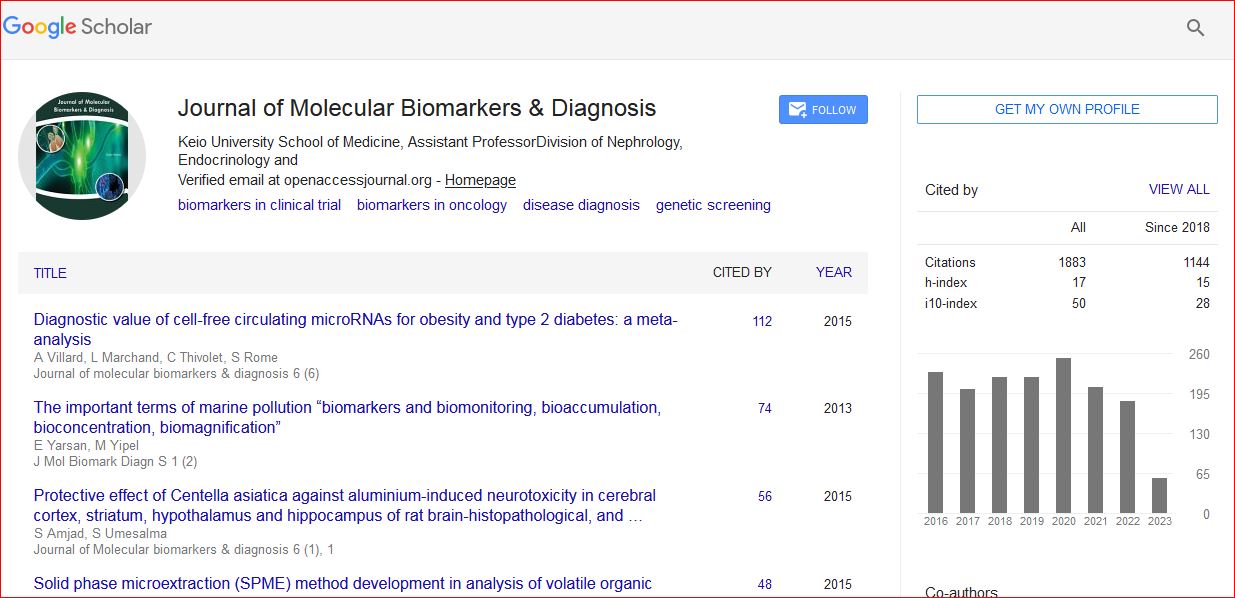
Journal of Molecular Biomarkers & Diagnosis received 2054 citations as per Google Scholar report