Commentary - (2025) Volume 11, Issue 5
Received: 02-Sep-2025, Manuscript No. ohcr-25-174312;
Editor assigned: 04-Sep-2025, Pre QC No. P-174312;
Reviewed: 18-Sep-2025, QC No. Q-174312;
Revised: 23-Sep-2025, Manuscript No. R-174312;
Published:
30-Sep-2025
, DOI: 10.37421/2471-8726.2025.11.211
Citation: Lee, Samuel. ”Innovative Dental Techniques for Aesthetic Smile Enhancement.” Oral Health Case Rep 11 (2025):211.
Copyright: © 2025 Lee S. This is an open-access article distributed under the terms of the Creative Commons Attribution License, which permits unrestricted use, distribution and reproduction in any medium, provided the original author and source are credited.
The successful application of minimally invasive ceramic veneers to enhance the esthetics of anterior teeth is documented, presenting a conservative yet highly effective approach for patients seeking smile improvements. This method underscores the critical need for precise planning and execution to ensure long-term esthetic and functional outcomes, demonstrating the durability and predictability of ceramic veneers over several years[1].
A detailed strategy for closing anterior maxillary diastema using direct composite resin is outlined, emphasizing a comprehensive esthetic approach. The techniques discussed focus on achieving natural tooth morphology and precise color matching, which ensures the final restoration integrates seamlessly with the patient's existing dentition, providing an efficient and non-invasive solution for managing spaces[2].
A complete digital workflow for esthetic rehabilitation in the anterior maxilla demonstrates precision and predictability in modern dental practices. This process encompasses digital impression-taking, sophisticated smile design, and advanced CAD/CAM fabrication, highlighting how digital technologies significantly improve communication between the dental team and the laboratory, ultimately leading to superior, patient-satisfying results[3].
Full-mouth rehabilitation utilizing all-ceramic crowns and veneers aims to achieve optimal esthetics and function. This report offers valuable insights into comprehensive treatment planning for complex dental cases, stressing careful material selection, thorough occlusal considerations, and meticulous preparation techniques essential for ensuring long-term stability and patient satisfaction, with success evidenced by a three-year follow-up[4].
Esthetic rehabilitation of a gummy smile can be effectively achieved through a combined approach of surgical crown lengthening and veneer placement. This case report thoroughly details the exact steps involved in modifying the gingival architecture to establish harmonious tooth proportions, which is then followed by ceramic veneer application to dramatically improve overall smile esthetics[5].
Diverse strategies for the esthetic management of anterior teeth are showcased through a case series, primarily employing direct resin restorations. This series illustrates various techniques for addressing different cosmetic concerns, ranging from discolored teeth to minor shape discrepancies. It highlights the remarkable versatility and predictability of composite materials when meticulously applied using specific layering and finishing protocols[6].
A minimally invasive method for the esthetic restoration of maxillary anterior teeth is demonstrated, involving direct composite resin and a flowable injection technique. This approach emphasizes its conservative nature, effectively preserving natural tooth structure while achieving exceptional esthetic outcomes. The innovation lies in its material application and layering, presenting a streamlined and highly effective clinical process[7].
The esthetic rehabilitation of maxillary anterior teeth using a multilayered direct composite resin restoration is precisely guided by a custom-made silicon index. This technique showcases how careful planning and a structured application can yield predictable and highly esthetic results, underlining the artistic skill necessary for creating natural-looking tooth contours and achieving accurate shade matching with direct restorative materials[8].
Interdisciplinary management of severe anterior teeth crowding in an adult patient with significant esthetic concerns is a key focus, illustrating a collaborative effort between orthodontics and restorative dentistry. This report details how complex malocclusions can be effectively corrected, leading to substantial functional improvements and a significantly enhanced smile, thereby underscoring the benefits of a multi-specialty approach in challenging cases[9].
An esthetic outcome of a single immediate implant placed in the anterior maxilla is presented, featuring a novel provisionalization technique. The report highlights crucial steps for achieving predictable soft tissue contours and a harmonious emergence profile, which are paramount for implant esthetics in highly visible areas. This demonstrates an advanced method for immediate loading and provisional restoration in challenging situations[10].
Modern dental practices are continuously evolving to meet the increasing demand for esthetic smile enhancements, with a strong emphasis on conservative and effective treatments. Minimally invasive ceramic veneers represent a prime example, offering a durable solution for improving anterior tooth esthetics with precise planning and execution being paramount for long-term success [1]. Parallel to this, direct composite resin has become a cornerstone in esthetic dentistry due to its versatility and conservative nature. It effectively addresses issues like anterior maxillary diastema closure, achieving natural tooth morphology and color integration with existing dentition [2]. These conservative techniques aim to preserve tooth structure while delivering significant visual improvements.
Here's the thing, the application of direct composite resin extends to a variety of anterior tooth concerns. Case series data highlights its use for managing diverse cosmetic issues such as discoloration and minor shape discrepancies, emphasizing the predictability achievable with meticulous layering and finishing protocols [6]. Further advancing these methods, a minimally invasive approach leverages direct composite resin with a flowable injection technique to restore maxillary anterior teeth. This method showcases a streamlined clinical process that maintains tooth structure while ensuring excellent esthetic outcomes through innovative material application [7]. For even greater precision, multilayered direct composite resin restorations are guided by custom-made silicon indices, enabling the creation of natural-looking tooth contours and accurate shade matching, which is a testament to the artistic skill involved in these direct material applications [8].
What this really means is, for more complex esthetic and functional demands, comprehensive solutions like full-mouth rehabilitation are employed. These involve the strategic use of all-ceramic crowns and veneers, requiring in-depth treatment planning, careful material selection, and attention to occlusal considerations to ensure enduring stability and patient satisfaction, as demonstrated by successful three-year follow-up cases [4]. Beyond just restorative materials, addressing soft tissue esthetics is also crucial. For instance, the esthetic rehabilitation of a gummy smile can be dramatically improved through a combination of surgical crown lengthening and subsequent ceramic veneer placement. This technique precisely modifies gingival architecture to achieve harmonious tooth proportions, significantly enhancing the smile's overall appearance [5].
Let's break it down: digital technology has revolutionized esthetic dentistry, enabling greater precision and predictability. A complete digital workflow in anterior maxillary rehabilitation integrates digital impression-taking, sophisticated smile design, and CAD/CAM fabrication. This digital integration fosters improved communication between the dental team and the laboratory, leading to superior, patient-satisfying results [3]. Furthermore, complex cases such as severe anterior teeth crowding in adults often necessitate an interdisciplinary management approach. This involves a collaborative effort between orthodontics and restorative dentistry to correct malocclusions, ultimately achieving both functional improvements and a significantly enhanced smile [9]. These multi-specialty approaches highlight the benefits of comprehensive care for challenging patient needs.
Achieving optimal esthetic outcomes in highly visible areas like the anterior maxilla sometimes involves advanced surgical and restorative techniques. For example, the placement of a single immediate implant in the anterior maxilla, coupled with novel provisionalization methods, focuses on creating predictable soft tissue contours and a harmonious emergence profile. This approach is vital for achieving natural-looking results with dental implants, showcasing advanced methods for immediate loading and provisional restoration that significantly contribute to overall smile esthetics [10].
These case reports collectively showcase a wide spectrum of modern dental techniques for enhancing smile esthetics and function. Minimally invasive ceramic veneers offer a conservative yet highly effective solution for improving anterior teeth, emphasizing precise planning and execution for durable outcomes. Direct composite resin emerges as a versatile material, used effectively for closing anterior maxillary diastema, achieving natural tooth morphology and color matching, and for minimally invasive restorations with flowable injection techniques. Complex esthetic rehabilitations in the anterior maxilla benefit from complete digital workflows, integrating digital impression-taking, smile design, and CAD/CAM fabrication for superior, predictable results. Full-mouth rehabilitation cases, involving all-ceramic crowns and veneers, underscore the importance of comprehensive treatment planning, material selection, and meticulous preparation for long-term stability. Addressing specific esthetic concerns, surgical crown lengthening combined with veneer placement dramatically improves gummy smiles by creating harmonious tooth proportions. Furthermore, a case series demonstrates the broad applicability of direct resin restorations for managing diverse anterior tooth cosmetic issues, from discoloration to minor shape discrepancies. Advanced techniques include multilayered direct composite restorations guided by custom-made silicon indices for precise contours and shade matching. Interdisciplinary management is crucial for severe anterior crowding, combining orthodontics and restorative dentistry for functional and esthetic improvements. Immediate single implant placement in the anterior maxilla, with novel provisionalization techniques, achieves predictable soft tissue contours and emergence profiles, vital for esthetic outcomes in highly visible areas. Overall, these reports highlight innovative, patient-focused solutions in restorative and esthetic dentistry.
None
None
1. Romina DS, Caterina P, Francesca DA. "Minimally Invasive Ceramic Veneers: A Clinical Case Report with Long-Term Follow-Up".Case Rep Dent 2021 (2021):6695393.
Indexed at, Google Scholar, Crossref
2. Mostafa E, Heba MS, El-Sayed EM. "A Comprehensive Approach to Anterior Maxillary Diastema Closure With Direct Composite Resin: A Case Report".Clin Case Rep Rev 2 (2022):1-5.
Indexed at, Google Scholar, Crossref
3. Dalia E, Heba A, Eman N. "Digital Workflow for Esthetic Rehabilitation in the Anterior Maxilla: A Clinical Case Report".Case Rep Dent 2022 (2022):5092042.
Indexed at, Google Scholar, Crossref
4. Mohammed AA, Abdulkarim MA, Abdullah BA. "A Full-Mouth Rehabilitation Using All-Ceramic Crowns and Veneers: A Case Report with 3-Year Follow-up".Case Rep Dent 2022 (2022):8872957.
Indexed at, Google Scholar, Crossref
5. Márcia AN, Priscila MdF, Daiana LGdM. "Esthetic rehabilitation of gummy smile with surgical crown lengthening and veneers: a clinical case report".J Indian Soc Periodontol 24 (2020):373-376.
Indexed at, Google Scholar, Crossref
6. Naveen SR, Bhupendra PS, Pratheek S. "Esthetic Management of Anterior Teeth: A Case Series".J Contemp Dent Pract 22 (2021):948-953.
Indexed at, Google Scholar, Crossref
7. Sahar G, Hedieh E, Mohammad G. "Minimally Invasive Approach for Esthetic Restoration of Maxillary Anterior Teeth Using Direct Composite Resin and Flowable Injection Technique: A Case Report".J Dent (Shiraz) 23 (2022):318-324.
Indexed at, Google Scholar, Crossref
8. Mohammed A, Nasser A, Muteb A. "Esthetic Rehabilitation of Maxillary Anterior Teeth Using a Multilayered Direct Composite Resin Restoration and a Custom-Made Silicon Index".Case Rep Dent 2021 (2021):3591940.
Indexed at, Google Scholar, Crossref
9. Mohammed AA, Mohammed AA, Abdullah MA. "Interdisciplinary Management of Severe Anterior Teeth Crowding in an Adult Patient with Aesthetic Concern: A Case Report".Case Rep Dent 2023 (2023):9940316.
Indexed at, Google Scholar, Crossref
10. Sultan AA, Marwan A, Naif A. "Esthetic outcome of a single immediate implant in the anterior maxilla with a novel provisionalization technique: A case report".J Clin Exp Dent 12 (2020):e796-e801.
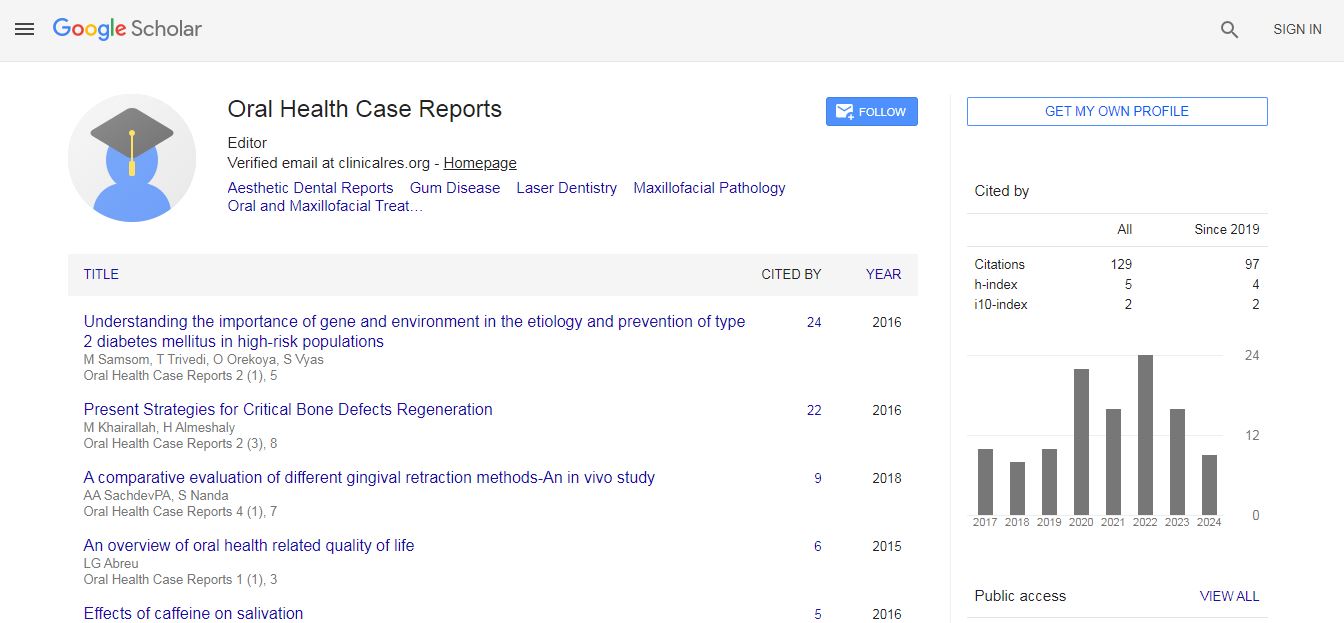
Oral Health Case Reports received 120 citations as per Google Scholar report