Short Communication - (2025) Volume 17, Issue 6
Received: 03-Nov-2025, Manuscript No. jcst-25-176316;
Editor assigned: 05-Nov-2025, Pre QC No. P-176316;
Reviewed: 19-Nov-2025, QC No. Q-176316;
Revised: 24-Nov-2025, Manuscript No. R-176316;
Published:
01-Dec-2025
, DOI: 10.37421/1948-5956.2025.17.740
Citation: Ramos, Lucia. ”Innovations Revolutionize Cancer Diagnosis
and Treatment.” J Cancer Sci Ther 17 (2025):740.
Copyright: © 2025 Ramos L. This is an open-access article distributed under the terms of the Creative Commons Attribution License, which permits unrestricted use,
distribution and reproduction in any medium, provided the original author and source are credited.
The landscape of cancer diagnosis and treatment is undergoing a profound transformation, driven by an array of sophisticated scientific and technological advancements. A cornerstone of this evolution involves multi-omics approaches, which holistically integrate genomics, proteomics, metabolomics, and epigenomics. This allows for a deeper, more comprehensive understanding of the intricate biology underlying cancer. Such integrated strategies are proving instrumental in improving the precision of early cancer diagnosis, refining patient stratification methods, and enabling the development of truly personalized treatment strategies through the identification of novel biomarkers and therapeutic targets [1].
Simultaneously, the advent of Artificial Intelligence (AI) and its powerful subfield, deep learning, has ushered in a new era for cancer diagnosis and prognosis. AI systems possess an unparalleled capability to analyze vast and complex datasets, including medical images and intricate clinical information. This analytical prowess directly translates into significantly improved diagnostic accuracy, the potential for much earlier disease detection, and more precise risk stratification across a diverse spectrum of cancer types, thereby revolutionizing how clinicians approach patient care [2].
In the pursuit of less invasive yet highly effective diagnostic tools, circulating tumor DNA (ctDNA) has emerged as a particularly promising area of research. This innovative approach leverages the non-invasive nature and inherent high specificity of ctDNA, making it a powerful biomarker. It holds substantial promise for widespread cancer screening, effectively monitoring disease progression, evaluating patient response to ongoing treatments, and critically, detecting minimal residual disease, all of which contribute to demonstrably better patient outcomes [3].
Complementing this, cell-free DNA (cfDNA) analysis represents another significant leap forward in non-invasive early cancer detection. Researchers are exploring various methodologies, such as methylation patterns and fragmentation analysis, to harness cfDNA's potential for screening numerous cancer types. While promising, the translation of these findings into widespread clinical practice still necessitates rigorous clinical validation [9].
Nanotechnology is equally at the forefront of innovation in early cancer diagnosis. Through the meticulous design and application of nanomaterials and sophisticated nanodevices, this field is dramatically enhancing the sensitivity and specificity required for biomarker detection, advanced medical imaging, and targeted drug delivery. These advancements are opening up entirely new avenues for developing non-invasive or minimally invasive diagnostic tools capable of identifying cancer at its very earliest, most treatable stages, offering hope for improved prognoses [4].
Furthermore, a comprehensive understanding of non-invasive biomarkers extends beyond just nucleic acids to include circulating proteins and exosomes. This broader category of markers holds immense potential to surmount the limitations inherent in traditional, often invasive, biopsy methods. By offering less invasive, more accessible, and earlier diagnostic opportunities, these biomarkers are crucial for truly improving patient outcomes across the board [5].
Delving deeper into specific non-invasive markers, exosomes play a profoundly crucial role in cancer biology. These remarkable nanovesicles, which naturally carry a diverse array of biomolecules, function exceptionally well as diagnostic biomarkers. They facilitate early detection and diligent progression monitoring of cancer. Beyond their diagnostic utility, exosomes also present considerable potential as highly efficient delivery vehicles for targeted cancer therapies, promising a dual benefit in patient management [6].
Returning to computational methods, Machine Learning (ML) techniques form a foundational component in medical imaging applications specifically tailored for cancer diagnosis and treatment. ML algorithms are expertly designed to analyze vast quantities of complex image data, providing invaluable assistance in precise tumor detection, detailed characterization, and accurate prediction of treatment response. This integration of ML significantly enhances diagnostic accuracy and is a key driver in the progression towards more personalized and effective precision medicine [7].
Another groundbreaking area is CRISPR-based technologies, which are rapidly reshaping cancer diagnosis and prognosis. These advanced CRISPR systems offer an impressive combination of high specificity and sensitivity for detecting critical cancer-related biomarkers. This capability paves the way for the development of rapid, highly precise, and remarkably cost-effective diagnostic tools, poised to fundamentally revolutionize early detection protocols and personalized medicine strategies [8].
Finally, the intricate relationship between the gut microbiome and cancer is increasingly recognized as a vital area of study. The microbiome exerts a multifaceted influence, affecting everything from cancer pathogenesis and its impact on diagnosis and prognosis, to modulating the efficacy of various therapeutic interventions. Intriguingly, specific microbial signatures are being identified that can serve as novel non-invasive biomarkers for early detection and meticulous risk assessment. They also hold predictive power for assessing a patient's likely response to different cancer treatments, underscoring the microbiome's broad significance in oncology [10].
Collectively, these diverse and innovative approaches represent a concerted effort to enhance our capabilities in diagnosing cancer earlier, more accurately, and less invasively, ultimately leading to more effective interventions and improved lives for patients worldwide.
Current oncology research is deeply invested in developing advanced methodologies for early cancer detection and precise treatment. One significant area involves the integration of multi-omics approaches. These methods combine genomics, proteomics, metabolomics, and epigenomics to offer a holistic view of cancer biology. This comprehensive data integration is critical for identifying novel biomarkers and therapeutic targets, ultimately enhancing early cancer diagnosis, improving patient stratification, and facilitating personalized treatment plans [1].
Technological innovations, especially in Artificial Intelligence (AI) and Machine Learning (ML), are profoundly impacting diagnostic capabilities. Artificial Intelligence, particularly deep learning, excels at analyzing complex medical images and clinical data. This leads to improved accuracy in diagnosis, earlier detection of malignancies, and more precise risk stratification across diverse cancer types [2]. Building on this, Machine Learning techniques provide a foundational understanding for their applications in medical imaging. ML algorithms analyze vast image datasets, aiding in tumor detection, detailed characterization, and predicting treatment responses, thereby significantly enhancing diagnostic accuracy and driving forward the field of precision medicine [7]. The synergy between AI and ML is crucial for deciphering complex patterns that human analysis might miss, promising more robust diagnostic tools.
The shift towards non-invasive diagnostic methods is a major theme in modern cancer research. Circulating tumor DNA (ctDNA) is a prime example, offering a non-invasive, highly specific biomarker for early cancer detection and ongoing disease monitoring. It shows great promise for screening, evaluating treatment efficacy, and detecting minimal residual disease, which directly contributes to better patient outcomes [3]. In a related development, cell-free DNA (cfDNA) analysis is also gaining traction for early cancer detection. Researchers are exploring various sophisticated methodologies, such as analyzing methylation patterns and DNA fragmentation. While cfDNA holds substantial potential as a non-invasive screening tool for numerous cancer types, further clinical validation is essential before it can be widely adopted in clinical practice [9]. These nucleic acid-based biomarkers represent a less burdensome alternative to traditional biopsies.
Further advancements in non-invasive techniques include the use of nanotechnology and other circulating biomarkers. Nanotechnology, through its development of nanomaterials and nanodevices, significantly enhances the sensitivity and specificity of biomarker detection, imaging, and drug delivery systems. This innovation opens up new avenues for non-invasive or minimally invasive diagnostic tools that can identify cancer at its earliest, most treatable stages [4]. A broader scope of non-invasive biomarkers, encompassing circulating nucleic acids, proteins, and exosomes, presents a powerful alternative to traditional biopsy methods. These offer less invasive, more accessible, and earlier diagnostic opportunities, which are absolutely vital for improving patient prognoses [5]. Specifically, exosomes, which are nanovesicles carrying various biomolecules, are emerging as excellent diagnostic biomarkers for early detection and progression monitoring. Their potential also extends to acting as targeted delivery vehicles for cancer therapies [6].
Beyond molecular and technological innovations, biological systems themselves offer new diagnostic insights. The gut microbiome, for instance, is increasingly understood to play a multifaceted role in cancer biology. Its influence spans from affecting pathogenesis to impacting diagnosis, prognosis, and even the effectiveness of therapeutic interventions. Intriguingly, specific microbial signatures can serve as valuable non-invasive biomarkers for early detection, risk assessment, and predicting how a patient might respond to various cancer treatments [10]. Lastly, CRISPR-based technologies are revolutionizing the landscape of cancer diagnosis and prognosis. These advanced systems offer exceptional specificity and sensitivity for detecting cancer-related biomarkers, enabling the creation of rapid, precise, and cost-effective diagnostic tools that promise to transform early detection and personalize medicine strategies significantly [8]. The collective progress across these diverse fields underscores a concerted global effort to enhance our capacity to diagnose cancer more effectively and intervene earlier, ultimately leading to improved patient survival and quality of life.
Progress in cancer diagnosis and treatment is rapidly evolving, driven by several innovative fields. Multi-omics approaches, integrating genomics, proteomics, metabolomics, and epigenomics, offer a comprehensive view of cancer biology to improve early diagnosis and personalized treatment strategies. Artificial Intelligence (AI), particularly deep learning, analyzes complex medical images and clinical data, significantly enhancing diagnostic accuracy, early detection, and precise risk stratification across various cancer types. Non-invasive methods are a major focus, with circulating tumor DNA (ctDNA) emerging as a promising biomarker for early detection, disease monitoring, and evaluating treatment response. Similarly, cell-free DNA (cfDNA) analysis presents potential for non-invasive screening, though it requires further clinical validation. Nanotechnology contributes by enhancing the sensitivity and specificity of biomarker detection and imaging, creating new avenues for early diagnostic tools. Exosomes, as nanovesicles carrying biomolecules, act as crucial diagnostic biomarkers and potential drug delivery vehicles. The broader category of non-invasive biomarkers, including circulating nucleic acids, proteins, and exosomes, offers less invasive, more accessible, and earlier diagnostic opportunities compared to traditional biopsy methods. Machine Learning (ML) techniques extend beyond AI into medical imaging, helping detect and characterize tumors and predict treatment response, thereby boosting diagnostic accuracy. CRISPR-based technologies are also transforming diagnosis and prognosis by offering highly specific and sensitive tools for detecting cancer-related biomarkers, leading to rapid and cost-effective diagnostic solutions. Even the gut microbiome is proving to be a key player, with specific microbial signatures acting as non-invasive biomarkers for early detection, risk assessment, and predicting treatment response. These diverse advancements collectively push the boundaries of cancer diagnosis, aiming for earlier, more precise, and less invasive methods, ultimately leading to improved patient outcomes and more effective personalized medicine.
Indexed at, Google Scholar, Crossref
Indexed at, Google Scholar, Crossref
Indexed at, Google Scholar, Crossref
Indexed at, Google Scholar, Crossref
Indexed at, Google Scholar, Crossref
Indexed at, Google Scholar, Crossref
Indexed at, Google Scholar, Crossref
Indexed at, Google Scholar, Crossref
Indexed at, Google Scholar, Crossref
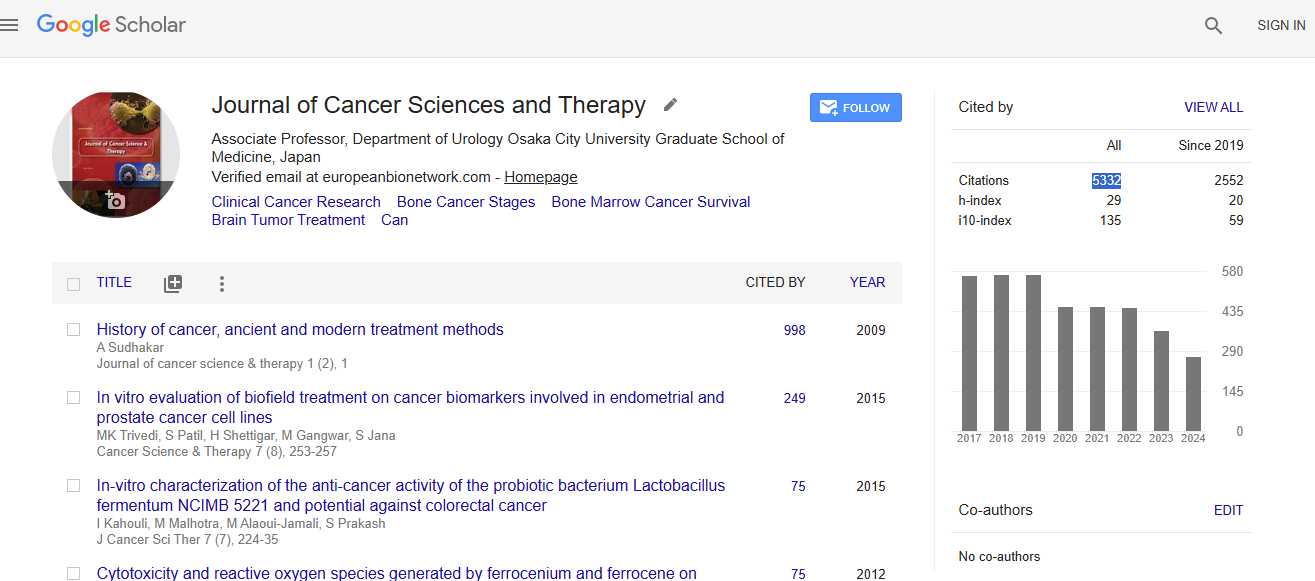
Cancer Science & Therapy received 5332 citations as per Google Scholar report