Opinion - (2025) Volume 11, Issue 6
Received: 01-Nov-2025, Manuscript No. ldt-25-178461;
Editor assigned: 03-Nov-2025, Pre QC No. P-178461;
Reviewed: 17-Nov-2025, QC No. Q-178461;
Revised: 24-Nov-2025, Manuscript No. R-178461;
Published:
29-Nov-2025
, DOI: 10.37421/2472-1018.2025.11.335
Citation: Osei, Daniel. ”Innovations Improving Respiratory Patient Outcomes.” J Lung Dis Treat 11 (2025):335.
Copyright: © 2025 Osei D. This is an open-access article distributed under the terms of the Creative Commons Attribution License, which permits unrestricted use, distribution and reproduction in any medium, provided the original author and source are credited.
Innovations in oxygen therapy and respiratory support are significantly enhancing patient outcomes across a spectrum of respiratory conditions. Recent advancements in delivery systems and monitoring technologies are revolutionizing how respiratory care is provided, leading to improved patient comfort and more effective treatment strategies. High-flow nasal cannula (HFNC) therapy, for instance, represents a major breakthrough, delivering heated and humidified oxygen at high flow rates, which aids in patient comfort and reduces the necessity for invasive ventilation. This approach has been particularly beneficial in managing patients with acute respiratory failure, offering a less invasive alternative to traditional methods [1].
Non-invasive ventilation (NIV) techniques, including continuous positive airway pressure (CPAP) and bilevel positive airway pressure (BiPAP), are also undergoing continuous refinement. These improvements encompass more sophisticated interfaces and adaptive algorithms, thereby providing enhanced support for individuals experiencing acute respiratory failure and managing chronic respiratory diseases. The adaptability of these systems allows for more personalized ventilation strategies, catering to the unique needs of each patient [1].
Remote patient monitoring, facilitated by wearable sensors, is fundamentally transforming respiratory care. By enabling real-time data collection on critical parameters such as oxygen saturation and respiratory rate, these technologies empower healthcare providers to make timely interventions and tailor treatment plans more precisely. This continuous stream of data facilitates a proactive approach to patient management, preventing exacerbations and improving overall health [1].
High-flow nasal cannula (HFNC) therapy has been extensively studied and proven effective in reducing the need for intubation and improving oxygenation in various acute respiratory conditions. Its mechanism of action involves washing out dead space, enhancing mucociliary clearance, and decreasing the work of breathing through the delivery of heated, humidified air at high flow rates. Ongoing research is focused on optimizing HFNC settings and identifying specific patient populations that derive the most benefit, particularly those with hypoxemic respiratory failure and post-extubation distress [2].
Non-invasive ventilation (NIV) technology continues to advance, with notable progress in ventilator design, interface development, and patient monitoring capabilities. Adaptive servo-ventilation (ASV) systems are showing particular promise in managing complex respiratory patterns, especially in patients with heart failure. The development of lighter and more portable NIV devices is also contributing to enhanced patient mobility and improved adherence, especially for individuals requiring long-term respiratory support [3].
Wearable sensors are a transformative innovation in respiratory care, allowing for continuous and unobtrusive monitoring of vital physiological parameters. These devices track metrics like oxygen saturation, respiratory rate, and heart rate, providing invaluable data for the early detection of disease exacerbations and enabling personalized therapy adjustments. The integration of these sensors with telehealth platforms further extends the reach of remote assessment and management, thereby improving access to care, especially for those in underserved geographical areas [4].
The development of novel oxygen delivery devices, such as portable oxygen concentrators with improved efficiency and extended battery life, is significantly enhancing the mobility and quality of life for patients suffering from chronic hypoxemia. Advances in sensor technology also enable more precise oxygen delivery that is responsive to patient demand, which optimizes therapy efficacy and conserves oxygen resources [5].
Mechanical ventilation strategies are undergoing continuous refinement with the primary goal of minimizing ventilator-induced lung injury (VILI). While lung-protective ventilation, characterized by low tidal volumes and appropriate positive end-expiratory pressure (PEEP), remains the cornerstone of care, emerging approaches are providing clinicians with more personalized insights. Techniques like electrical impedance tomography (EIT) allow for real-time assessment of lung aeration and recruitment, guiding more individualized ventilator settings [6].
The integration of artificial intelligence (AI) and machine learning (ML) into respiratory support represents a rapidly advancing frontier. AI algorithms possess the capability to analyze extensive patient data, enabling predictions of respiratory failure, optimization of ventilator settings, and personalization of oxygen therapy. This integration holds substantial potential for enhancing clinical decision-making and improving patient outcomes, particularly in managing complex and challenging cases [7].
Patient-ventilator asynchrony continues to be a significant challenge in mechanical ventilation. Innovations aimed at improving ventilator waveform analysis and developing adaptive breath delivery algorithms are crucial in detecting and mitigating asynchrony. Successful management of asynchrony can lead to enhanced patient comfort, reduced reliance on sedation, and potentially shorter durations of mechanical ventilation [8].
Novel approaches to oxygen delivery are also contributing to better patient care. Advanced oxygen delivery interfaces, such as ergonomically designed nasal prongs that ensure a better seal, and integrated humidification systems for even basic oxygen delivery, are improving patient tolerance and adherence to prescribed oxygen therapy. This is especially critical for individuals requiring long-term oxygen support [9].
Adjunctive therapies in respiratory management are also seeing continuous development. For instance, exogenous surfactant therapy, though primarily used in neonates, is being explored for adult respiratory distress syndrome (ARDS). Research is focusing on novel delivery methods and formulations to enhance efficacy and minimize adverse effects. Furthermore, techniques such as prone positioning and neuromuscular blockade are being refined and integrated into comprehensive ARDS management protocols to optimize patient outcomes [10].
Innovations in oxygen therapy and respiratory support are profoundly impacting patient care through advancements in delivery systems and monitoring technologies. High-flow nasal cannula (HFNC) therapy has emerged as a significant innovation, providing heated and humidified oxygen at high flow rates, which enhances patient comfort and reduces the need for invasive ventilation, proving particularly beneficial for acute respiratory failure [1].
Non-invasive ventilation (NIV) techniques, including CPAP and BiPAP, are becoming more sophisticated with improved interfaces and adaptive algorithms, offering better support for patients with acute respiratory failure and chronic respiratory conditions. These advancements allow for more tailored and effective ventilation strategies [1].
Remote patient monitoring, empowered by wearable sensors, is revolutionizing respiratory care by enabling real-time data collection on crucial physiological parameters. This facilitates timely interventions and personalized treatment adjustments, allowing for a more proactive management of respiratory conditions. The continuous monitoring capability ensures that potential issues are identified and addressed promptly, leading to improved patient outcomes [1].
High-flow nasal cannula (HFNC) therapy has demonstrated its efficacy in reducing intubation rates and improving oxygenation in a variety of acute respiratory conditions. Its ability to deliver heated, humidified air at high flow rates helps to clear the airways, improve mucociliary function, and decrease the work of breathing. Current research efforts are directed towards optimizing HFNC settings and pinpointing patient groups that benefit most, especially those experiencing hypoxemic respiratory failure and post-extubation distress [2].
Non-invasive ventilation (NIV) technology is continuously evolving, marked by advancements in ventilator hardware, interface design, and patient monitoring systems. Adaptive servo-ventilation (ASV) systems are showing considerable promise in managing complex respiratory patterns, particularly in patients with heart failure. The development of lighter and more portable NIV devices is also playing a crucial role in enhancing patient mobility and improving adherence to therapy, especially for those with chronic respiratory diseases requiring long-term support [3].
Wearable sensors are leading a transformation in respiratory care by enabling continuous, unobtrusive monitoring of physiological data. These devices can track oxygen saturation, respiratory rate, and heart rate, offering valuable insights for the early detection of exacerbations and for personalizing therapy adjustments. Integration with telehealth platforms further enhances remote assessment and management capabilities, broadening access to care, particularly in underserved regions [4].
The advent of novel oxygen delivery devices, such as portable oxygen concentrators with enhanced efficiency and prolonged battery life, is significantly improving the mobility and overall quality of life for patients with chronic hypoxemia. Innovations in sensor technology are also enabling more precise oxygen delivery that adapts to patient demand, thereby optimizing therapeutic outcomes and conserving oxygen resources [5].
Mechanical ventilation strategies are undergoing continuous refinement aimed at minimizing ventilator-induced lung injury (VILI). Lung-protective ventilation, which emphasizes low tidal volumes and appropriate PEEP, remains standard practice. However, novel approaches, such as the use of electrical impedance tomography (EIT) for real-time assessment of lung aeration and recruitment, are providing clinicians with more individualized data to guide ventilator settings effectively [6].
The integration of artificial intelligence (AI) and machine learning (ML) within the field of respiratory support is a rapidly expanding area of research and development. AI algorithms are capable of analyzing extensive patient data to predict respiratory failure, optimize ventilator settings, and personalize oxygen therapy. This capability has the potential to significantly improve clinical decision-making and enhance patient outcomes, especially in complex cases [7].
Patient-ventilator asynchrony continues to pose a significant challenge in mechanical ventilation. Innovations in analyzing ventilator waveforms and developing adaptive breath delivery algorithms are instrumental in detecting and mitigating asynchrony. This leads to improved patient comfort, reduced need for sedation, and potentially shorter durations of mechanical ventilation [8].
Improvements in advanced oxygen delivery interfaces, including nasal prongs designed for enhanced comfort and a better seal, along with the development of integrated humidification systems for even basic oxygen delivery, are contributing to improved patient tolerance and adherence to oxygen therapy. This is particularly vital for individuals requiring long-term oxygen therapy [9].
Adjunctive therapies in respiratory management are also witnessing ongoing refinement. For example, exogenous surfactant therapy, primarily used in neonates, is being investigated for its potential in adult respiratory distress syndrome (ARDS). Research is focusing on novel delivery methods and formulations to enhance its efficacy and reduce adverse effects. Additionally, therapies such as prone positioning and neuromuscular blockade are being refined and integrated into comprehensive ARDS management protocols to optimize patient outcomes [10].
Recent advancements in respiratory care are significantly improving patient outcomes through innovations in oxygen therapy, non-invasive ventilation, and patient monitoring. High-flow nasal cannula (HFNC) therapy offers a comfortable and effective alternative to invasive ventilation, while sophisticated NIV systems and adaptive algorithms provide better support for respiratory failure. Remote monitoring with wearable sensors and telehealth platforms enhances early detection and personalized treatment. Novel oxygen delivery devices improve patient mobility and quality of life. Ongoing research focuses on refining mechanical ventilation strategies to minimize lung injury and address patient-ventilator asynchrony. The integration of AI and machine learning shows promise for optimizing care, and adjunctive therapies like surfactant replacement and prone positioning are being further developed for conditions such as ARDS.
None
None
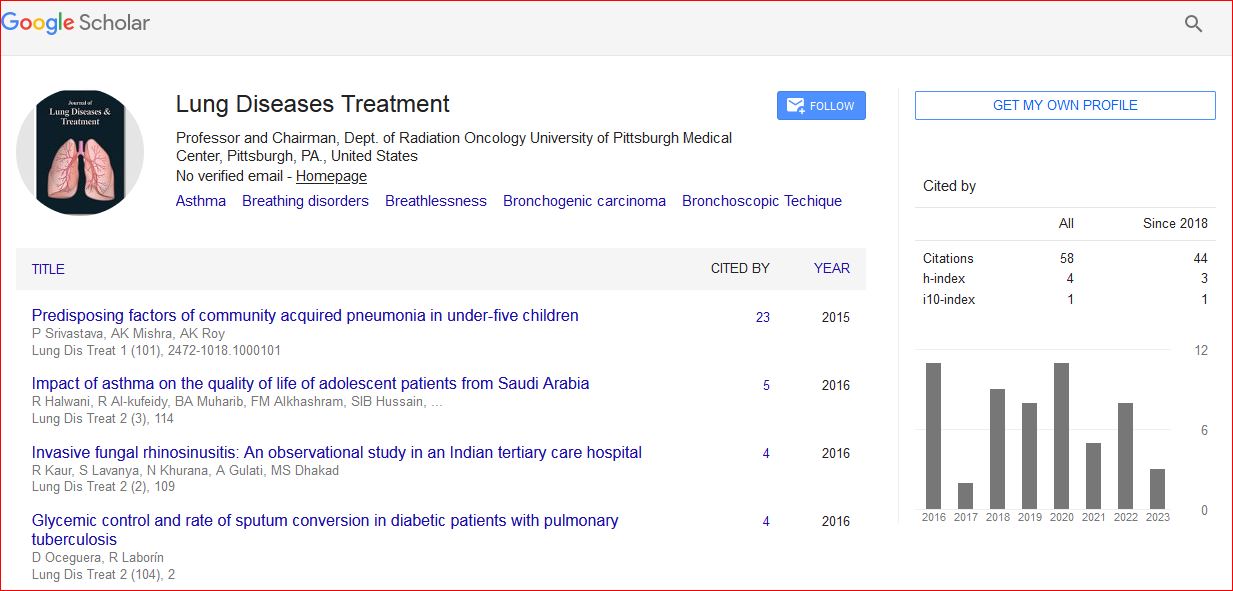
Journal of Lung Diseases & Treatment received 247 citations as per Google Scholar report