Short Communication - (2025) Volume 10, Issue 3
Received: 02-Jun-2025, Manuscript No. jcct-26-183218;
Editor assigned: 04-Jun-2025, Pre QC No. P-183218;
Reviewed: 18-Jun-2025, QC No. Q-183218;
Revised: 23-Jun-2025, Manuscript No. R-183218;
Published:
30-Jun-2025
, DOI: 10.37421/2577-0535.2025.9.316
Citation: Okoye, Samuel. ”Innovating Rare Cancer Trials: A Multi-faceted Approach.” J Cancer Clin Trials 10 (2025):316.
Copyright: © 2025 Okoye S. This is an open-access article distributed under the terms of the Creative Commons Attribution License, which permits unrestricted use, distribution and reproduction in any medium, provided the original author and source are credited.
Clinical trials for rare and orphan cancers are inherently challenging due to their limited patient populations, the heterogeneity of these diseases, and often insufficient funding, necessitating innovative trial designs and robust international collaboration to advance therapeutic development [1].
Understanding the molecular underpinnings of these rare conditions is paramount for developing effective targeted therapies, with genomic sequencing playing a crucial role in identifying actionable mutations and stratifying patients for more precise treatment strategies [2].
Adaptive clinical trial designs offer a flexible and efficient approach to drug development in rare cancers, allowing for modifications based on accumulating data such as sample size adjustments or dose changes, thereby maximizing information yield from limited patient cohorts [3].
Innovative designs like basket trials and umbrella trials are particularly well-suited for rare cancers, especially those driven by specific molecular alterations, enabling the evaluation of single drugs across multiple cancer types with a shared target or testing multiple agents within a single cancer type stratified by molecular profiles [4].
The regulatory landscape for rare cancer drug approvals is continually evolving, with expedited pathways and adaptive licensing being explored to facilitate timely patient access to promising therapies, while real-world evidence is increasingly important in supporting these regulatory decisions [5].
International collaboration is absolutely essential for rare cancer research, allowing for the pooling of limited patient resources and expertise, thereby enabling multi-center, multi-national trials that can accelerate recruitment and provide more statistically robust data by harmonizing protocols and data collection across regions [6].
The integration of artificial intelligence (AI) and machine learning (ML) holds significant promise for enhancing rare cancer clinical trials by assisting in patient stratification, predicting treatment responses, and optimizing trial designs, ultimately helping to identify novel therapeutic targets and accelerate drug discovery [7].
Patient advocacy groups are indispensable partners in the development of rare cancer clinical trials, providing critical insights into patient needs, facilitating recruitment through their extensive networks, and championing essential research funding to ensure trials prioritize patient well-being and reflect their needs [8].
Drug repurposing presents a highly viable strategy for developing treatments for rare cancers, as identifying existing drugs with potential efficacy against rare cancer subtypes can dramatically shorten development timelines and reduce costs by leveraging existing safety and pharmacokinetic data, making it an attractive option for conditions with limited therapeutic choices [9].
Precision medicine approaches, driven by comprehensive genomic profiling, are fundamentally transforming the landscape of rare cancer treatment by identifying specific driver mutations that allow for the selection of targeted therapies, leading to improved response rates and survival, though the challenge remains in translating these molecular insights into effective clinical trials for these limited patient populations [10].
Rare and orphan cancers present unique challenges for clinical trials, including small patient populations, disease heterogeneity, and limited funding, which collectively necessitate the adoption of innovative trial designs and extensive international collaboration to improve drug development and patient outcomes [1].
The development of targeted therapies for rare cancers fundamentally relies on a deep understanding of their molecular underpinnings, with genomic sequencing being an instrumental tool for identifying actionable mutations and guiding treatment selection [2].
Adaptive clinical trial designs provide a flexible framework for drug development in rare cancers, enabling modifications during the trial based on emerging data, such as adjusting sample sizes or doses, which is critical for maximizing the information gained from small patient cohorts and accelerating the evaluation of treatment efficacy [3].
Basket trials and umbrella trials represent innovative design strategies that are particularly advantageous for rare cancers, especially those characterized by specific molecular alterations, as they allow for the efficient evaluation of targeted therapies across patient groups with shared molecular drivers or within specific cancer types stratified by their molecular profiles [4].
The regulatory environment surrounding rare cancer drug development is adapting to these unique disease characteristics, with an increasing emphasis on expedited pathways and adaptive licensing to ensure timely patient access to potentially life-saving therapies, complemented by the growing importance of real-world evidence in supporting regulatory decisions [5].
Global collaboration is paramount in rare cancer research, facilitating the pooling of scarce patient resources and specialized expertise, thereby enabling multi-center, multi-national trials that can accelerate patient recruitment and generate more statistically robust data through harmonized trial protocols and data collection practices across different geographical regions [6].
The application of artificial intelligence (AI) and machine learning (ML) technologies holds considerable promise for advancing rare cancer clinical trials by aiding in patient stratification, predicting treatment responses, and optimizing trial designs, ultimately contributing to the identification of novel therapeutic targets and the acceleration of the drug discovery process [7].
Patient advocacy groups play an indispensable role in the development of rare cancer clinical trials, offering invaluable insights into patient needs, facilitating patient recruitment through their established networks, and actively championing research funding to ensure that trial designs prioritize patient well-being and reflect their essential priorities [8].
Drug repurposing offers a compelling strategy for the development of treatments for rare cancers, as it allows for the identification of existing drugs with potential efficacy against rare cancer subtypes, thereby significantly shortening development timelines and reducing associated costs by leveraging established safety and pharmacokinetic data, making it a highly attractive approach for conditions with limited therapeutic alternatives [9].
Precision medicine, underpinned by comprehensive genomic profiling, is revolutionizing rare cancer treatment by enabling the identification of specific driver mutations that guide the selection of targeted therapies, leading to improved response rates and enhanced survival, although the critical challenge remains in effectively translating these molecular insights into robust clinical trials capable of reaching the necessary limited patient populations [10].
Clinical trials for rare cancers face significant challenges including small patient numbers and disease heterogeneity, driving the need for innovative designs like adaptive, basket, and umbrella trials. Genomic profiling is crucial for identifying targetable mutations, enabling precision medicine approaches. International collaboration and patient advocacy are vital for resource pooling, recruitment, and ensuring patient-centered research. Regulatory pathways are evolving to expedite access to therapies, with real-world evidence gaining importance. Emerging technologies like AI and ML offer potential to optimize trial design and drug discovery. Drug repurposing is a cost-effective strategy for developing treatments. Overall, a multi-faceted approach combining innovative trial designs, advanced molecular understanding, global cooperation, and patient engagement is essential for advancing rare cancer therapeutics.
None
None
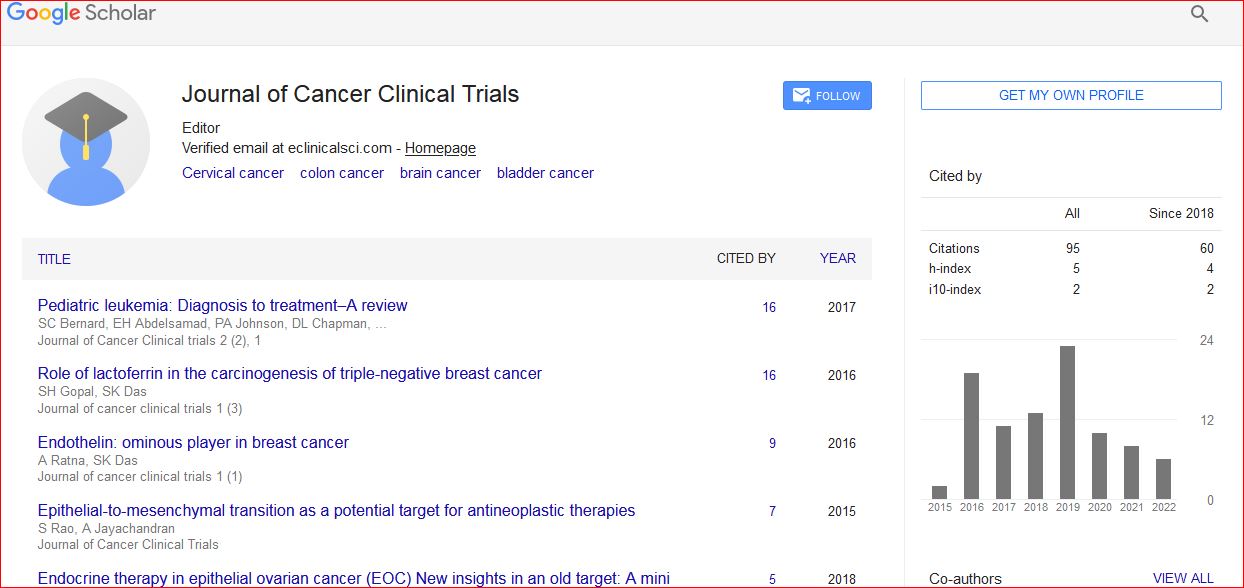
Journal of Cancer Clinical Trials received 95 citations as per Google Scholar report