Commentary - (2025) Volume 16, Issue 3
Received: 02-May-2025, Manuscript No. jhmi-26-178831;
Editor assigned: 05-May-2025, Pre QC No. P-178831;
Reviewed: 19-May-2025, QC No. Q-178831;
Revised: 23-May-2025, Manuscript No. R-178831;
Published:
30-May-2025
, DOI: 10.37421/2157-7420.2025.16.588
Citation: Rahman, Fatima S.. ”Informatics Tools For Reducing Medication Errors.” J Health Med Informat 16 (2025):588.
Copyright: © 2025 Rahman S. Fatima This is an open-access article distributed under the terms of the Creative Commons Attribution License, which permits unrestricted use, distribution and reproduction in any medium, provided the original author and source are credited.
Clinical informatics presents a robust framework for significantly reducing medication errors within healthcare systems. A primary strategy involves the widespread implementation of electronic health records (EHRs), which can be further enhanced by integrating clinical decision support systems (CDSS). These integrated systems are designed to flag potential drug-drug interactions, identify patient allergies, and alert clinicians to incorrect dosing, thereby bolstering patient safety. The introduction of automated dispensing cabinets (ADCs) and barcode medication administration (BCMA) systems represents another critical advancement, enhancing accuracy at the precise point where medications are administered to patients. Furthermore, the sophisticated analysis of data derived from EHRs offers invaluable insights into prevalent error patterns, enabling healthcare providers to systematically identify and implement necessary system improvements. The seamless integration of patient data across diverse care settings, facilitated by interoperable health information systems, is absolutely crucial for developing and maintaining a comprehensive and effective approach to medication safety. [1] Barcode medication administration (BCMA) has demonstrated a substantial capacity to reduce medication errors that occur at the patient bedside. This technology fundamentally ensures adherence to the 'five rights' of medication administration: the right patient, the right drug, the right dose, the right route, and the right time. This is achieved through the systematic scanning of patient wristbands and the medications themselves. While the implementation of BCMA may present certain challenges, the resulting benefits in terms of enhanced patient safety are undeniably significant and far-reaching. Continuous monitoring of BCMA usage and consistent feedback mechanisms are therefore vital for optimizing its performance and ensuring its sustained effectiveness in clinical practice. [2] Clinical decision support systems (CDSS), when effectively integrated into electronic prescribing (e-prescribing) platforms, assume a critical role in the proactive prevention of medication errors. These intelligent systems furnish prescribers with real-time alerts and actionable recommendations. They are designed to address potential issues such as dangerous drug interactions, the inadvertent prescription of duplicate therapies, and the administration of inappropriate doses, often based on a patient's unique clinical factors. The efficacy of CDSS is heavily contingent on their thoughtful design and meticulous implementation, which are paramount for minimizing alert fatigue among clinicians and maximizing the overall utility of these powerful tools. [3] The strategic deployment of automated dispensing cabinets (ADCs) within hospital settings demonstrably contributes to a safer medication management environment. ADCs play a key role in ensuring the accuracy of drug dispensing and are instrumental in reducing the risk of medication diversion. These systems are typically integrated with pharmacy information systems and frequently incorporate barcode scanning for verification purposes, a feature that significantly minimizes errors associated with manual filling and retrieval processes. The implementation of ADCs can lead to streamlined workflows and improved inventory control, enhancing overall operational efficiency. [4] Achieving interoperability among health information systems stands as a fundamental requirement for effectively reducing medication errors, particularly during critical transitions of care. When patient medication histories can be seamlessly and reliably shared between primary care physicians, hospitals, and pharmacies, it becomes possible to prevent dangerous omissions, avoid duplicative therapies, and mitigate adverse drug events. The establishment and widespread adoption of standardized data formats and robust communication protocols are absolutely essential prerequisites for attaining true and effective interoperability across the healthcare landscape. [5] Infusion pumps equipped with advanced safety features, most notably dose error reduction software (DERS), are indispensable for preventing medication errors that can occur during the intravenous administration of medications. DERS empowers healthcare professionals to program drug-specific libraries and set predefined limits, thereby establishing crucial safeguards against the incorrect programming of infusion rates and medication doses. Regular, diligent updates and ongoing maintenance of these sophisticated systems are unequivocally necessary to ensure their continued efficacy and reliability in clinical practice. [6] The meticulous analysis of medication error data, particularly when facilitated by advanced informatics tools, possesses the remarkable capacity to reveal critical system vulnerabilities. This analysis can then inform the development and implementation of highly targeted interventions. Methodologies such as root cause analysis (RCA), when augmented by sophisticated data mining techniques and rigorous statistical analysis, can effectively identify contributing factors that extend beyond individual blame. This approach ultimately leads to the implementation of more impactful and sustainable system-level changes. [7] Patient portals and personal health records (PHRs), when empowered by the capabilities of clinical informatics, can significantly enhance medication adherence and improve overall patient safety. These tools provide patients with direct access to their comprehensive medication lists and readily available educational resources. When patients are well-informed and actively engaged in their care, they are demonstrably more likely to identify and report discrepancies or potential errors, thus serving as a vital component of the overall patient safety net. [8] The application of artificial intelligence (AI) and machine learning (ML) within the domain of clinical informatics holds substantial promise for the proactive identification of patients who are at a heightened risk of experiencing medication errors. These advanced analytical techniques are capable of analyzing vast and complex datasets to accurately predict potential adverse drug events, identify prescribing errors before they manifest, and facilitate the personalization of medication regimens to achieve optimal safety outcomes. [9] The systematic development and diligent implementation of standardized medication reconciliation processes, critically supported by appropriate informatics tools, are absolutely essential for the effective prevention of errors that can arise during patient transitions between care settings. This vital process involves a thorough comparison of the patient's current medication regimen with newly prescribed medications to identify any discrepancies. Electronic tools can significantly streamline this complex process by automatically retrieving medication data from various sources and presenting it in a clear, organized format for review by healthcare professionals. [10]
Clinical informatics provides powerful technological tools that contribute significantly to the reduction of medication errors in healthcare settings. A cornerstone of this approach is the implementation of electronic health records (EHRs), often augmented with integrated clinical decision support systems (CDSS). These systems are engineered to identify potential drug-drug interactions, flag patient allergies, and alert clinicians to incorrect dosing, thereby enhancing patient safety. Furthermore, automated dispensing cabinets (ADCs) and barcode medication administration (BCMA) systems are pivotal in ensuring accuracy at the point of care, where medications are directly administered to patients. The analytical capabilities derived from EHR data allow for the identification of error patterns, which in turn informs necessary system improvements. Crucially, the ability to integrate patient data across different care settings through interoperable systems is fundamental to achieving a comprehensive and effective strategy for medication error reduction. [1] Barcode medication administration (BCMA) has been shown to significantly decrease medication errors at the patient's bedside. This technology fundamentally ensures that the 'five rights' of medication administrationâ??the right patient, right drug, right dose, right route, and right timeâ??are consistently met through the systematic scanning of patient wristbands and medication barcodes. While the implementation of BCMA may involve certain challenges, the substantial benefits it offers in terms of improving patient safety are undeniable. Therefore, continuous monitoring of BCMA usage and the provision of regular feedback are essential for maximizing its performance and ensuring its ongoing effectiveness in clinical practice. [2] Clinical decision support systems (CDSS) that are integrated into electronic prescribing (e-prescribing) platforms play a vital role in preventing medication errors. These systems provide prescribers with real-time alerts and guidance, addressing potential issues such as drug interactions, duplicate therapies, and inappropriate dosing, often taking into account patient-specific factors. The success of CDSS hinges on their effective design and thoughtful implementation to minimize alert fatigue among clinicians and maximize their practical utility. [3] The utilization of automated dispensing cabinets (ADCs) in hospitals contributes to safer medication management by ensuring accurate drug dispensing and minimizing the risk of diversion. ADCs are designed to integrate with pharmacy information systems and frequently employ barcode scanning for verification, which substantially reduces errors associated with manual filling and retrieval processes. The implementation of ADCs can lead to streamlined workflows and improved inventory control, enhancing operational efficiency. [4] Interoperability of health information systems is a critical element in reducing medication errors, especially during patient transitions of care. When patient medication histories are reliably shared among primary care providers, hospitals, and pharmacies, it helps prevent medication omissions, duplications, and adverse drug events. The widespread adoption of standardized data formats and communication protocols is essential for achieving effective interoperability across the healthcare continuum. [5] Infusion pumps equipped with advanced safety features, such as dose error reduction software (DERS), are crucial for preventing medication errors during intravenous drug administration. DERS allows for the programming of drug-specific libraries and limits, providing safeguards against incorrect programming of infusion rates and doses. Regular updates and diligent maintenance of these systems are necessary to ensure their continued efficacy and reliability in clinical practice. [6] The analysis of medication error data using informatics tools can effectively reveal system vulnerabilities and inform the development of targeted interventions. Root cause analysis (RCA), supported by data mining and statistical analysis, can identify contributing factors that extend beyond individual error, leading to more effective system-level improvements. This data-driven approach fosters a culture of continuous improvement in medication safety. [7] Patient portals and personal health records (PHRs), leveraging the capabilities of informatics, can enhance medication adherence and patient safety by providing patients with access to their medication lists and educational resources. When patients are informed and actively involved, they are more likely to report discrepancies and potential errors, thereby acting as a crucial part of the patient safety net. [8] The integration of artificial intelligence (AI) and machine learning (ML) in clinical informatics holds significant potential for the proactive identification of patients at high risk for medication errors. These advanced analytical techniques can process extensive datasets to predict adverse drug events, identify potential prescribing errors before they occur, and personalize medication regimens to improve safety. [9] The development and implementation of standardized medication reconciliation processes, supported by informatics tools, are essential for preventing errors during patient transitions. This process involves comparing a patient's current medication list with newly ordered medications to identify discrepancies. Electronic tools can greatly facilitate this by aggregating medication data from various sources and presenting it for review. [10]
Clinical informatics offers a suite of powerful tools and strategies to significantly reduce medication errors. Key technologies include electronic health records (EHRs) with integrated clinical decision support systems (CDSS), automated dispensing cabinets (ADCs), and barcode medication administration (BCMA) systems, all contributing to enhanced accuracy and safety at various stages of medication management. Data analytics derived from EHRs help identify error patterns for system improvements, while interoperable systems are crucial for seamless data sharing across care settings. Barcode medication administration (BCMA) directly impacts patient safety by ensuring the 'five rights' of administration. CDSS integrated into e-prescribing platforms provide real-time alerts for potential issues. ADCs streamline dispensing and reduce diversion risks. Interoperability is vital for preventing errors during care transitions. Smart infusion pumps with dose error reduction software (DERS) safeguard intravenous administrations. Analyzing medication error data through informatics tools aids in identifying system vulnerabilities and implementing targeted interventions. Patient portals and personal health records empower patients to actively participate in their medication management. Advanced analytics like AI and ML show promise in proactively identifying high-risk patients and predicting adverse events. Standardized medication reconciliation processes, supported by informatics, are essential for preventing errors during care transitions.
None
None
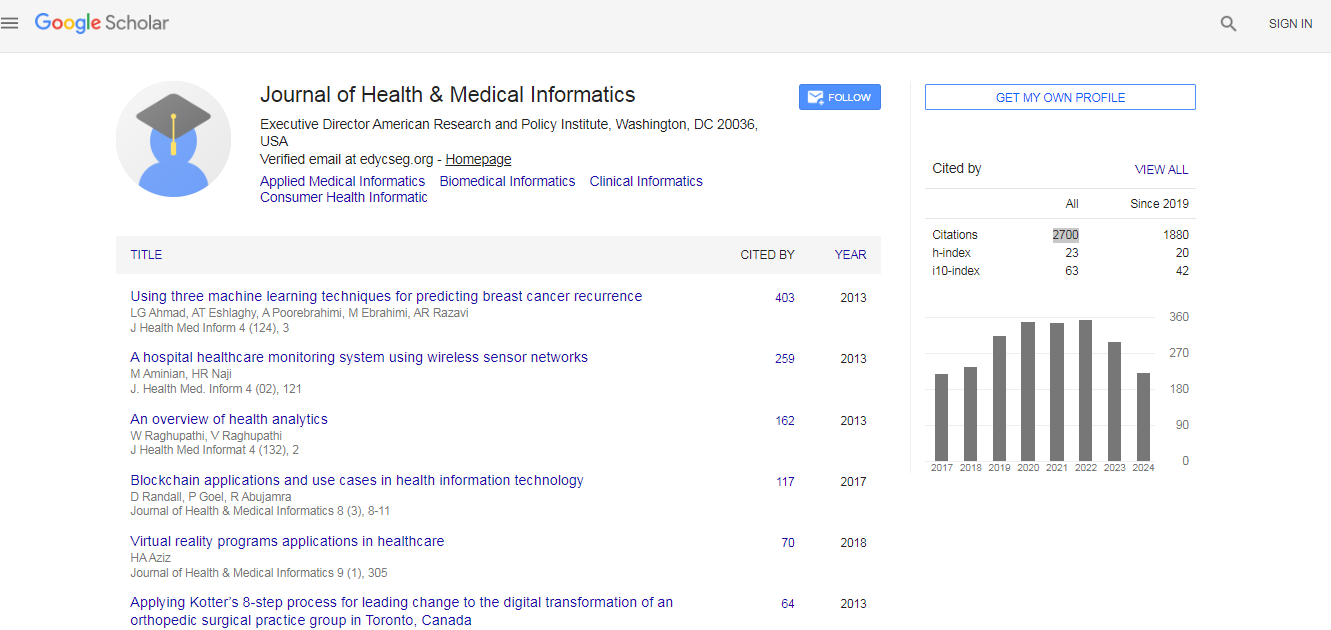
Journal of Health & Medical Informatics received 2700 citations as per Google Scholar report