Commentary - (2025) Volume 16, Issue 6
Received: 01-Nov-2025, Manuscript No. jhmi-26-178886;
Editor assigned: 03-Nov-2025, Pre QC No. P-178886;
Reviewed: 17-Nov-2025, QC No. Q-178886;
Revised: 24-Nov-2025, Manuscript No. R-178886;
Published:
29-Nov-2025
, DOI: 10.37421/2157-7420.2025.16.618
Citation: Al-Shehri, Khalid M.. ”Informatics Revolutionizing Healthcare For Equity.” J Health Med Informat 16 (2025):618.
Copyright: © 2025 Al-Shehri M. Khalid This is an open-access article distributed under the terms of the Creative Commons Attribution License, which permits unrestricted use, distribution and reproduction in any medium, provided the original author and source are credited.
The pervasive impact of informatics solutions on bridging healthcare disparities is a topic of growing significance and warrants thorough examination. These advanced technological tools are proving instrumental in identifying vulnerable patient populations, enabling the tailoring of interventions to specific needs, and ultimately improving overall access to quality healthcare services. A key emphasis is placed on the necessity of culturally sensitive design principles and equitable implementation strategies to ensure these technologies serve all individuals, particularly those historically underserved by conventional healthcare systems [1].
The potential of telehealth and remote monitoring technologies to overcome significant geographical and socioeconomic barriers in healthcare delivery is being increasingly explored. These informatics tools are vital in extending healthcare services to individuals residing in rural areas and marginalized communities, thereby enhancing chronic disease management and potentially reducing unnecessary hospitalizations. Nevertheless, the persistence of the digital divide, coupled with the need for robust infrastructure and digital literacy support, remains a critical consideration for maximizing their widespread impact [2].
Furthermore, the application of big data analytics and machine learning techniques within informatics is proving to be a powerful method for uncovering patterns of healthcare disparities. By meticulously analyzing extensive datasets, informatics can illuminate hidden trends in disease prevalence, variations in treatment access, and disparate health outcomes across diverse demographic groups. The insights derived from such analyses strongly advocate for data-driven policymaking to ensure that interventions are targeted effectively and that progress toward health equity is accelerated [3].
Electronic health records (EHRs) play a crucial role in supporting and advancing efforts aimed at reducing healthcare disparities. EHRs facilitate the systematic collection of data necessary for disparity analysis, improve the coordination of care for patients facing significant challenges, and enable the seamless integration of decision support tools specifically designed to promote equitable care practices. Despite these benefits, challenges related to data quality and interoperability across different systems continue to be addressed [4].
The utilization of mobile health (mHealth) applications is a burgeoning area of investigation, focusing on empowering patients and enhancing health literacy, especially within underserved communities. mHealth offers a pathway to provide readily accessible health information, streamline communication channels between patients and providers, and offer robust support for the self-management of chronic conditions, thereby contributing significantly to the reduction of health disparities. The importance of user-centered design and proactive efforts to address digital literacy gaps are paramount to its success [5].
The integration of social determinants of health (SDOH) data into informatics systems is a critical step toward effectively addressing healthcare disparities. Capturing and utilizing SDOH data provides a more holistic and nuanced understanding of patient needs and the complex social factors that contribute to poorer health outcomes. Strategies for the effective integration and application of this data are being developed to inform the design of more targeted and impactful interventions [6].
Concurrent with the technological advancements, the ethical considerations and inherent challenges associated with leveraging informatics to reduce healthcare disparities are coming under scrutiny. Issues surrounding data privacy, the potential for algorithmic bias, and the risk of exacerbating existing inequalities if implementations are not carefully managed are significant concerns. The adoption of a human-centered approach and the establishment of robust ethical frameworks are strongly advocated for [7].
Artificial intelligence (AI) is emerging as a powerful tool in identifying and mitigating inherent biases within healthcare delivery systems. AI algorithms, when trained on sufficiently diverse datasets, can significantly enhance diagnostic accuracy and refine treatment recommendations, particularly for underrepresented patient populations. However, the imperative for transparency and continuous monitoring of AI systems is paramount to prevent the inadvertent perpetuation of existing disparities [8].
A comprehensive review of patient-generated health data (PGHD) integration into clinical workflows highlights its potential to enhance patient engagement and actively address health disparities. PGHD offers invaluable insights into individuals' health status and lived experiences, paving the way for more personalized and equitable care delivery. The necessary informatics infrastructure for the effective collection and utilization of PGHD is a key area of development [9].
Finally, the development and deployment of culturally competent informatics tools and interventions are essential for reaching diverse and often marginalized patient populations. This encompasses the creation of patient portals and educational materials in multiple languages, the incorporation of culturally relevant imagery, and ensuring accessibility for individuals with varying levels of digital literacy. The overarching objective is to guarantee that informatics solutions actively promote, rather than inadvertently hinder, equitable health outcomes for all [10].
Informatics solutions are playing a pivotal role in addressing and reducing healthcare disparities by offering innovative ways to identify vulnerable populations and tailor interventions. Data analytics, artificial intelligence, and digital health platforms are at the forefront of these efforts, aiming to improve access to quality care. A critical component highlighted is the necessity for culturally sensitive design and equitable implementation to ensure that these technologies benefit all individuals, especially those in underserved communities [1].
Telehealth and remote monitoring technologies are being recognized for their substantial potential to overcome geographical and socioeconomic barriers in healthcare. These informatics tools serve to extend essential healthcare services to individuals in rural and marginalized areas, thereby improving the management of chronic diseases and potentially decreasing hospitalizations. However, challenges such as the digital divide, alongside the need for adequate infrastructure and digital literacy support, must be addressed to fully realize their impact [2].
The power of big data analytics and machine learning within informatics is being harnessed to identify and understand the complexities of healthcare disparities. Through the analysis of vast datasets, informatics can reveal subtle trends in disease prevalence, access to treatments, and health outcomes across various demographic segments. This underscores the importance of data-driven policy development to ensure effective intervention strategies and promote health equity [3].
Electronic health records (EHRs) are foundational tools supporting the reduction of healthcare disparities. They enable efficient data collection for disparity analysis, facilitate better care coordination for vulnerable patients, and allow for the deployment of decision support systems aimed at promoting equitable healthcare practices. Nevertheless, ongoing efforts are directed towards overcoming challenges related to data quality and system interoperability [4].
Mobile health (mHealth) applications are being investigated for their capacity to empower patients and enhance health literacy, particularly among underserved populations. By providing accessible health information, improving communication with healthcare providers, and supporting self-management of chronic conditions, mHealth contributes to narrowing health disparities. Emphasis is placed on user-centered design and addressing digital literacy gaps to maximize effectiveness [5].
The integration of social determinants of health (SDOH) data into informatics systems is crucial for a comprehensive approach to reducing disparities. Incorporating SDOH data offers a deeper understanding of patient needs and the social factors influencing health outcomes, guiding the development of more targeted interventions [6].
Ethical considerations surrounding the use of informatics in reducing healthcare disparities are paramount. Issues such as data privacy, the potential for algorithmic bias, and the risk of worsening existing inequalities necessitate careful attention. A human-centered approach and robust ethical frameworks are essential for responsible implementation [7].
Artificial intelligence (AI) holds significant promise in identifying and mitigating biases in healthcare delivery. By training AI algorithms on diverse datasets, improvements in diagnostic accuracy and treatment recommendations for underrepresented groups can be achieved. Transparency and continuous monitoring of AI systems are vital to prevent the perpetuation of disparities [8].
Patient-generated health data (PGHD) offers valuable opportunities for enhancing patient engagement and addressing healthcare disparities when integrated into clinical workflows. PGHD provides unique insights into individual health statuses and lived experiences, enabling more personalized and equitable care. The development of appropriate informatics infrastructure is key to its effective utilization [9].
Finally, the creation and implementation of culturally competent informatics tools are essential for reaching diverse and often marginalized populations. This involves developing multilingual patient portals and educational materials, using culturally relevant visuals, and ensuring accessibility for all users, regardless of their digital literacy levels. The ultimate aim is to ensure that informatics solutions foster health equity [10].
Informatics solutions are revolutionizing healthcare by addressing disparities through data analytics, AI, telehealth, and mHealth. These technologies help identify vulnerable populations, tailor interventions, and improve access to care, particularly for underserved communities. Electronic health records and the integration of social determinants of health data further enhance these efforts. Ethical considerations, including data privacy and algorithmic bias, are crucial. Patient-generated health data and culturally competent design are also vital for achieving health equity. Addressing the digital divide and promoting digital literacy are key to maximizing the impact of these advancements.
None
None
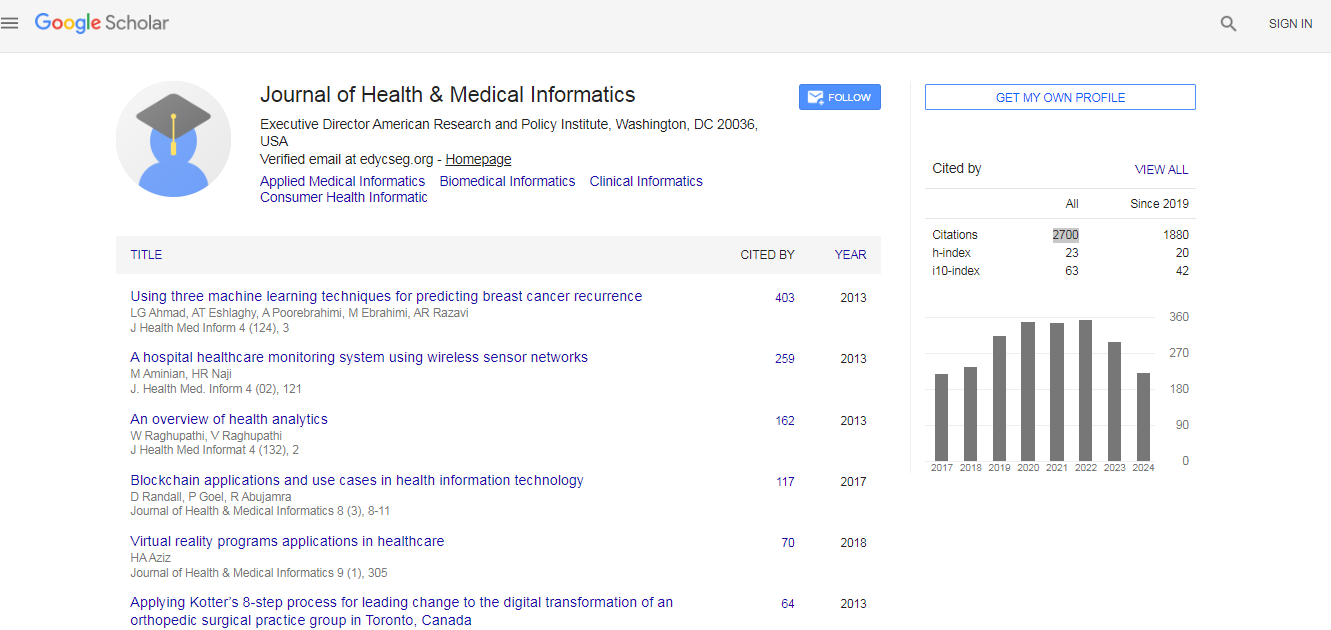
Journal of Health & Medical Informatics received 2700 citations as per Google Scholar report