Opinion - (2025) Volume 16, Issue 4
Received: 01-Jul-2025, Manuscript No. jhmi-26-178855;
Editor assigned: 03-Jul-2025, Pre QC No. P-178855;
Reviewed: 17-Jul-2025, QC No. Q-178855;
Revised: 22-Jul-2025, Manuscript No. R-178855;
Published:
29-Jul-2025
, DOI: 10.37421/2157-7420.2025.16.603
Citation: Morgan, Rebecca L.. ”Informatics: Powering Emergency and Critical Care.” J Health Med Informat 16 (2025):603.
Copyright: © 2025 Morgan L. Rebecca This is an open-access article distributed under the terms of the Creative Commons Attribution License, which permits unrestricted use, distribution and reproduction in any medium, provided the original author and source are credited.
Clinical informatics is an indispensable component in optimizing emergency and critical care settings. It significantly enhances patient data management, fostering improved communication among healthcare teams and supporting evidence-based decision-making processes. The implementation of electronic health records (EHRs), coupled with clinical decision support systems (CDSS) and advanced analytics, plays a pivotal role in predicting patient deterioration, streamlining workflows, and reducing the incidence of medical errors. The core objective revolves around real-time data capture and analysis to ensure timely and effective interventions, ultimately leading to improved patient outcomes and enhanced operational efficiency across these demanding environments [1].
The integration of real-time monitoring and predictive analytics within critical care environments offers substantial benefits. It enables the early identification of patients who are at risk of experiencing adverse events, such as sepsis or cardiac arrest. Informatics tools are crucial in facilitating the rapid aggregation of data from a multitude of sources, including bedside monitors and laboratory results, thereby empowering clinicians to make proactive treatment decisions. This data-driven approach is fundamental to improving survival rates and reducing the length of patient stays in intensive care units [2].
Effective communication and comprehensive care coordination within emergency and critical care settings are profoundly amplified by robust clinical informatics systems. These systems ensure that every member of the care team has access to the most current and accurate patient information, thereby mitigating the likelihood of communication breakdowns and preventing medical errors during critical transitions of care. Technologies such as secure messaging platforms and integrated EHR functionalities are instrumental in supporting seamless information exchange among all stakeholders [3].
The strategic application of clinical informatics within emergency departments (EDs) contributes to a more streamlined patient flow, enhances the accuracy of triage processes, and optimizes the efficiency of diagnostic and treatment procedures. Informatics tools are capable of supporting the rapid identification of patients presenting with time-sensitive conditions, enabling the prioritization of their care and facilitating quicker access to necessary resources. This, in turn, leads to reduced ED wait times and an overall improvement in patient satisfaction [4].
Clinical decision support systems (CDSS), when integrated within EHRs, offer real-time alerts and actionable recommendations to clinicians operating in emergency and critical care. These systems are designed to prevent medication errors, identify potential drug interactions, and ensure strict adherence to established evidence-based guidelines, particularly within complex and rapidly evolving clinical scenarios. The overarching goal is to augment clinician judgment and significantly enhance patient safety [5].
The application of big data analytics and artificial intelligence in the realm of critical care opens avenues for discovering novel patterns and deriving insightful knowledge that can inform treatment strategies and refine prognostication. By meticulously analyzing extensive datasets of patient information, informatics can detect subtle indicators of disease progression or treatment response, paving the way for more personalized and effective care plans tailored to individual patient needs [6].
Mobile health technologies and wearable devices are increasingly finding their place in emergency and critical care settings. Their integration facilitates continuous patient monitoring and enables rapid data transmission, providing real-time physiological data. This capability is crucial for the earlier detection of changes in patient status, allowing for more timely and appropriate interventions, especially in pre-hospital or remote care scenarios where direct supervision may be limited [7].
The development and widespread implementation of standardized terminologies and data models are absolutely essential for achieving interoperability and enabling meaningful data exchange within the domain of clinical informatics in emergency and critical care. This standardization ensures that data collected across disparate systems and various institutions can be consistently understood and effectively utilized for research, quality improvement initiatives, and informed clinical decision-making [8].
Patient safety is consistently a paramount concern in the high-stakes environments of emergency and critical care, and clinical informatics plays an undeniably vital role in the mitigation of associated risks. Through features such as automated alerts for critical laboratory values, comprehensive drug interaction checks, and real-time patient tracking, informatics systems actively contribute to preventing adverse events and ensuring that patients receive the timely and appropriate care they require, especially during periods of extreme stress [9].
The burgeoning volume and inherent complexity of data generated within emergency and critical care settings necessitate the deployment of advanced informatics solutions for effective management and insightful analysis. Telehealth and remote monitoring technologies, underpinned by a robust informatics infrastructure, are instrumental in expanding the reach of critical care services. They also enable more efficient patient management, particularly benefiting underserved populations or during periods of public health emergencies [10].
Clinical informatics plays a pivotal role in enhancing emergency and critical care settings by optimizing patient data management, thereby fostering improved communication among healthcare teams and supporting evidence-based decision-making. The integration of electronic health records (EHRs), clinical decision support systems (CDSS), and advanced analytics is crucial for predicting patient deterioration, streamlining workflows, and reducing the incidence of medical errors. The primary focus is on real-time data capture and analysis to ensure that interventions are both timely and effective, ultimately leading to improved patient outcomes and enhanced operational efficiency within these critical environments [1].
In critical care settings, the integration of real-time monitoring and predictive analytics is instrumental in enabling the early identification of patients at elevated risk of adverse events, such as sepsis or cardiac arrest. Advanced informatics tools facilitate the rapid aggregation of data from diverse sources, including bedside monitors and laboratory results, empowering clinicians to make proactive and informed treatment decisions. This data-centric approach is fundamentally important for augmenting survival rates and diminishing the length of patient stays in intensive care units [2].
Robust clinical informatics systems significantly bolster effective communication and comprehensive care coordination within emergency and critical care environments. These systems guarantee that all members of the care team have consistent access to the most up-to-date patient information, thereby minimizing the potential for communication lapses and preventing medical errors during critical care transitions. Technologies like secure messaging platforms and integrated EHR functionalities are vital for facilitating seamless information exchange among all care providers [3].
The strategic deployment of clinical informatics within emergency departments (EDs) serves to streamline patient flow, enhance the accuracy of triage assessments, and improve the overall efficiency of diagnostic and treatment processes. Informatics tools are adept at supporting the swift identification of patients presenting with time-sensitive conditions, facilitating the prioritization of their care, and expediting access to necessary medical resources. This leads to a reduction in ED wait times and an improvement in overall patient satisfaction [4].
Clinical decision support systems (CDSS) embedded within electronic health records (EHRs) are designed to furnish clinicians in emergency and critical care with real-time alerts and pertinent recommendations. These systems are pivotal in preventing medication errors, identifying potential drug interactions, and ensuring strict adherence to evidence-based clinical guidelines, particularly in situations characterized by complexity and rapid clinical changes. The core objective is to enhance clinician judgment and elevate patient safety [5].
The application of big data analytics and artificial intelligence within critical care settings facilitates the discovery of novel patterns and insights that can profoundly inform treatment strategies and improve patient prognostication. Through the comprehensive analysis of extensive patient data, informatics can identify subtle indicators of disease progression or variations in treatment response, thereby enabling the development of more individualized and effective care plans [6].
Mobile health technologies and wearable devices are increasingly being incorporated into emergency and critical care settings to support continuous patient monitoring and enable rapid data transmission. These tools offer real-time physiological data, which is crucial for the earlier detection of changes in a patient's condition and allows for more timely interventions, especially in pre-hospital or remote care scenarios where immediate clinical oversight may be challenging [7].
The establishment and adoption of standardized terminologies and data models are critical prerequisites for achieving interoperability and enabling meaningful data exchange within the context of clinical informatics in emergency and critical care. This standardization ensures that data captured from different systems and institutions can be accurately interpreted and effectively utilized for research purposes, quality improvement initiatives, and informed clinical decision-making [8].
Patient safety remains a paramount consideration in the demanding fields of emergency and critical care. Clinical informatics contributes significantly to risk mitigation through features such as automated alerts for critical laboratory values, comprehensive drug interaction checks, and real-time patient tracking. These functionalities help prevent adverse events and ensure that patients receive the timely and appropriate care they need, especially during high-stress clinical situations [9].
The escalating volume and complexity of data generated in emergency and critical care environments underscore the necessity for advanced informatics solutions for effective management and analysis. Telehealth and remote monitoring technologies, supported by a robust informatics infrastructure, are expanding the accessibility of critical care services and promoting more efficient patient management, particularly in underserved geographical areas or during public health crises [10].
Clinical informatics is essential for emergency and critical care, improving data management, team communication, and evidence-based decision-making. Technologies like EHRs, CDSS, and analytics help predict deterioration, streamline workflows, and reduce errors, leading to better patient outcomes. Real-time monitoring and predictive analytics in critical care allow for early identification of at-risk patients, facilitating proactive treatment. Effective communication and care coordination are enhanced by informatics systems providing access to up-to-date patient information. In EDs, informatics streamlines patient flow and improves triage accuracy. CDSS within EHRs provide real-time alerts to prevent medication errors and ensure guideline adherence. Big data analytics and AI uncover patterns to inform treatment and prognostication. Mobile health and wearables enable continuous monitoring and rapid data transmission. Standardized terminologies are crucial for interoperability and data exchange. Informatics significantly contributes to patient safety by mitigating risks through alerts and tracking. Telehealth and remote monitoring expand critical care services and improve patient management, especially in underserved areas.
None
None
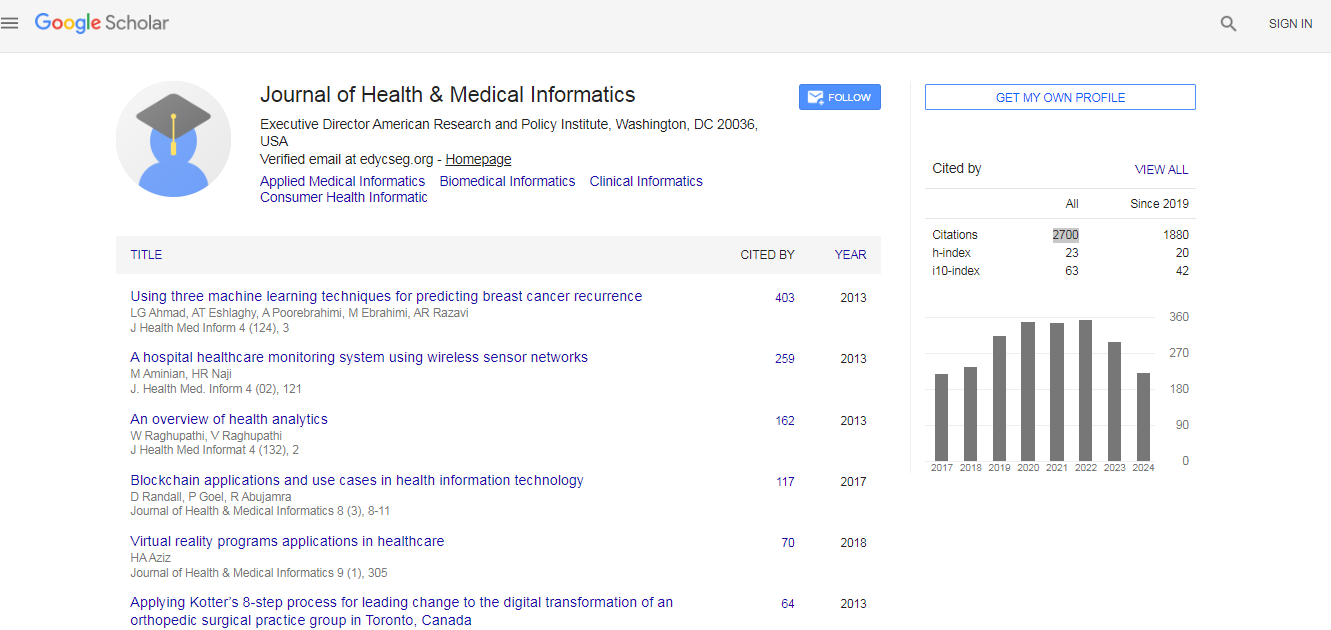
Journal of Health & Medical Informatics received 2700 citations as per Google Scholar report