Opinion - (2025) Volume 16, Issue 5
Received: 01-Sep-2025, Manuscript No. jhmi-26-178873;
Editor assigned: 03-Sep-2025, Pre QC No. P-178873;
Reviewed: 17-Sep-2025, QC No. Q-178873;
Revised: 22-Sep-2025, Manuscript No. R-178873;
Published:
29-Sep-2025
, DOI: 10.37421/2157-7420.2025.16.613
Citation: Diallo, Amina K.. ”Informatics Drives Efficiency, Integrity in Clinical Trials.” J Health Med Informat 16 (2025):612.
Copyright: © 2025 Diallo K. Amina This is an open-access article distributed under the terms of the Creative Commons Attribution License, which permits unrestricted use, distribution and reproduction in any medium, provided the original author and source are credited.
The burgeoning field of clinical trial management is undergoing a profound transformation, driven by the integration of informatics principles and advanced technologies. These advancements are not merely incremental; they represent a paradigm shift in how research is conducted, data is managed, and outcomes are achieved. The core of this revolution lies in the strategic application of information science to streamline complex processes, enhance data integrity, and ultimately accelerate the delivery of life-saving therapies to patients. This evolving landscape necessitates a deep understanding of the tools and methodologies that are reshaping the clinical trial ecosystem [1].
The practical implementation of informatics solutions is particularly evident in the adoption of electronic health records (EHRs). These systems are becoming indispensable for capturing patient data directly at the source, minimizing manual transcription errors and providing a more holistic view of patient histories relevant to trial participation. The seamless integration of EHRs into clinical workflows is crucial for improving the quality and reliability of the data collected throughout a trial's lifecycle [2].
Further pushing the boundaries of data utilization, the power of big data analytics and artificial intelligence (AI) is being harnessed to identify suitable patient populations for clinical trials and to predict potential trial outcomes. By leveraging sophisticated computational methods on vast datasets, researchers can achieve greater precision in patient stratification, enabling more targeted recruitment and increasing the likelihood of trial success. This approach also aids in the early detection of adverse events and optimizes trial design [3].
In the highly regulated environment of clinical research, informatics plays a pivotal role in ensuring adherence to stringent guidelines. Centralized data repositories, robust audit trails, and electronic signatures are essential components that facilitate compliance with the demanding requirements set forth by regulatory bodies such as the FDA and EMA. Effective informatics systems are therefore critical for the successful submission and approval of trial results [4].
The complexities of multi-center clinical trials, which often involve data from numerous disparate sites and systems, highlight the critical need for interoperability. Achieving seamless data flow and aggregation across these diverse platforms requires standardized data formats and communication protocols. Informatics solutions are key to overcoming these integration challenges and fostering more effective collaborative research endeavors [5].
The advent of mobile health (mHealth) technologies has opened new avenues for remote patient monitoring within clinical trials. By utilizing mobile devices and wearable sensors, researchers can gather real-time physiological data, enhance patient adherence to trial protocols, and reduce the logistical burden associated with frequent site visits. mHealth offers the potential to broaden trial accessibility and collect more comprehensive datasets [6].
Emerging technologies like blockchain are being explored for their potential to revolutionize clinical trial data management by enhancing security, transparency, and immutability. Distributed ledger technology can create a secure and auditable record of trial data, thereby mitigating risks of fraud and tampering. This has significant implications for secure data sharing and robust patient privacy protection [7].
Cloud computing is increasingly recognized for its ability to support efficient clinical trial operations. Cloud-based platforms provide scalable, flexible, and cost-effective solutions for data storage, processing, and collaboration. The benefits include improved accessibility to trial data, enhanced disaster recovery capabilities, and streamlined operational workflows, making it an attractive option for modern trial management [8].
Despite the significant technological advancements, ethical considerations and data privacy remain paramount in informatics-driven clinical trial management. The implementation of robust anonymization techniques, secure data handling practices, and strict adherence to privacy regulations like GDPR are essential to safeguard patient information while facilitating efficient research [9].
Looking ahead, the field of informatics for clinical trials is poised for further innovation with emerging technologies such as federated learning, digital twins, and advanced simulation tools. These future trends promise to further transform trial design, execution, and analysis, paving the way for more personalized and effective therapeutic development strategies [10].
Informatics principles are fundamentally reshaping the landscape of clinical trial management, focusing on enhancing efficiency and accelerating the drug development pipeline. This evolution is driven by sophisticated data management systems, electronic data capture (EDC) tools, and advanced data analytics, all of which contribute to improving data integrity and streamlining trial processes. Key benefits include real-time data monitoring capabilities and improved patient recruitment and retention strategies through the innovative application of informatics solutions. However, challenges related to data standardization and achieving interoperability across diverse systems remain significant areas of focus [1].
The practical integration of informatics is vividly illustrated by the widespread adoption of electronic health records (EHRs) in clinical trials. These systems are instrumental in optimizing the collection of clinical trial data by streamlining data abstraction processes and significantly reducing the incidence of manual entry errors. By providing a more comprehensive patient history, EHRs contribute to a substantial increase in the quality of trial data, while also necessitating careful attention to data security and privacy protocols within these integrated systems [2].
Advancements in big data analytics and artificial intelligence (AI) are revolutionizing the identification of appropriate patient cohorts for clinical trials and enhancing the predictability of trial outcomes. These powerful computational methods enable the analysis of extensive datasets, leading to more precise patient stratification, earlier detection of adverse events, and the optimization of trial designs, thereby improving the overall probability of successful trial completion. Ethical considerations associated with AI deployment in this domain are also a critical aspect of ongoing research [3].
The critical role of informatics in ensuring regulatory compliance within clinical trials cannot be overstated. Informatics systems, through features such as centralized data repositories, comprehensive audit trails, and the implementation of electronic signatures, provide the necessary infrastructure to meet the rigorous demands of regulatory agencies like the FDA and EMA. Well-managed informatics platforms are indispensable for the successful navigation of trial submissions and approval processes [4].
Addressing the complexities inherent in multi-center clinical trials, informatics offers crucial solutions for achieving system interoperability. The integration of data from geographically dispersed sites and disparate systems presents a significant challenge, which is being tackled through the emphasis on standardized data formats and communication protocols. These standardization efforts are vital for enabling seamless data flow and aggregation, thereby enhancing collaborative research capabilities [5].
Mobile health (mHealth) technologies are transforming remote patient monitoring in clinical trials by enabling the collection of real-time physiological data through mobile devices and wearable sensors. This approach not only improves patient adherence to trial protocols but also significantly reduces the operational burden associated with traditional site visits. The potential of mHealth to expand trial accessibility and yield richer datasets is substantial [6].
The application of blockchain technology in clinical trial data management is gaining traction due to its inherent capabilities for enhancing data security, transparency, and immutability. By leveraging distributed ledger technology, a secure and auditable record of trial data can be established, effectively minimizing the risks associated with fraud and data tampering. This technology holds significant promise for improving data sharing practices and strengthening patient privacy [7].
Cloud computing is emerging as a pivotal technology for enhancing the efficiency of clinical trial operations. Cloud-based platforms offer highly scalable, flexible, and cost-effective solutions for critical functions such as data storage, processing, and collaborative activities. Key advantages include improved data accessibility for all stakeholders, robust disaster recovery mechanisms, and the streamlining of operational workflows, all of which contribute to more efficient trial execution [8].
In the context of informatics-driven clinical trial management, ethical considerations and data privacy challenges are of paramount importance. The implementation of advanced anonymization techniques, stringent secure data handling practices, and unwavering compliance with privacy regulations such as GDPR are essential. Establishing a comprehensive ethical framework is crucial for safeguarding patient data while simultaneously enabling the effective advancement of research initiatives [9].
Looking towards the future, the informatics landscape for clinical trials is characterized by the emergence of innovative technologies and approaches. Trends such as federated learning, digital twins, and sophisticated simulation tools are set to further revolutionize trial design, execution, and analysis. These advancements are anticipated to drive the development of more personalized and effective therapeutic interventions [10].
This collection of research explores the significant impact of informatics on clinical trial management. Key areas of focus include the use of data management systems, electronic data capture (EDC) tools, and data analytics to enhance efficiency and data integrity. The integration of electronic health records (EHRs) is highlighted for its role in streamlining data collection and reducing errors. Advancements in big data analytics and AI are being applied to improve patient stratification and predict trial outcomes. The importance of informatics for regulatory compliance, ensuring data security, and meeting stringent guidelines is emphasized. Furthermore, the challenges and solutions for achieving interoperability in multi-center trials are discussed, alongside the growing role of mobile health (mHealth) for remote patient monitoring. The potential of blockchain technology for enhancing data security and transparency is examined, as is the contribution of cloud computing to efficient trial operations. Ethical considerations and data privacy in informatics-driven trials are addressed, with a look towards future trends such as federated learning and digital twins poised to further transform therapeutic development.
None
None
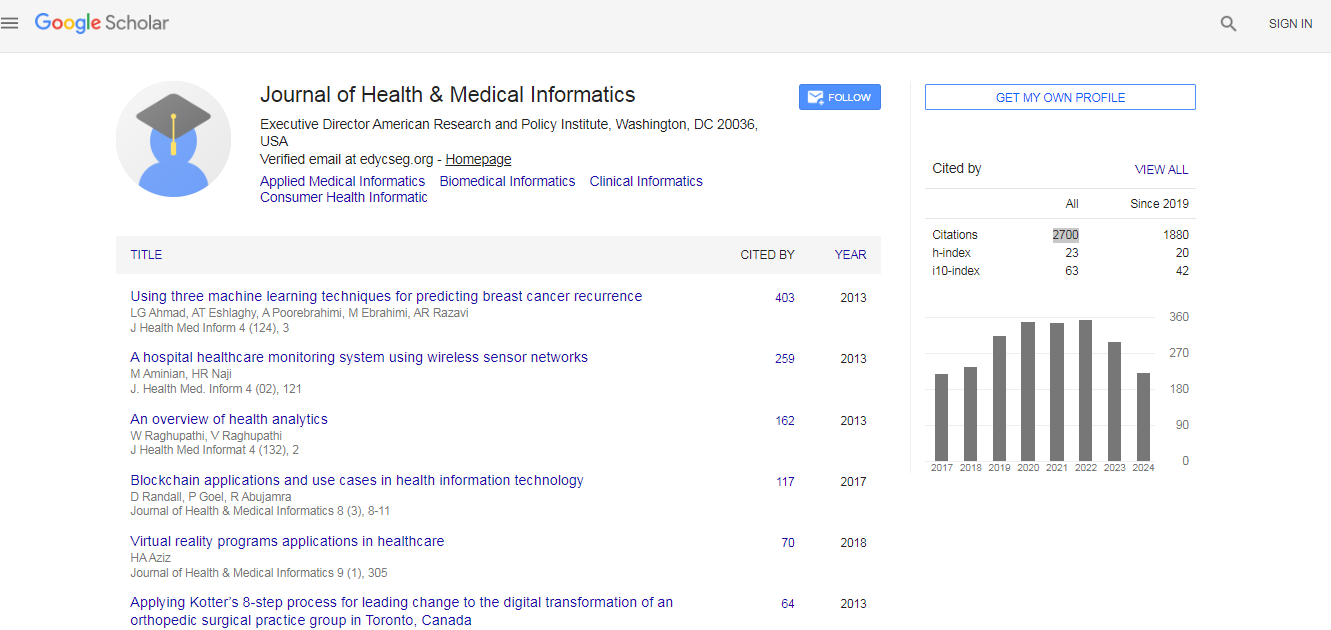
Journal of Health & Medical Informatics received 2700 citations as per Google Scholar report