Commentary - (2025) Volume 8, Issue 2
Received: 01-Apr-2025, Manuscript No. pollution-25-176596;
Editor assigned: 03-Apr-2025, Pre QC No. P-176596;
Reviewed: 17-Apr-2025, QC No. Q-176596;
Revised: 22-Apr-2025, Manuscript No. R-176596;
Published:
29-Apr-2025
, DOI: 10.37421/2684-4958.2025.8.375
Citation: Brooks, Alexander. ”Industrial Noise: Pervasive Health Risks, Smart Solutions.” Pollution 08 (2025):375.
Copyright: © 2025 Brooks A. This is an open-access article distributed under the terms of the Creative Commons Attribution License, which permits unrestricted use,
distribution and reproduction in any medium, provided the original author and source are credited.
Industrial environments expose workers to noise, threatening human health. Research clarifies these impacts. A meta-analysis links occupational noise exposure to increased hypertension risk, highlighting the need for noise control to protect cardiovascular health [1].
Occupational noise-induced hearing loss remains a critical concern. A systematic review and meta-analysis shows an alarmingly high prevalence among industrial workers. This finding emphasizes the urgent need for comprehensive hearing conservation programs and stricter enforcement of noise exposure limits to mitigate this challenge [3].
Beyond hearing loss, industrial noise exposure in industrial settings correlates with non-auditory health issues. A comprehensive review and meta-analysis confirms increased risks of cardiovascular disease, metabolic disorders, and mental health issues. This shows industrial noise profoundly impacts worker well-being beyond hearing damage [5].
Industrial noise also affects cognitive performance and perceived workload. A systematic review demonstrates that high noise levels impair attention, memory, and decision-making. This leads to reduced productivity and heightened workplace stress [7].
Industrial noise impacts not only workers but also surrounding communities. This often causes significant annoyance and dissatisfaction among residents. A systematic review investigates factors contributing to this community annoyance, citing sound characteristics, individual sensitivity, and contextual elements. This research stresses the need for comprehensive impact assessments beyond mere decibel levels [4].
Addressing these noise challenges demands innovative control and mitigation strategies. Active noise control (ANC) for industrial machinery is promising. An article explores an ANC method leveraging a convolutional neural network. This advanced approach effectively reduces noise, suggesting new engineering solutions for industrial noise abatement [2].
Passive noise control, through sound absorption materials, is also vital. A recent review details developments in these materials and structures, essential for effective industrial noise reduction. It explores innovative designs and compositions, offering insights for more efficient mitigation [8].
Accurate identification and real-time monitoring of noise sources are fundamental for successful management. Machine learning techniques are powerful tools in this area. A comprehensive review highlights their application for identifying and predicting industrial noise sources, improving noise mapping precision. This leads to more targeted control strategies in complex settings [6].
Internet of Things (IoT)-based smart sensing systems are revolutionizing real-time industrial noise monitoring. A review explores their critical role, demonstrating continuous, accurate data provision. These capabilities enable proactive noise management and effective compliance with occupational safety regulations [10].
Finally, understanding intervention efficacy guides policy. A systematic review assesses various occupational noise control interventions in industrial settings. It offers critical insights into effective strategies and areas needing improvement. This evidence informs better policy decisions and enhances worker protection approaches [9].
Industrial noise exposure represents a serious and far-reaching public health challenge, directly affecting workers and contributing to significant environmental burdens. Extensive research, including a recent meta-analysis, has established a compelling link between occupational noise exposure and an increased risk of hypertension among industrial workers. This finding critically underscores the need for robust preventative measures and effective noise control strategies within industrial settings to proactively safeguard workers' cardiovascular health [1]. This pervasive threat is further exacerbated by the alarmingly high prevalence of occupational noise-induced hearing loss (ONIHL) globally, as confirmed by a systematic review and meta-analysis. This situation urgently calls for the implementation of comprehensive hearing conservation programs and the rigorous enforcement of stricter noise exposure limits to mitigate this widespread and debilitating health issue [3]. Moreover, the impact of industrial noise extends beyond the auditory system; a comprehensive review and meta-analysis conclusively demonstrates its association with a spectrum of non-auditory health problems. These include heightened risks of cardiovascular disease, metabolic disorders, and various mental health issues, collectively highlighting industrial noise's profound and systemic influence on overall worker well-being, far surpassing localized hearing damage [5]. The insidious effects of industrial noise also significantly impair cognitive performance and elevate subjective workload within the industrial environment. A systematic review meticulously found that sustained exposure to elevated noise levels can profoundly disrupt critical cognitive functions such as attention, memory recall, and effective decision-making. This cognitive interference directly translates into reduced worker productivity and an exacerbated sense of stress and fatigue in the workplace [7]. Beyond the immediate work environment, industrial noise is not contained within factory walls; it invariably extends into surrounding residential areas, frequently leading to considerable community annoyance and dissatisfaction. A comprehensive systematic review investigated the complex interplay of factors influencing this community annoyance, highlighting that specific sound characteristics, individual sensitivities, and broader contextual factors all significantly shape residents' perceptions and levels of dissatisfaction. This research strongly advocates for comprehensive impact assessments that consider these qualitative and subjective aspects, moving beyond mere quantitative decibel readings to fully understand and address community concerns [4]. To effectively counter these pervasive and detrimental noise issues, substantial advancements are being achieved in innovative noise control technologies. Active noise control (ANC) methods, in particular, show remarkable promise for mitigating noise from industrial machinery. One notable article specifically explores an innovative ANC approach that intelligently leverages a convolutional neural network. This sophisticated, data-driven methodology has demonstrated considerable potential in effectively reducing noise levels, thereby carving out a new and impactful direction for engineering solutions dedicated to industrial noise abatement [2]. Complementing these active intervention strategies, continuous progress in passive noise control through the development of advanced sound absorption materials and structures is equally vital. A recent comprehensive review meticulously details the latest developments in these essential materials, exploring innovative designs and optimized material compositions that are critical for achieving highly efficient noise mitigation within complex industrial environments [8]. The strategic integration of both active reduction techniques with passive absorption materials offers a robust and comprehensive strategy for effectively managing industrial noise at its sources and throughout the surrounding environment. Successful and sustainable industrial noise management fundamentally relies on precise identification, continuous monitoring, and strategically planned interventions. Machine learning techniques are experiencing burgeoning application in this domain, providing powerful tools for accurately identifying and predicting industrial noise sources. This enhances the precision of noise mapping efforts and directly facilitates the development of more targeted and ultimately more effective control strategies, especially in complex and dynamic industrial settings [6]. Parallel to this, the integration of Internet of Things (IoT)-based smart sensing systems is profoundly transforming real-time industrial noise monitoring. A dedicated review explores the critical and emerging role of these systems, demonstrating their unparalleled capacity to provide continuous, highly accurate, and actionable noise data. Such robust capabilities are instrumental for enabling truly proactive noise management strategies and ensuring stringent compliance with occupational safety regulations, shifting from reactive responses to preventative oversight [10]. Furthermore, systematically evaluating the efficacy of implemented interventions is crucial for continuous improvement. A comprehensive systematic review critically assessed various occupational noise control interventions, offering vital insights into which strategies have proven significantly effective in reducing noise exposure. Critically, it also identified specific areas that still require further development and refinement, providing an evidence-based foundation for informing better policy decisions and continuously enhancing practical approaches to worker protection against the pervasive threat of industrial noise [9]. This integrated approach encompassing advanced detection, real-time monitoring, and evidence-based intervention is paramount for achieving sustainable and effective noise reduction.
The persistent challenge of industrial noise profoundly affects both workers and surrounding communities. Extensive research confirms that occupational noise exposure leads to serious health consequences, extending far beyond hearing damage. Meta-analyses reveal a significant link between industrial noise and increased hypertension risk, alongside an alarmingly high prevalence of occupational noise-induced hearing loss among workers globally. Beyond auditory issues, industrial noise contributes to various non-auditory health problems, including elevated risks of cardiovascular disease, metabolic disorders, and mental health issues. Workers also experience impaired cognitive performance, affecting attention, memory, and decision-making, which in turn reduces productivity and heightens workplace stress. The effects are not limited to the workplace. Communities near industrial sites often experience significant annoyance influenced by sound characteristics, individual sensitivity, and contextual factors, underscoring the need for comprehensive impact assessments beyond mere decibel levels. Addressing these widespread issues requires multifaceted approaches to noise control and management. Innovations like active noise control, utilizing convolutional neural networks, show promise for effectively reducing noise levels in industrial machinery. Machine learning applications are proving valuable for accurately identifying and predicting noise sources, leading to more targeted mitigation strategies. Moreover, advancements in sound absorption materials and structures are critical for developing more efficient noise control solutions. Evaluations of occupational noise control interventions highlight successful strategies and areas needing improvement to better protect workers. The adoption of Internet of Things (IoT)-based smart sensing systems enables real-time noise monitoring, providing continuous, accurate data for proactive noise management and compliance with safety regulations. These findings collectively emphasize the urgent need for stringent noise exposure limits, comprehensive conservation programs, and continued investment in technological and engineering solutions to safeguard public health and worker well-being.
None
None
Indexed at, Google Scholar, Crossref
Indexed at, Google Scholar, Crossref
Indexed at, Google Scholar, Crossref
Indexed at, Google Scholar, Crossref
Indexed at, Google Scholar, Crossref
Indexed at, Google Scholar, Crossref
Indexed at, Google Scholar, Crossref
Indexed at, Google Scholar, Crossref
Indexed at, Google Scholar, Crossref
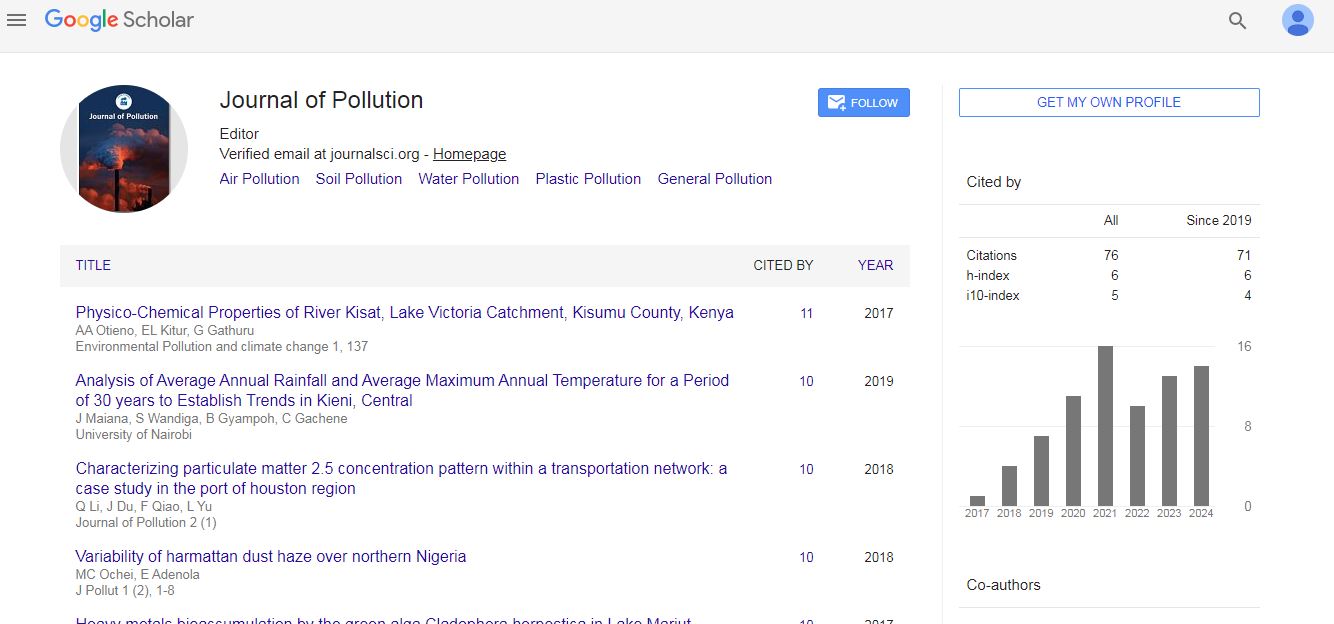
Journal of Pollution received 64 citations as per Google Scholar report