Brief Report - (2025) Volume 15, Issue 5
Received: 01-Sep-2025, Manuscript No. jccr-25-173655;;
Editor assigned: 03-Sep-2025, Pre QC No. P-173655;;
Reviewed: 17-Sep-2025, QC No. Q-173655;;
Revised: 22-Sep-2025, Manuscript No. R-173655;;
Published:
29-Sep-2025
, DOI: 10.37421-2165-7920.2025.15.1682
Citation: Herrera, Nathaniel. ”Indispensable Pathology for Complex, Rare Diagnoses.” J Clin Case Rep 15 (2025):1682.
Copyright: © 2025 Herrera N. This is an open-access article distributed under the terms of the Creative Commons Attribution License, which permits unrestricted use, distribution and reproduction in any medium, provided the original author and source are credited.
This case report details a rare instance of a giant cell tumor of bone coexisting with a secondary aneurysmal bone cyst in the proximal tibia of a 30-year-old female. Clinical pathology played a crucial role in distinguishing this complex presentation through histological and imaging studies, highlighting the importance of thorough pathological examination for accurate diagnosis and tailored treatment strategies in challenging musculoskeletal tumors [1].
This case report describes a patient diagnosed with Mycobacterium abscessus complex infection that clinically and histologically mimicked Crohn's disease, leading to a significant diagnostic delay. Clinical pathology, particularly advanced microbiological culture and molecular identification techniques, were essential to differentiate the true etiology, underscoring the need for vigilance when gastrointestinal symptoms are atypical or unresponsive to conventional treatment [2].
This case highlights a patient presenting with primary plasma cell leukemia (PPCL) initially manifesting as acute kidney injury, a less common initial presentation. Clinical pathology played a critical role in confirming the diagnosis through bone marrow biopsy, flow cytometry, and serum protein electrophoresis, emphasizing that PPCL should be considered in the differential diagnosis for acute kidney injury of unclear etiology, especially in the context of unexplained paraproteinemia [3].
This report details a unique presentation of IgG4-related disease (IgG4-RD) characterized by multifocal lymphadenopathy and peripheral eosinophilia in a patient. Pathological examination of lymph node biopsies, guided by clinical suspicion and elevated IgG4 levels, was crucial in establishing the diagnosis. This case underscores the diagnostic challenge of IgG4-RD due to its varied presentations and the importance of integrated clinical and pathological findings [4].
This case report highlights an ALK-positive lung adenocarcinoma featuring a previously undocumented fusion partner. Clinical pathology, particularly advanced molecular testing such as next-generation sequencing, was instrumental in identifying this novel genetic rearrangement. This finding has significant implications for targeted therapy, illustrating how detailed molecular characterization guides precision medicine in lung cancer management [5].
This case describes C3 glomerulopathy secondary to paraproteinemia, a rare and challenging diagnosis. Clinical pathology, through renal biopsy and immunofluorescence studies, was vital in identifying the C3 glomerulopathy and subsequent laboratory tests, including serum and urine immunofixation electrophoresis, confirmed the underlying monoclonal gammopathy. This emphasizes the need for comprehensive diagnostic workup in patients with unexplained renal dysfunction [6].
This report describes a case of primary cutaneous diffuse large B-cell lymphoma, leg type, with an unusual presentation in a non-leg site. Clinical pathology, particularly dermatopathological examination and immunophenotyping of skin biopsy, was crucial for accurate classification. This highlights the importance of precise histopathological diagnosis, even for rare presentations, to guide appropriate therapeutic interventions [7].
This case report details an adrenal adenoma that clinically and biochemically mimicked pheochromocytoma, presenting a significant diagnostic challenge. Clinical pathology played a crucial role in the differential diagnosis through a combination of endocrine laboratory tests and careful histopathological examination of the adrenalectomy specimen. This case reminds us that a precise pathological diagnosis is essential to differentiate benign from malignant adrenal masses and avoid unnecessary surgical interventions for misdiagnosed conditions [8].
This case illustrates gastric MALT lymphoma progressing to diffuse large B-cell lymphoma (DLBCL), a known but critical transformation. Clinical pathology, particularly serial endoscopic biopsies and immunophenotyping, was pivotal in tracking the disease progression and identifying the transformation. This underscores the need for continuous surveillance and re-biopsy in MALT lymphoma to detect early signs of aggressive transformation and adapt treatment accordingly [9].
This case describes a patient with Creutzfeldt-Jakob disease (CJD) who presented with atypical psychiatric symptoms, delaying diagnosis. Clinical pathology, through advanced neuroimaging, electroencephalography, and cerebrospinal fluid analysis for 14-3-3 protein and RT-QuIC, was crucial in confirming this rare and rapidly progressive neurodegenerative disease. This highlights the importance of considering CJD in patients with rapidly progressive dementia and unusual psychiatric manifestations, guiding early supportive care [10].
Clinical pathology is fundamental in diagnosing complex tumor presentations and rare diseases. A giant cell tumor of bone coexisting with a secondary aneurysmal bone cyst in the proximal tibia required crucial histological and imaging studies for accurate diagnosis and tailored treatment strategies [1]. Similarly, primary plasma cell leukemia (PPCL) initially manifesting as acute kidney injury, a less common presentation, relied on bone marrow biopsy, flow cytometry, and serum protein electrophoresis for confirmation [3]. Such cases emphasize the indispensable role of thorough pathological examination in intricate musculoskeletal tumors and when confronting acute kidney injury of unclear etiology, especially with unexplained paraproteinemia.
The field excels in differentiating conditions that mimic other diseases, often leading to diagnostic delays. A Mycobacterium abscessus complex infection resembling Crohn's disease required advanced microbiological culture and molecular identification for true etiology, highlighting the need for vigilance with atypical gastrointestinal symptoms [2]. In a distinct instance, an adrenal adenoma clinically and biochemically mimicked pheochromocytoma, presenting a significant diagnostic challenge. This condition was accurately diagnosed through endocrine laboratory tests and careful histopathological examination, ultimately preventing unnecessary surgical interventions [8].
Beyond mimics, clinical pathology also guides diagnosis for unusual or rare inflammatory and lymphoid presentations. For example, IgG4-related disease (IgG4-RD) characterized by multifocal lymphadenopathy and peripheral eosinophilia, a unique presentation, required pathological examination of lymph node biopsies for diagnosis [4]. This case underscores the importance of integrated clinical and pathological findings in complex inflammatory conditions. Likewise, primary cutaneous diffuse large B-cell lymphoma, leg type, with an unusual non-leg site presentation, relied critically on dermatopathological examination and immunophenotyping of skin biopsy for accurate classification and guiding appropriate therapies [7].
Advanced molecular characterization and comprehensive diagnostic workups are increasingly vital for precision medicine and identifying underlying systemic conditions. An ALK-positive lung adenocarcinoma with a previously undocumented fusion partner was identified using advanced molecular testing such as next-generation sequencing [5]. This finding has significant implications for targeted therapy, demonstrating how detailed molecular characterization guides precision medicine in lung cancer management. In another complex scenario, C3 glomerulopathy secondary to paraproteinemia, a rare diagnosis, was elucidated through renal biopsy and immunofluorescence studies. Subsequent serum and urine immunofixation electrophoresis confirmed the underlying monoclonal gammopathy, stressing the need for comprehensive diagnostic workup in patients with unexplained renal dysfunction [6]. These instances underscore how integrated pathological and molecular insights unlock crucial treatment pathways and clarify intricate systemic pathologies.
Clinical pathology is also instrumental in monitoring disease progression and confirming rare, rapidly progressive diseases. The transformation of gastric MALT lymphoma to diffuse large B-cell lymphoma (DLBCL) was tracked through serial endoscopic biopsies and immunophenotyping, emphasizing continuous surveillance and re-biopsy to detect aggressive transformation early [9]. Additionally, Creutzfeldt-Jakob disease (CJD) presenting with atypical psychiatric symptoms, which delayed diagnosis, saw its confirmation through advanced neuroimaging, electroencephalography, and cerebrospinal fluid analysis for 14-3-3 protein and RT-QuIC [10]. This reinforces the importance of considering CJD in patients with rapidly progressive dementia and unusual psychiatric manifestations, guiding early supportive care.
Across ten diverse case reports, clinical pathology emerged as crucial for diagnosing complex and rare medical conditions. It distinguished musculoskeletal tumors, identified infections mimicking other diseases like Crohn's, and confirmed challenging presentations such as primary plasma cell leukemia manifesting as acute kidney injury. For uncommon presentations of IgG4-related disease or primary cutaneous diffuse large B-cell lymphoma, detailed pathological examination was paramount. Advanced molecular testing, including next-generation sequencing, proved critical for novel genetic rearrangements in ALK-positive lung adenocarcinoma, guiding targeted therapies. The discipline also elucidated complex renal dysfunctions like C3 glomerulopathy secondary to paraproteinemia, and differentiated mimics such as an adrenal adenoma resembling pheochromocytoma, ensuring precise diagnoses. It tracked disease progression, as exemplified by gastric MALT lymphoma transforming into diffuse large B-cell lymphoma, underscoring the need for continuous surveillance. Ultimately, clinical pathology was instrumental in confirming rare neurodegenerative conditions like Creutzfeldt-Jakob disease presenting with atypical psychiatric symptoms, utilizing advanced neuroimaging and cerebrospinal fluid analysis. These instances collectively highlight the indispensable role of comprehensive pathological and laboratory diagnostics in navigating complex clinical scenarios, ensuring accurate diagnoses, and informing tailored treatment strategies.
None
None
1. Xiaohui W, Meng L, Jinbo Z. "Giant Cell Tumor of Bone with Secondary Aneurysmal Bone Cyst: A Case Report".BMC Surg 22 (2022):222.
Indexed at, Google Scholar, Crossref
2. Mengting W, Yan Z, Jian Y. "Mycobacterium abscessus Complex Infection Mimicking Crohn's Disease: A Case Report".BMC Infect Dis 21 (2021):55.
Indexed at, Google Scholar, Crossref
3. Jia-Qi F, Hai-Yan Y, Wei-Wei F. "Primary plasma cell leukemia presenting with acute kidney injury: A case report".J Clin Lab Anal 37 (2023):e24898.
Indexed at, Google Scholar, Crossref
4. Xiangning Z, Chunlei L, Jinhua H. "IgG4-related disease presenting as multifocal lymphadenopathy and peripheral eosinophilia: A case report".J Clin Lab Anal 34 (2020):e23547.
Indexed at, Google Scholar, Crossref
5. Min Z, Lei L, Yuanyuan L. "ALK-positive lung adenocarcinoma with a novel fusion partner: A case report".Lung Cancer (Auckl) 15 (2024):1-6.
Indexed at, Google Scholar, Crossref
6. Xiao-Lu Y, Juan-Juan W, Xiao-Lin Z. "C3 glomerulopathy secondary to paraproteinemia: A case report and literature review".Chin Med J (Engl) 135 (2022):498-500.
Indexed at, Google Scholar, Crossref
7. Qian Z, Lei W, Xiaohui Z. "Primary cutaneous diffuse large Bâ?cell lymphoma, leg type, with unusual presentation: A case report".J Clin Lab Anal 35 (2021):e23730.
Indexed at, Google Scholar, Crossref
8. Yang L, Jun L, Min Z. "Adrenal Adenoma Mimicking Pheochromocytoma: A Case Report and Diagnostic Challenge".Medicine (Baltimore) 102 (2023):e33527.
Indexed at, Google Scholar, Crossref
9. Yan L, Linlin W, Xuejiao S. "Gastric MALT lymphoma with transformation to diffuse large B-cell lymphoma: A case report".J Clin Lab Anal 34 (2020):e23075.
Indexed at, Google Scholar, Crossref
10. Ling L, Qi S, Mingxia L. "Creutzfeldt-Jakob disease presenting with atypical psychiatric symptoms: A case report".BMC Neurol 24 (2024):21.
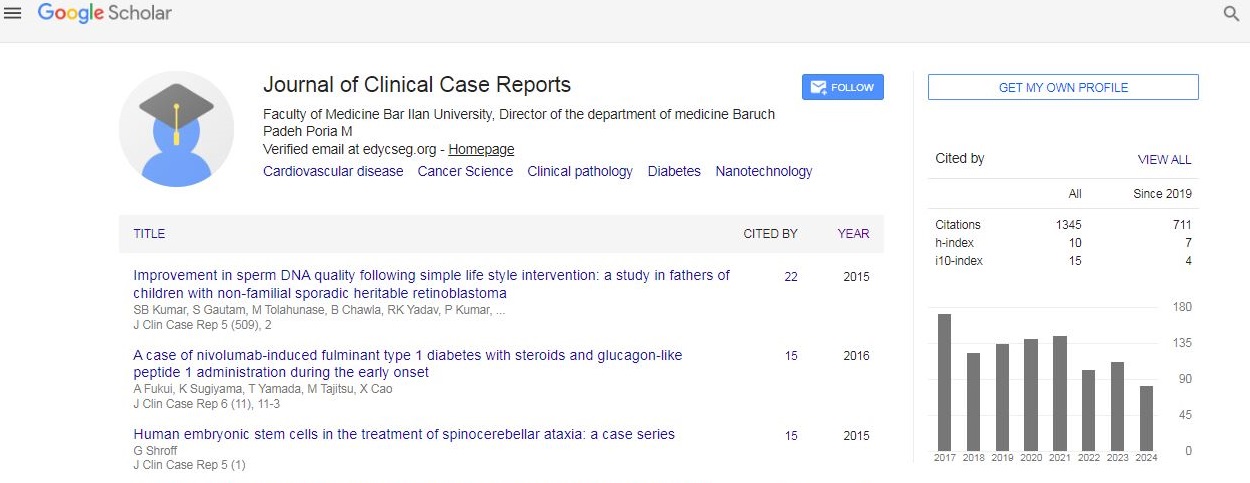
Journal of Clinical Case Reports received 1345 citations as per Google Scholar report