Commentary - (2025) Volume 14, Issue 6
Received: 01-Dec-2025, Manuscript No. jhoa-26-187875;
Editor assigned: 03-Dec-2025, Pre QC No. P-187875;
Reviewed: 17-Dec-2025, QC No. Q-187875;
Revised: 22-Dec-2025, Manuscript No. R-187875;
Published:
29-Dec-2025
, DOI: 10.37421/2167-1095.2025.14.548
Citation: Tran, Linh. ”Improving Hypertension Medication Compliance: A Multifaceted Approach.” J Hypertens 14 (2025):548.
Copyright: © 2025 Tran L. This is an open-access article distributed under the terms of the Creative Commons Attribution License, which permits unrestricted use, distribution and reproduction in any medium, provided the original author and source are credited.
Managing hypertension effectively hinges significantly on medication compliance, as suboptimal adherence demonstrably diminishes treatment outcomes. This critical aspect of care is explored in depth, highlighting various challenges and strategic interventions. The complex nature of medication regimens, potential side effects, financial burdens, and insufficient patient education are frequently cited as barriers to consistent adherence. Addressing these multifaceted issues requires comprehensive strategies aimed at enhancing patient engagement and understanding. This review synthesizes existing research to provide a holistic view of medication adherence in hypertension management. The role of patient education in fostering better adherence is a key focus, with tailored programs showing promise in improving patient outcomes. Understanding the disease, the benefits of medication, and the importance of lifestyle modifications are crucial components of effective educational initiatives. Empowering patients with knowledge is essential for their active participation in managing their condition and adhering to treatment plans. Furthermore, socioeconomic factors play a significant role in medication compliance. Lower income, limited access to healthcare services, and lack of insurance coverage can create substantial hurdles for patients attempting to adhere to their prescribed regimens. Policy interventions aimed at mitigating these disparities are vital for ensuring equitable access to necessary treatments and improving overall public health outcomes. The influence of family support on medication compliance is also a notable area of research. Active involvement from family members in providing reminders, encouraging healthy lifestyle choices, and offering emotional support can significantly bolster adherence rates. Integrating family-centered care approaches into hypertension management programs can harness this valuable resource. The advent of mHealth interventions has opened new avenues for improving medication adherence. Mobile applications and SMS reminders offer timely prompts, facilitate medication tracking, and deliver educational content, thereby increasing patient engagement and self-management capabilities. These digital tools are proving to be effective in supporting consistent medication intake and improving overall hypertension control. The challenges of polypharmacy, particularly for patients with hypertension and multiple comorbidities, present a distinct set of adherence issues. Simplifying medication schedules, improving care coordination, and enhancing patient comprehension of their multiple medications are crucial for minimizing non-adherence and preventing adverse events. Health literacy is another foundational element influencing medication compliance. Lower levels of health literacy are consistently associated with poorer adherence, underscoring the need for interventions that simplify communication and utilize visual aids to improve patient understanding. Acknowledging and addressing patient-centric factors is paramount in developing effective adherence strategies. Patients' perceptions of medication necessity, concerns about side effects, trust in healthcare providers, and the integration of medication into daily routines all profoundly impact their willingness and ability to adhere to treatment. Pharmacist-led interventions have emerged as a valuable strategy for improving medication compliance. Through regular counseling and medication reviews, pharmacists can significantly enhance adherence, improve blood pressure control, and increase patient satisfaction, demonstrating their crucial role in chronic disease management. Finally, the interplay between lifestyle factors and medication compliance is evident. Patients who adopt healthy lifestyle choices, such as regular exercise and a balanced diet, often exhibit better medication adherence. Integrating lifestyle counseling with medication management can create a synergistic effect, reinforcing adherence and promoting overall well-being.[ ]
The critical role of medication compliance in managing hypertension cannot be overstated, as suboptimal adherence significantly undermines treatment efficacy. This comprehensive analysis delves into the common barriers faced by patients, including complex medication regimens, bothersome side effects, the financial burden of medications, and a general lack of adequate patient education. To combat these challenges, a range of multifaceted strategies are proposed, encompassing the simplification of medication schedules, the implementation of patient-centered communication techniques, the leveraging of technology for medication reminders, and the active involvement of healthcare providers in continuous monitoring and support systems.[ ] Patient education plays a pivotal role in enhancing medication compliance among individuals with hypertension. Research indicates that comprehensive and tailored educational programs, which focus on imparting a thorough understanding of the disease, the benefits derived from medication, and the importance of adopting healthy lifestyle modifications, lead to statistically significant improvements in adherence rates. This emphasis on empowering patients with knowledge is fundamental to fostering their active participation in their own treatment journeys.[ ] Socioeconomic factors exert a considerable influence on medication compliance within the hypertensive patient population. Studies conducted in urban Vietnamese settings have identified lower income levels, restricted access to essential healthcare services, and the absence of health insurance as significant predictors of poor medication adherence. Consequently, there is a strong advocacy for the implementation of policy interventions designed to mitigate these socioeconomic disparities and thereby enhance the accessibility and affordability of necessary medications.[ ] The influence of family support in bolstering medication compliance among patients diagnosed with hypertension is a significant factor. Findings from qualitative studies demonstrate that the active involvement of family members in tasks such as providing medication reminders, offering encouragement for lifestyle changes, and delivering emotional support can lead to a substantial enhancement in adherence rates. This highlights the potential benefit of integrating family-centered care approaches into established hypertension management programs.[ ] mHealth interventions, encompassing the use of mobile applications and short message service (SMS) reminders, have been evaluated for their effectiveness in improving medication compliance in hypertensive patients. Results from systematic reviews and meta-analyses suggest that these digital tools can positively impact adherence by providing timely reminders, facilitating the tracking of medication intake, and delivering essential educational content, thereby increasing patient engagement and promoting self-management skills.[ ] Polypharmacy, the use of multiple medications, presents unique challenges to medication adherence for hypertensive patients, especially those with co-existing comorbidities. Addressing this requires a concerted effort to simplify medication regimens, improve the coordination of care among different healthcare providers, and enhance patients' understanding of their prescribed medications to optimize compliance and reduce the likelihood of adverse drug events.[ ] Health literacy is intrinsically linked to medication compliance in patients with hypertension. Systematic reviews consistently show that individuals with lower health literacy levels tend to exhibit poorer adherence to their medication regimens. This underscores the critical importance of implementing interventions specifically designed to improve health literacy, such as utilizing simplified language and employing visual aids to enhance patient comprehension and subsequent adherence.[ ] Patients' perspectives on medication compliance in the context of hypertension management reveal several key themes that influence adherence. These include the patient's perception of the necessity of their medication, their concerns regarding potential side effects, the level of trust they place in their healthcare providers, and the impact of their daily routines on their ability to take medication consistently. Addressing these patient-centric factors is essential for the development of effective and sustainable adherence strategies.[ ] Pharmacist-led interventions have demonstrated significant effectiveness in improving medication compliance among hypertensive patients. Studies indicate that regular counseling sessions and comprehensive medication reviews conducted by pharmacists can lead to marked improvements in adherence rates, better blood pressure control, and higher levels of patient satisfaction. This reinforces the expanding and vital role of pharmacists in the management of chronic diseases like hypertension.[ ] Lifestyle factors are closely associated with medication compliance in patients managing hypertension. Research suggests that individuals who actively maintain healthy lifestyle choices, including regular physical activity and adherence to a balanced diet, tend to exhibit higher rates of medication compliance. These findings support the integration of comprehensive lifestyle counseling alongside medication management strategies to reinforce adherence and promote overall cardiovascular health.[ ]
Medication compliance is crucial for effective hypertension management, yet many patients struggle due to complex regimens, side effects, cost, and lack of education. Studies highlight the importance of tailored patient education, socioeconomic support, and family involvement in improving adherence. Digital tools like mHealth apps and SMS reminders offer promising solutions for timely reminders and patient engagement. Managing polypharmacy and addressing health literacy are also key. Patient perspectives on medication necessity, side effects, and trust in providers influence adherence. Pharmacist-led interventions and the integration of healthy lifestyle counseling alongside medication management further enhance compliance and blood pressure control. Addressing these multifaceted factors is essential for successful hypertension treatment.
None
None
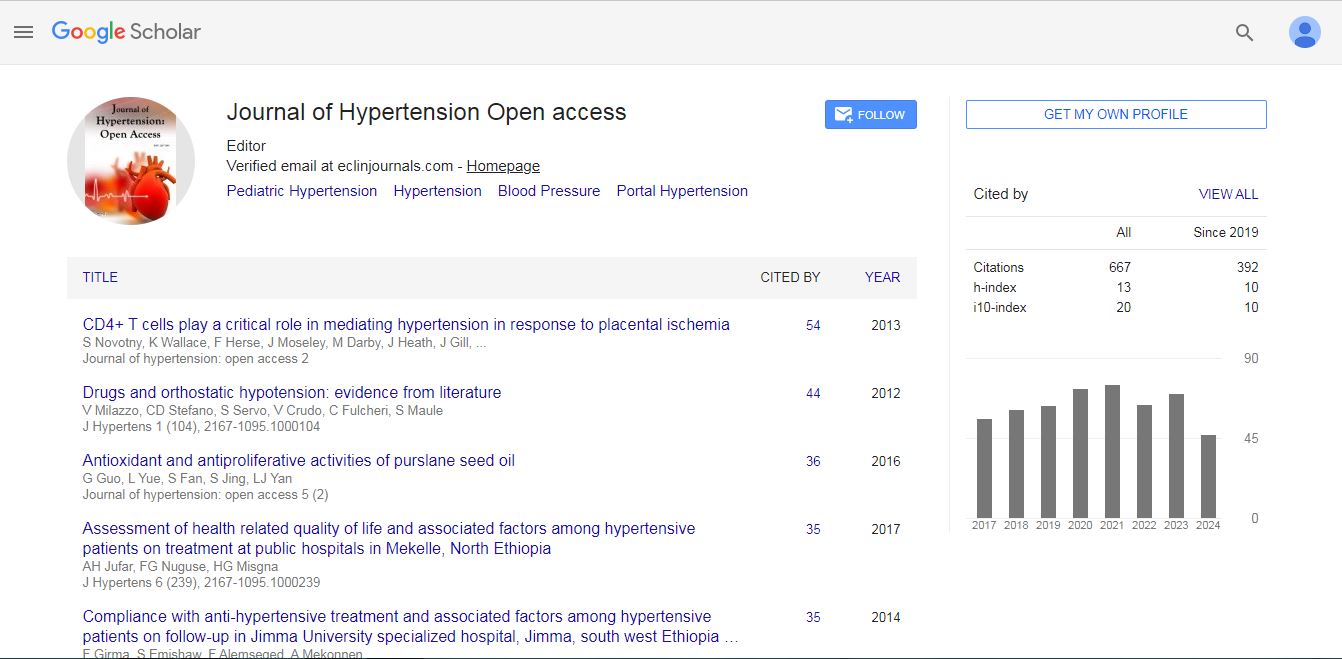
Journal of Hypertension: Open Access received 614 citations as per Google Scholar report