Perspective - (2025) Volume 8, Issue 2
Received: 20-Jul-2024, Manuscript No. POLLUTION-24-142606;
Editor assigned: 23-Jul-2025, Pre QC No. POLLUTION-24-142606 (PQ);
Reviewed: 06-Aug-2024, QC No. POLLUTION-24-142606;
Revised: 14-Apr-2025, Manuscript No. POLLUTION-24-142606 (R);
Published:
21-Apr-2025
, DOI: 10.37421/2684-4958.2025.8.378
Citation: Cao, Nan. "Impact of Uncertainty in Model Input on the Simulation of Typical Pollutant Transport in China's Coastal Waters. "J Pollution 08 (2025): 378.
Copyright: © 2025 Cao N. This is an open-access article distributed under the terms of the creative commons attribution license which permits unrestricted use,
distribution and reproduction in any medium, provided the original author and source are credited.
Pollutant transport models are essential tools for predicting the movement and dispersion of contaminants in water bodies. These models integrate various factors such as ocean currents, wind patterns and pollutant characteristics to simulate how pollutants spread over time. The accuracy of these simulations depends on the quality and reliability of the input data used.
Pollutant • Transport models • Wind patterns • Ocean currents
China's coastal waters face significant challenges due to the transport of pollutants, impacting marine ecosystems and human health. Effective management of these waters requires accurate modeling of pollutant transport, which heavily relies on precise input data. However, uncertainties in these inputs can profoundly influence simulation outcomes, complicating efforts to mitigate environmental and health risks.
Pollutant transport models
Pollutant transport models are essential tools for predicting the movement and dispersion of contaminants in water bodies. These models integrate various factors such as ocean currents, wind patterns and pollutant characteristics to simulate how pollutants spread over time. The accuracy of these simulations depends on the quality and reliability of the input data used. Pollutant transport models are sophisticated tools used to simulate the movement, dispersion and fate of pollutants in various environmental settings, including China's coastal waters. These models integrate complex interactions between physical processes, pollutant characteristics and environmental conditions to predict how pollutants spread over time and space. Understanding the fundamentals of pollutant transport models involves exploring their components, applications and challenges in accurately simulating pollutant behavior. Pollutant transport models incorporate physical processes such as water currents, tides, winds and waves. These factors influence the movement of pollutants through advection (transport by currents), dispersion (spreading due to turbulence) and diffusion (random motion at microscopic scales). Each pollutant has unique properties that affect its behavior in water, including density, solubility, buoyancy and degradation rates. Models must account for these characteristics to accurately predict how pollutants disperse, accumulate or degrade in aquatic environments. Factors such as temperature, salinity, pH and sediment characteristics play crucial roles in pollutant transport. These environmental conditions affect chemical reactions, bioaccumulation and the overall fate of pollutants in marine and coastal ecosystems. Models vary in their spatial resolution (from local scales to regional or global scales) and temporal resolution (from hours to decades). Choosing the appropriate scale is essential for capturing relevant processes and making predictions that align with monitoring and management needs. Models are used to assess the potential impacts of pollutant releases on ecosystems and human health. They predict pollutant concentrations at sensitive receptors, such as coastal habitats, fisheries and recreational beaches, aiding in risk management and mitigation strategies. During pollution incidents or natural disasters, models provide real-time or predictive assessments of pollutant spread. This information helps emergency responders plan effective containment, cleanup and evacuation measures to minimize environmental and societal impacts. Governments and regulatory agencies use pollutant transport models to develop science-based policies and regulations. Models support decisions on pollutant discharge limits, marine spatial planning, and pollution prevention measures aimed at preserving water quality and ecosystem health.
Pollutant transport models serve as valuable tools for scientific research, facilitating the study of pollutant pathways, long-term trends and the effectiveness of pollution control measures. They also support ongoing environmental monitoring efforts by providing insights into pollutant dynamics over large spatial scales. Pollutant transport models are indispensable tools for understanding and managing pollution in China's coastal waters and beyond. By integrating physical processes, pollutant characteristics and environmental conditions, these models provide valuable insights into pollutant behavior, support informed decision-making and contribute to sustainable environmental stewardship. Continued advancements in modeling techniques, data collection and interdisciplinary collaboration are essential for enhancing the accuracy and utility of pollutant transport models in addressing contemporary environmental challenges.
Sources of uncertainty in model inputs
Meteorological data: Inputs such as wind speed and direction are critical for simulating surface water currents and pollutant dispersion. However, these data are subject to variability and can change rapidly, introducing uncertainty into model predictions.
Oceanographic conditions: Factors like tidal currents, water temperature and salinity affect water circulation patterns and pollutant behavior. Variations in these parameters can significantly alter simulation outcomes.
Pollutant characteristics: Parameters such as pollutant density, solubility and degradation rates determine how pollutants behave in water. Uncertainties in these characteristics can lead to inaccuracies in predicting pollutant concentration levels.
Spatial and temporal resolution: The resolution of input data (both spatially and temporally) affects the fidelity of model simulations. Coarse resolution may overlook small-scale processes crucial for accurate predictions.
Impact of uncertainty on simulation results
Parameters such as wind speed, direction and atmospheric pressure influence surface water currents and the dispersion of pollutants. Variability in these meteorological factors, which can change rapidly due to weather patterns, seasonal shifts or local terrain effects, directly affects model predictions. For example, a sudden change in wind direction can alter the trajectory of pollutants, leading to different dispersion patterns than initially simulated. Underestimation or overestimation: Variability in input data can cause models to underestimate or overestimate pollutant concentrations in coastal waters. For instance, if wind speeds are underestimated or the direction is inaccurately modeled, the actual extent of pollutant spread may be greater than predicted, leading to potential environmental and health risks being underestimated.
Spatial and temporal misalignment: Inaccuracies in input data regarding the timing and spatial distribution of pollutant releases can lead to misalignment between simulated and actual pollutant concentrations. This misalignment can affect the effectiveness of pollution management strategies and emergency response measures.
Consequences for environmental management
Policy and regulatory implications: Decision-makers rely on accurate pollutant transport models to formulate policies and regulations aimed at protecting coastal ecosystems and human health. Inaccurate predictions due to input data variability can undermine the effectiveness of these measures, potentially leading to inadequate pollution control or unnecessary restrictions.
Public health and safety: Misleading model predictions can pose risks to public health, particularly in coastal areas where communities rely on fisheries and tourism. If pollutant concentrations are inaccurately estimated, there is a risk of exposing populations to harmful substances or imposing unnecessary restrictions on economic activities.
Improved data collection: Enhancing the quality and frequency of data collection for model inputs through advanced monitoring systems, remote sensing technologies and data assimilation techniques can help reduce uncertainties.
Conducting sensitivity analyses to identify which input parameters have the most significant impact on model predictions can guide efforts to prioritize data collection and improve the accuracy of pollutant transport models. Regular validation of models against observed data is essential to ensure their reliability and effectiveness in predicting pollutant transport. This validation process helps identify and correct discrepancies between model predictions and actual observations, enhancing confidence in model outputs.
Uncertainties in model inputs can propagate through the simulation process, resulting in several potential impacts. Variability in input data can lead to discrepancies between model predictions and actual observations of pollutant concentrations. Incorrect simulations may underestimate or overestimate the potential risks posed by pollutants, affecting decisions related to human health and environmental management. Policymakers rely on accurate model predictions to formulate effective regulations and strategies for pollution control. Uncertainties challenge the reliability of these decisions.
Enhancing the quality and frequency of data collection for model inputs can reduce uncertainties. This includes using advanced sensors, satellite imagery and data assimilation techniques. Conducting sensitivity analyses helps identify which input parameters have the most significant impact on simulation outcomes, guiding efforts to prioritize data collection and improve accuracy. Regular calibration and validation of pollutant transport models against observational data are essential to ensure their reliability and reduce uncertainty. China's extensive coastline and rapid industrialization make its coastal waters particularly vulnerable to pollution. Modeling efforts, such as those focused on the Bohai Sea or the Pearl River Delta, highlight the complexities and challenges of simulating pollutant transport in these dynamic environments.
Accurate modeling of pollutant transport in China's coastal waters is crucial for effective environmental management and public health protection. However, uncertainties in model inputs pose significant challenges to achieving reliable simulations. Addressing these uncertainties through improved data collection, sensitivity analysis and rigorous model validation is essential for enhancing the predictive capabilities of pollutant transport models. By doing so, stakeholders can make more informed decisions to mitigate the adverse impacts of pollution and safeguard coastal ecosystems and communities.
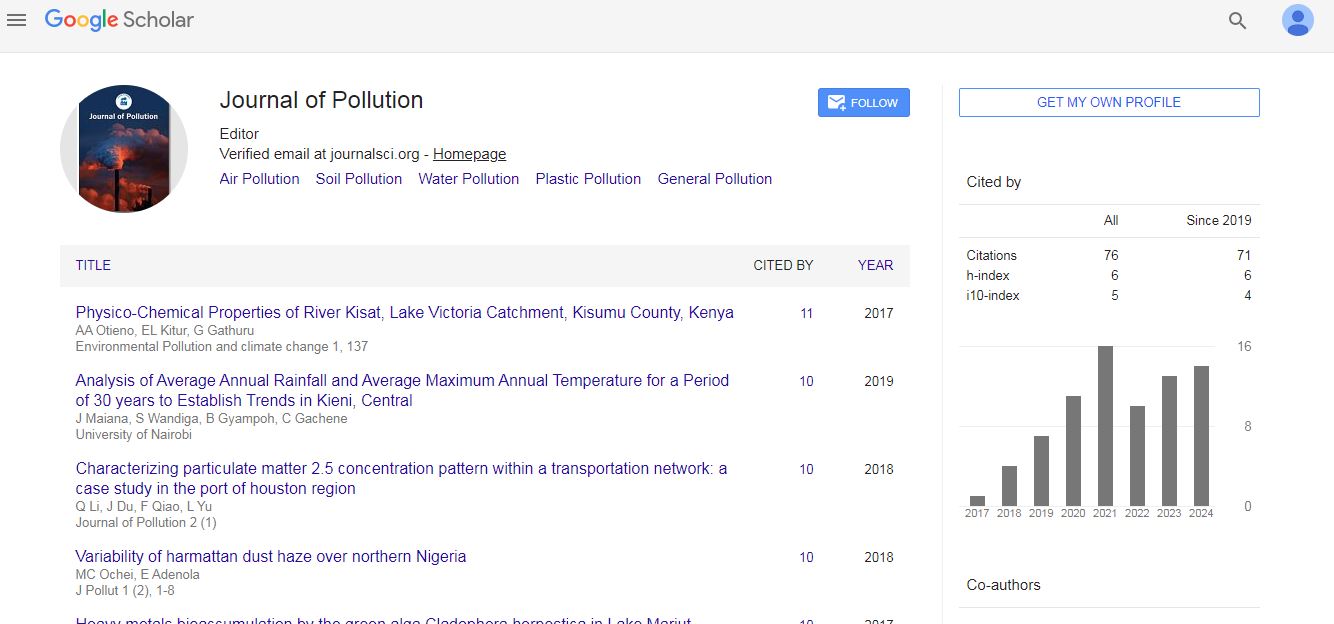
Journal of Pollution received 64 citations as per Google Scholar report