Perspective - (2025) Volume 14, Issue 3
Received: 02-Jun-2025, Manuscript No. jsp-26-182253;
Editor assigned: 04-Jun-2025, Pre QC No. P-182253;
Reviewed: 18-Jun-2025, QC No. Q-182253;
Revised: 23-Jun-2025, Manuscript No. R-182253;
Published:
30-Jun-2025
, DOI: 10.37421/2165-7939.2025.14.724
Citation: O’Connell, Peter J.. ”Imaging’s Essential Role in Spinal Diagnosis and Treatment.” J Spine 14 (2025):724.
Copyright: © 2025 O’Connell J. Peter This is an open-access article distributed under the terms of the Creative Commons Attribution License, which permits unrestricted use, distribution and reproduction in any medium, provided the original author and source are credited.
The field of spinal imaging is continuously evolving, offering increasingly sophisticated tools for diagnosis and treatment planning. This article provides a comprehensive overview of various imaging modalities and their critical roles in managing spinal conditions. The advent of advanced techniques like MRI, CT, and X-ray has revolutionized how anatomical and pathological information is acquired, thereby guiding clinicians in making informed decisions for patient care [1].
Magnetic Resonance Imaging (MRI) stands out as the preeminent modality for visualizing the delicate soft tissues of the spine. Its unparalleled ability to delineate disc herniations, spinal cord compression, and tumors makes it indispensable in modern spinal diagnostics and surgical planning. Understanding the nuances of different MRI sequences and contrast enhancement is crucial for accurate interpretation of complex pathologies and for precisely defining lesion extent and involvement of neural structures [2].
Computed Tomography (CT) offers exceptional resolution for evaluating the bony architecture of the spine. It is particularly vital for assessing fractures, identifying degenerative changes, and quantifying the severity of bony stenosis. The utility of CT in surgical planning, especially for fusion procedures, spinal instrumentation, and deformity correction, is undeniable, given the paramount importance of precise bony anatomy visualization [3].
Radiography, encompassing plain X-rays, continues to serve as a foundational imaging tool in the initial evaluation of the spine. It remains crucial for assessing spinal alignment, identifying degenerative changes, and detecting instability. X-rays are instrumental in screening, monitoring treatment response, and complementing more advanced imaging techniques within the overall diagnostic pathway for various spinal conditions [4].
Interventional imaging techniques, such as fluoroscopy-guided injections and minimally invasive biopsies, play a significant role in both the diagnosis and therapeutic management of spinal pathology. These methods leverage real-time imaging to enable precise targeting of lesions or specific anatomical structures for interventions, thereby enhancing treatment efficacy and minimizing potential complications [5].
The incorporation of cutting-edge imaging innovations like 3D CT reconstructions and functional MRI (fMRI) has significantly enhanced our understanding of spinal anatomy and function. These advancements provide a more detailed spatial comprehension and deeper insight into spinal cord and nerve root dynamics, which are critical for diagnosing subtle pathologies and optimizing surgical strategies for complex cases [6].
Imaging plays a pivotal role in the management of spinal tumors, with MRI and CT being essential for staging, assessing resectability, and guiding adjuvant therapies. The characteristic imaging features of diverse spinal tumors are meticulously analyzed to inform treatment decisions, ensuring the most appropriate course of action is taken for each patient [7].
Degenerative spine disease, a prevalent condition, heavily relies on imaging for accurate assessment. MRI and CT scans are employed to meticulously evaluate the extent of disc degeneration, facet joint arthropathy, and spinal stenosis, providing critical information for planning both conservative management and surgical interventions such as decompression and fusion [8].
In the context of spinal trauma, advanced imaging modalities are crucial for comprehensive evaluation. CT excels in the initial assessment of fractures, while MRI is vital for detecting associated soft tissue injuries, including ligamentous tears and spinal cord contusion. This information is paramount for determining appropriate treatment strategies and predicting neurological outcomes [9].
The integration of artificial intelligence (AI) into spinal imaging represents a frontier in diagnostic technology. AI algorithms are being developed to assist in automated abnormality detection, quantitative analysis of imaging findings, and ultimately, to improve the efficiency and accuracy of diagnosis and treatment planning, signaling a transformative future for spinal imaging [10].
The evolving landscape of spinal imaging is marked by the critical contributions of various modalities in diagnosing complex conditions and formulating effective treatment strategies. Advanced techniques such as Magnetic Resonance Imaging (MRI), Computed Tomography (CT), and X-ray provide essential anatomical and pathological insights that guide surgeons and clinicians. This array of imaging tools offers complementary strengths, enabling precise identification of pathologies and informed decision-making for both conservative and surgical interventions, with emerging technologies promising even greater diagnostic precision [1].
Magnetic Resonance Imaging (MRI) is recognized as the gold standard for visualizing spinal soft tissues, making it indispensable for diagnosing conditions like disc herniations, spinal cord compression, and tumors. Detailed understanding of MRI sequences, contrast enhancement principles, and interpretation nuances is crucial for pre-operative planning, allowing for precise delineation of lesion extent and involvement of neural elements in complex spinal pathologies [2].
Computed Tomography (CT) is invaluable for assessing the bony structures of the spine, offering high-resolution imaging critical for evaluating fractures, degenerative changes, and the degree of bony stenosis. Its role in surgical planning, particularly for fusion procedures, spinal instrumentation, and corrective surgeries for deformities, is significant due to the necessity of precise visualization of bone anatomy [3].
Radiography, including standard X-rays, remains a fundamental tool for the initial assessment of spinal alignment, degenerative conditions, and instability. Its utility extends to screening purposes, monitoring treatment response, and serving as a complementary modality alongside more advanced imaging techniques in the comprehensive diagnostic pathway for spinal ailments [4].
Interventional imaging techniques, such as fluoroscopy-guided injections and minimally invasive biopsies, are increasingly employed for both diagnostic and therapeutic interventions in spinal care. These real-time imaging-guided procedures allow for accurate targeting of pathological areas or specific anatomical structures, thereby enhancing therapeutic outcomes and reducing the risk of complications [5].
Innovations in spinal imaging, including the development of 3D CT reconstructions and functional MRI (fMRI), offer enhanced anatomical understanding and functional insights. These advancements provide a more detailed appreciation of spinal cord and nerve root dynamics, which are critical for diagnosing subtle conditions and optimizing surgical planning for intricate cases [6].
The management of spinal tumors relies heavily on imaging strategies to accurately stage the disease, determine resectability, and plan adjuvant therapies. MRI and CT play crucial roles in characterizing various spinal tumors, providing information that directly influences treatment decisions and prognosis [7].
Imaging plays a central role in evaluating degenerative spine disorders. MRI and CT are utilized to comprehensively assess the extent of disc degeneration, facet joint arthropathy, and spinal stenosis, providing essential data for guiding conservative management or surgical interventions like decompression and fusion [8].
For spinal trauma, imaging modalities are vital for prompt and accurate assessment. CT is the cornerstone for initial fracture evaluation, while MRI is essential for identifying associated soft tissue injuries, such as ligamentous damage and spinal cord contusion, which are critical for treatment planning and predicting neurological recovery [9].
The integration of artificial intelligence (AI) into spinal imaging is poised to transform diagnostic capabilities. AI algorithms can facilitate automated detection of abnormalities, quantitative analysis of imaging data, and improve the overall efficiency and accuracy of diagnosis and treatment planning, heralding a new era in spinal diagnostics [10].
This collection of articles highlights the indispensable role of various imaging modalities in the diagnosis and treatment of spinal conditions. From the foundational utility of X-rays to the detailed soft tissue visualization of MRI and the bony anatomy assessment of CT, each technique offers unique insights. Advanced imaging techniques like 3D CT reconstructions and functional MRI enhance anatomical and functional understanding, aiding in the diagnosis of subtle pathologies and complex cases. Interventional imaging guides precise therapeutic interventions, while imaging is critical for staging spinal tumors and evaluating degenerative diseases and trauma. The integration of artificial intelligence promises to further refine diagnostic accuracy and efficiency in spinal imaging, paving the way for improved patient outcomes.
None
None
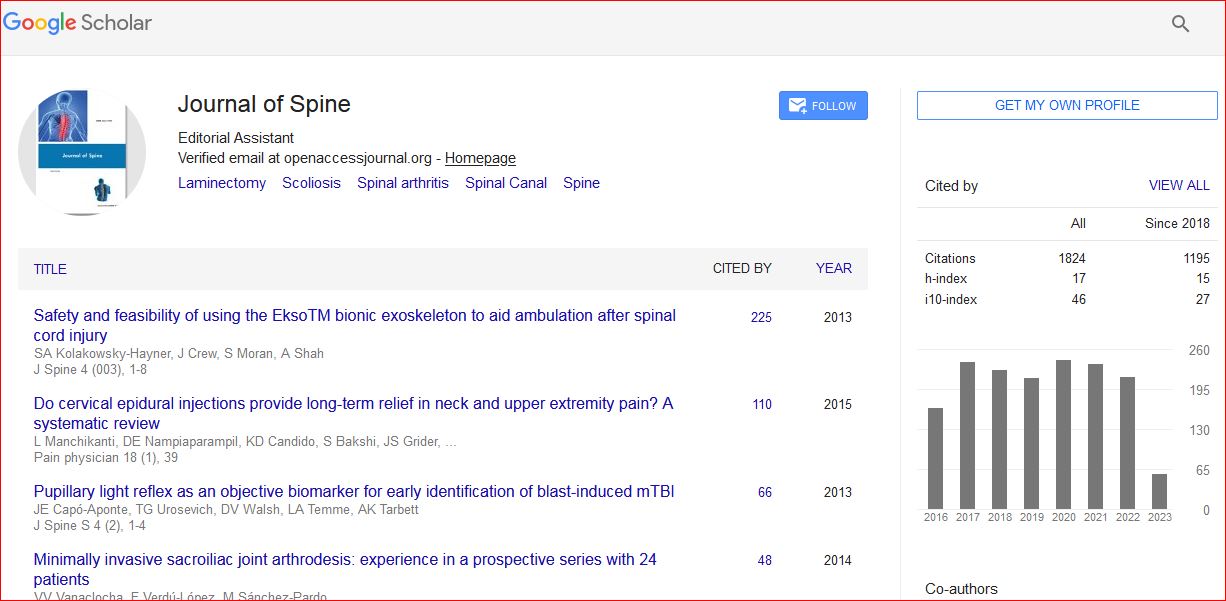
Journal of Spine received 2022 citations as per Google Scholar report