Opinion - (2025) Volume 14, Issue 4
Received: 01-Jul-2025, Manuscript No. jtm-26-186019;
Editor assigned: 03-Jul-2025, Pre QC No. P-186019;
Reviewed: 17-Jul-2025, QC No. Q-186019;
Revised: 22-Jul-2025, Manuscript No. R-186019;
Published:
29-Jul-2025
, DOI: 10.37421/2167-1222.2025.14.692
Citation: Sorensen, Camilla. ”Imaging Modalities for Acute Trauma Diagnosis and Management.” J Trauma Treat 14 (2025):692.
Copyright: © 2025 Sorensen C. This is an open-access article distributed under the terms of the Creative Commons Attribution License, which permits unrestricted use, distribution and reproduction in any medium, provided the original author and source are credited.
Rapid and accurate diagnosis is paramount in the management of acute trauma, serving as the bedrock for effective treatment strategies and ultimately, improved patient outcomes. This evolving field necessitates a comprehensive understanding of the various imaging modalities available, their inherent strengths, recognized limitations, and optimal deployment in time-sensitive clinical scenarios. The critical role of computed tomography (CT) in providing detailed anatomical information, alongside the portability and accessibility of ultrasound, and the foundational utility of X-ray, are central to identifying life-threatening injuries with the necessary efficiency. Emerging technologies further augment these capabilities, offering novel approaches to trauma assessment and management. The impact of these diagnostic tools extends throughout the crucial 'golden hour' and beyond, with considerations for resource availability and individual patient conditions playing a significant role in modality selection. Key insights underscore a significant shift towards rapid, whole-body CT protocols, which have become increasingly standard for comprehensive trauma surveys. Concurrently, the integration of point-of-care ultrasound (POCUS) is expanding, providing immediate bedside assessment and procedural guidance, particularly valuable in resource-limited or emergent situations. Challenges persist in interpreting imaging findings in the context of complex, multi-system trauma patients, underscoring the indispensable need for continuous and robust radiologist-clinician collaboration to ensure optimal patient care and outcomes. Point-of-care ultrasound (POCUS) has dramatically reshaped emergency and trauma care, offering immediate, non-invasive imaging directly at the patient's bedside. Its applications in trauma patient evaluation are extensive, encompassing the well-established FAST (Focused Assessment with Sonography for Trauma) exam, the assessment of specific organ injuries in the thorax and abdomen, and crucial guidance for interventional procedures. Evidence increasingly supports POCUS as a primary imaging modality, especially in settings where resources are constrained, with the potential to significantly reduce diagnostic delays and expedite the initiation of treatment. The review emphasizes the technical aspects of POCUS, common interpretation pitfalls, and the critical importance of standardized training for both sonographers and clinicians to ensure proficiency and efficacy in its application. Computed tomography (CT) continues to be the cornerstone of modern trauma imaging, providing unparalleled, comprehensive visualization of injuries throughout the entire body. This paper critically examines the pivotal role of multidetector CT (MDCT) in the thorough evaluation of both blunt and penetrating trauma. It meticulously highlights the significant evolution of CT protocols, including the widespread adoption of whole-body CT imaging, and meticulously discusses its profound impact on diagnostic accuracy and subsequent patient management decisions. The article also thoughtfully addresses persistent challenges, such as the imperative for radiation dose optimization, effective artifact reduction strategies, and the nuanced interpretation of subtle injuries that may be easily missed. Key takeaways unequivocally emphasize the remarkable speed and exceptional sensitivity of MDCT in rapidly detecting a broad spectrum of pathologies, ranging from intracranial hemorrhage to solid organ lacerations and complex skeletal fractures. The critical concept of the 'golden hour' in trauma care emphatically underscores the absolute urgency of timely diagnosis and intervention to maximize patient survival and minimize morbidity. This article meticulously investigates how various imaging modalities contribute synergistically to achieving this vital objective. It provides a comparative analysis of the distinct strengths offered by X-ray, ultrasound, and CT across a spectrum of clinical scenarios, from initial triage to definitive diagnosis. The paper strongly emphasizes the systematic integration of these modalities into a tiered diagnostic approach, where less invasive methods like ultrasound are strategically employed for rapid screening, subsequently followed by more comprehensive imaging with CT when clinically indicated. Pertinent considerations for pediatric trauma and pregnant patients are also thoroughly discussed, highlighting the paramount need for tailored imaging strategies that effectively minimize radiation exposure while rigorously ensuring diagnostic efficacy. Radiography, commonly known as X-ray, continues to maintain an indispensable role in the initial assessment of trauma patients, proving particularly adept at detecting fractures and dislocations with remarkable efficiency. Despite the remarkable advent and widespread availability of more advanced imaging technologies, X-ray remains a crucial tool owing to its inherent availability, rapid acquisition times, and cost-effectiveness. This article provides a comprehensive review of the current applications of plain radiography in the acute trauma setting, with a specific focus on its proven utility in evaluating extremity injuries, thoracic trauma (including conditions like pneumothorax, rib fractures), and the initial assessment of suspected spinal injuries. The inherent limitations of X-ray, such as its inability to adequately visualize soft tissues or internal organ damage, are thoroughly discussed, alongside practical strategies for optimizing image quality and enhancing interpretation accuracy in the demanding acute trauma environment. The advent of dual-energy CT (DECT) technology has ushered in a new era of enhanced material characterization, offering significant benefits in the complex field of trauma imaging. This paper thoroughly explores the specific advantages conferred by DECT in the critical evaluation of acute trauma. These advantages include markedly improved detection of acute hemorrhage, superior visualization of vascular injuries with potentially reduced contrast agent volumes, and enhanced characterization of bony abnormalities. The article meticulously discusses the fundamental technical principles underlying DECT imaging and meticulously details its practical application in the challenging evaluation of complex polytrauma patients. Potential challenges, such as increased data processing times and complexities in workflow integration, are also thoughtfully considered, alongside the burgeoning body of evidence that increasingly supports its utility in bolstering diagnostic confidence and effectively guiding critical management decisions. Magnetic resonance imaging (MRI) presents a unique interplay of both significant challenges and promising opportunities within the acute trauma setting. While it is not typically considered a first-line modality due to inherent time constraints and potential contraindications, MRI profoundly excels in the detailed visualization of soft tissues. Consequently, it proves invaluable for evaluating specific injuries, including spinal cord trauma, complex ligamentous injuries, and certain types of brain injury that might appear subtle or be missed on CT imaging. This article reviews the evolving role of MRI in the subacute and delayed phases of trauma assessment, with a specific focus on its remarkable ability to provide highly detailed anatomical information. The authors meticulously discuss strategies for the rapid acquisition of MRI scans in trauma patients and underscore the critical importance of careful patient selection and continuous monitoring within the demanding MRI environment. The integration of artificial intelligence (AI) and machine learning (ML) into the realm of medical imaging is undergoing rapid and transformative advancement, presenting significant potential for revolutionizing trauma diagnosis. This paper thoroughly explores the current and prospective applications of AI/ML in the interpretation of trauma imaging, encompassing the automated detection of fractures, hemorrhage, and other life-threatening injuries. The authors discuss in detail how sophisticated AI algorithms can serve as invaluable assistants to radiologists and clinicians by demonstrably improving diagnostic accuracy, substantially reducing interpretation times, and effectively prioritizing urgent cases for immediate attention. Challenges related to data standardization, rigorous algorithm validation, and crucial ethical considerations are also comprehensively addressed, prominently highlighting the essential need for careful and deliberate implementation to fully maximize the profound benefits offered by these novel and powerful technologies. Imaging plays an absolutely pivotal role in the effective management of severe thoracic trauma, directly influencing critical decisions regarding the necessity for surgical intervention and the provision of essential supportive care. This review specifically focuses on the key imaging modalities that are routinely employed to meticulously assess thoracic injuries. These include the readily available chest X-ray, focused lung ultrasound (LUS) for rapid bedside evaluation, and the highly detailed computed tomography (CT) scan. The article meticulously details the typical imaging findings and the diagnostic accuracy of each modality for a range of critical conditions, such as pneumothorax, hemothorax, pulmonary contusions, and injuries to the great vessels. Significant emphasis is placed on the rapid and efficient interpretation of imaging findings in hemodynamically unstable patients, and the complementary roles that different imaging techniques play in achieving a comprehensive and accurate diagnosis. Imaging of abdominal trauma demands a rapid, systematic, and highly organized approach to accurately identify and characterize potentially life-threatening injuries. This article provides a comprehensive overview of the imaging modalities predominantly utilized for the thorough evaluation of abdominal trauma, with a primary and significant focus on ultrasound and CT. It meticulously discusses the fundamental principles of the FAST exam and acknowledges its inherent limitations, as well as detailing the extensive role of contrast-enhanced CT in diagnosing solid organ injuries, hollow viscus injuries, and critical vascular damage. The authors also briefly touch upon the historical utility of diagnostic peritoneal lavage (DPL) as an adjunct and highlight the increasing utilization of CT angiography (CTA) for the precise identification and characterization of vascular injuries, thereby effectively guiding therapeutic decisions in both hemodynamically stable and unstable patients.
The prompt and accurate diagnosis of acute trauma is a critical determinant of effective treatment and favorable patient outcomes. This article delves into the evolving landscape of imaging modalities utilized in trauma settings, meticulously examining their respective strengths, limitations, and optimal applications. Key modalities discussed include computed tomography (CT), ultrasound, and X-ray, alongside an exploration of emerging technologies aimed at efficiently identifying life-threatening injuries. The focus is on how these diagnostic tools influence decision-making during the crucial 'golden hour' and subsequent periods, taking into account resource availability and patient condition. Significant trends highlighted include the move towards rapid, whole-body CT protocols and the growing integration of point-of-care ultrasound (POCUS) for initial patient assessment and procedural guidance. The inherent challenges in interpreting imaging in complex trauma cases and the imperative for ongoing collaboration between radiologists and clinicians are also addressed. Point-of-care ultrasound (POCUS) has fundamentally transformed emergency and trauma care by enabling rapid, non-invasive imaging at the patient's bedside. This review comprehensively details the diverse applications of POCUS in evaluating trauma patients. These include the standard FAST (Focused Assessment with Sonography for Trauma) examination, the evaluation of specific organ injuries within the thorax and abdomen, and its critical role in guiding interventional procedures. The article discusses the accumulating evidence that increasingly supports POCUS as a first-line imaging modality, particularly in resource-limited environments, emphasizing its potential to reduce diagnostic delays and accelerate treatment initiation. Furthermore, it places significant emphasis on the technical aspects, potential interpretation pitfalls, and the indispensable importance of standardized training for both sonographers and clinicians. Computed tomography (CT) remains an indispensable tool in contemporary trauma imaging, offering comprehensive visualization of injuries throughout the body. This paper critically analyzes the pivotal role of multidetector CT (MDCT) in the evaluation of both blunt and penetrating trauma. It elucidates the evolution of CT protocols, including the widespread adoption of whole-body CT, and examines its significant impact on diagnostic accuracy and patient management. The article also addresses critical challenges such as optimizing radiation dose, reducing artifacts, and interpreting subtle injuries. Key findings underscore the speed and sensitivity of MDCT in detecting a wide range of pathologies, from intracranial hemorrhage to solid organ lacerations and skeletal fractures. The critical concept of the 'golden hour' in trauma care highlights the urgent need for timely diagnosis and intervention. This article investigates the contributions of various imaging modalities to achieving this goal. It compares the strengths of X-ray, ultrasound, and CT in different clinical scenarios, from initial triage to definitive diagnosis. The paper advocates for the integration of these modalities into a tiered approach, where less invasive methods like ultrasound are used for rapid screening, followed by more comprehensive imaging with CT when indicated. Special considerations for pediatric trauma and pregnant patients are also discussed, emphasizing the necessity of tailored imaging strategies to minimize radiation exposure while ensuring diagnostic efficacy. Radiography (X-ray) continues to play a vital role in the initial assessment of trauma patients, particularly for detecting fractures and dislocations. Despite the development of advanced imaging techniques, X-ray remains essential due to its availability, speed, and cost-effectiveness. This article reviews the current applications of plain radiography in trauma, focusing on its utility in evaluating extremity injuries, chest trauma (e.g., pneumothorax, rib fractures), and the initial assessment of suspected spinal injuries. The limitations of X-ray, such as its inability to visualize soft tissues or internal organ damage, are discussed, along with strategies for optimizing image quality and interpretation in the acute trauma setting. The introduction of dual-energy CT (DECT) provides enhanced material characterization capabilities, offering significant advantages in trauma imaging. This paper explores the specific benefits of DECT in evaluating acute trauma, including improved detection of acute hemorrhage, better visualization of vascular injuries with reduced contrast volumes, and characterization of bone abnormalities. The article details the technical principles of DECT and its application in assessing complex polytrauma patients. Potential challenges, such as increased data processing time and workflow integration issues, are also considered, alongside the growing evidence supporting its utility in enhancing diagnostic confidence and guiding management decisions. Magnetic resonance imaging (MRI) presents unique challenges and opportunities in the acute trauma setting. While not typically a first-line modality due to time constraints and contraindications, MRI excels in visualizing soft tissues and is invaluable for evaluating specific injuries such as spinal cord trauma, ligamentous injuries, and certain subtle brain injuries. This article reviews the role of MRI in subacute and delayed trauma assessment, focusing on its ability to provide detailed anatomical information. The authors discuss strategies for rapid MRI acquisition in trauma patients and the importance of careful patient selection and monitoring in the MRI environment. The integration of artificial intelligence (AI) and machine learning (ML) in medical imaging is advancing rapidly, offering substantial potential for trauma diagnosis. This paper examines the current and future applications of AI/ML in interpreting trauma imaging, including automated detection of fractures, hemorrhage, and other critical injuries. The authors discuss how AI algorithms can assist radiologists and clinicians by improving diagnostic accuracy, reducing interpretation time, and prioritizing urgent cases. Challenges related to data standardization, algorithm validation, and ethical considerations are also addressed, highlighting the need for careful implementation to maximize the benefits of these technologies. Imaging is crucial in managing severe thoracic trauma, influencing decisions regarding surgical intervention and supportive care. This review focuses on key imaging modalities for assessing thoracic injuries, including chest X-ray, focused lung ultrasound (LUS), and CT. The article details typical findings and diagnostic accuracy for conditions such as pneumothorax, hemothorax, pulmonary contusions, and great vessel injuries. Emphasis is placed on rapid interpretation in hemodynamically unstable patients and the complementary roles of different imaging techniques for comprehensive diagnosis. Abdominal trauma imaging requires a rapid and systematic approach to identify life-threatening injuries. This article provides an overview of imaging modalities for abdominal trauma assessment, primarily focusing on ultrasound and CT. It discusses the principles and limitations of the FAST exam, as well as the detailed role of contrast-enhanced CT in diagnosing solid organ injuries, hollow viscus injuries, and vascular damage. The utility of diagnostic peritoneal lavage (DPL) and the increasing use of CT angiography (CTA) for vascular injuries are also mentioned.
This collection of articles reviews various imaging modalities crucial for acute trauma diagnosis and management. It highlights the central roles of computed tomography (CT), ultrasound, and X-ray, discussing their strengths, limitations, and optimal applications. Key trends include the adoption of whole-body CT and point-of-care ultrasound (POCUS) for rapid assessment. The 'golden hour' importance and tailored imaging strategies for specific patient groups are emphasized. Emerging technologies like dual-energy CT (DECT) and artificial intelligence (AI) are explored for their potential to enhance diagnostic accuracy and efficiency. While MRI is generally reserved for subacute or delayed assessments, it excels in soft tissue evaluation. Challenges in interpreting complex trauma and the necessity of radiologist-clinician collaboration are also recurrent themes.
None
None
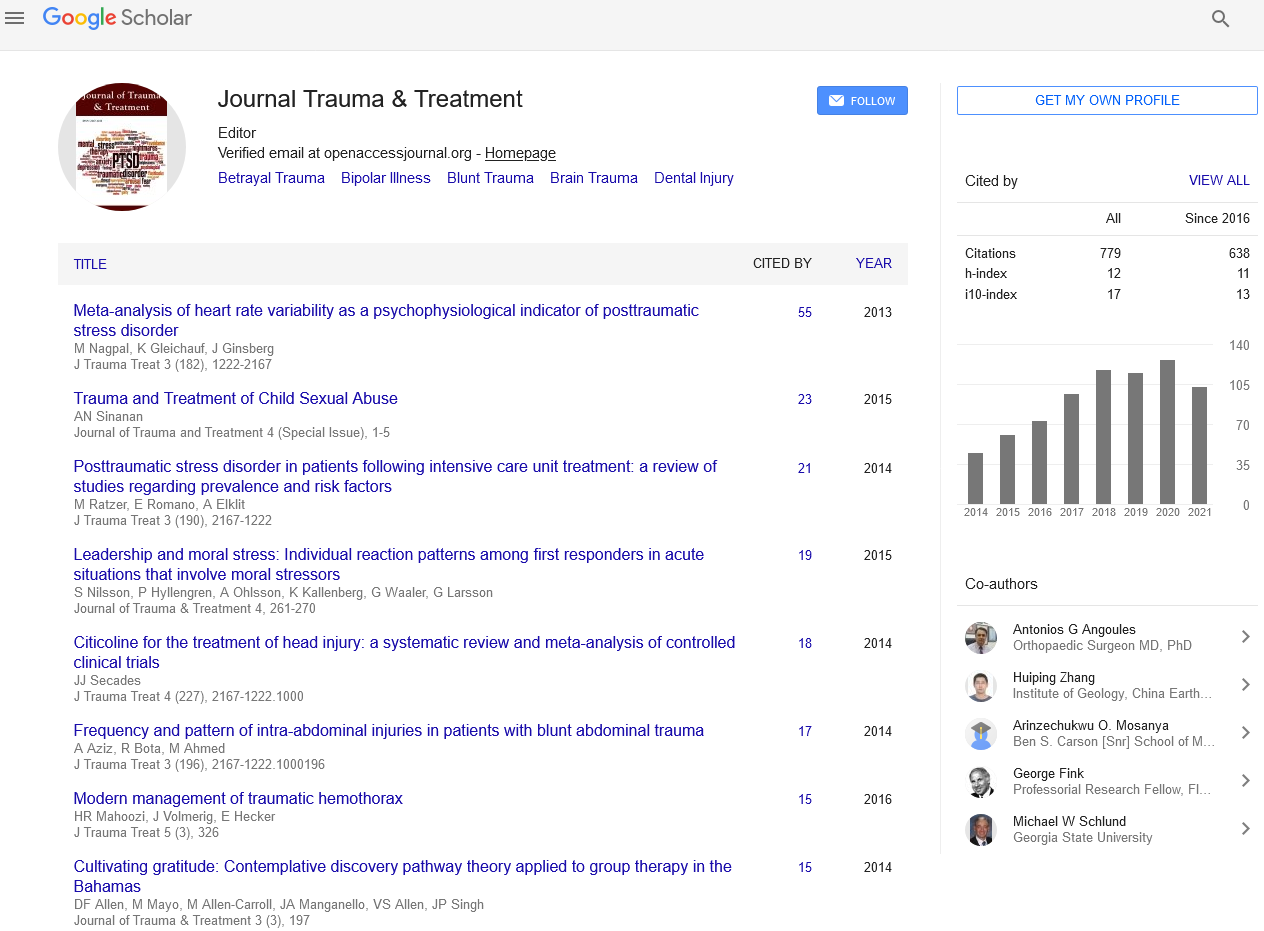
Journal of Trauma & Treatment received 1048 citations as per Google Scholar report