Brief Report - (2025) Volume 16, Issue 6
Received: 01-Nov-2025, Manuscript No. jhmi-26-178888;
Editor assigned: 03-Nov-2025, Pre QC No. P-178888;
Reviewed: 17-Nov-2025, QC No. Q-178888;
Revised: 24-Nov-2025, Manuscript No. R-178888;
Published:
29-Nov-2025
, DOI: 10.37421/2157-7420.2025.16.619
Citation: Haddad, Yara S.. ”Imaging Informatics: Driving Better Healthcare and Patient Outcomes.” J Health Med Informat 16 (2025):619.
Copyright: © 2025 Haddad S. Yara This is an open-access article distributed under the terms of the Creative Commons Attribution License, which permits unrestricted use, distribution and reproduction in any medium, provided the original author and source are credited.
Imaging informatics has become an indispensable component of contemporary healthcare, significantly enhancing collaboration and decision-making across diverse medical disciplines. Its seamless integration streamlines the management, retrieval, and analysis of medical images, thereby elevating diagnostic accuracy and optimizing patient care pathways. This informatics-driven approach is crucial for empowering multidisciplinary teams, providing them with a unified and accessible platform for visual data interpretation and utilization [1].
The effective incorporation of imaging informatics into multidisciplinary care necessitates the establishment of robust infrastructure and standardized protocols. Such measures guarantee that all team members, irrespective of their specialty or geographical location, can consistently access and interpret imaging data. Furthermore, advancements in artificial intelligence and machine learning are actively contributing to this integration by automating various tasks and offering sophisticated analytical insights, further solidifying its importance in modern medicine [2].
Despite its significant benefits, the integration of imaging informatics faces several challenges. These include ensuring data security, addressing interoperability issues between disparate systems, and the critical need for comprehensive training programs for clinical staff. Successfully navigating these obstacles is paramount to fully harnessing the advantages offered by a multidisciplinary approach underpinned by advanced imaging informatics solutions [3].
The trajectory of imaging informatics in multidisciplinary care is increasingly pointing towards the adoption of cloud-based solutions and federated learning. These emerging technologies promise to enhance data sharing capabilities and foster more robust collaborative analysis. Ultimately, this evolution will empower diverse clinical teams to make well-informed, evidence-based decisions with greater speed and precision [4].
Successfully implementing imaging informatics solutions demands a profound understanding of existing clinical workflows and the dynamics of healthcare teams. When integration is achieved effectively, it cultivates improved communication, reduces diagnostic delays, and ultimately enhances patient outcomes by ensuring all involved clinicians have timely access to comprehensive imaging information [5].
The deployment of advanced imaging informatics platforms plays an instrumental role in supporting the complex informational needs inherent in modern multidisciplinary care. These platforms are designed to optimize the sharing of radiological reports, sophisticated visualization data, and diagnostic images, thereby strengthening collaborative decision-making and improving overall patient management strategies [6].
Standardizing imaging data formats and embracing interoperable imaging informatics solutions represent critical advancements toward achieving true integration within multidisciplinary care settings. Such standardization is fundamental for facilitating seamless data exchange and mitigating the potential for misinterpretations, leading to more precise diagnoses and effective treatment plans [7].
The integration of imaging informatics plays a vital role in facilitating the timely review of imaging studies by a variety of specialists. This expedited review process is crucial for accelerating diagnosis and treatment planning, particularly in cases involving complex patient conditions. Consequently, it significantly enhances the efficiency and effectiveness of multidisciplinary team meetings and overall clinical decision-making processes [8].
Patient-centric care models stand to gain substantially from the integration of imaging informatics. This integration enables a fluid flow of information among various healthcare providers involved in a patient's treatment journey. The comprehensive view of patient data facilitated by informatics ensures that all team members are aligned and collaboratively working towards achieving the best possible patient outcomes [9].
The continuous evolution of imaging informatics is actively reshaping the landscape of multidisciplinary care through the introduction of innovative tools for image analysis, reporting, and communication. These technological advancements are pivotal for not only improving diagnostic precision but also for fostering more effective and collaborative healthcare environments, benefiting both clinicians and patients alike [10].
Imaging informatics is fundamentally transforming modern healthcare by enabling enhanced collaboration and informed decision-making across various medical specialties. Its integration facilitates efficient image management, retrieval, and analysis, leading to improved diagnostic accuracy and optimized patient care pathways. This approach is essential for advancing multidisciplinary teams by establishing a shared, accessible platform for visual data [1].
The successful integration of imaging informatics into multidisciplinary care hinges on the establishment of a robust infrastructure and adherence to standardized protocols. These elements ensure consistent access and interpretation of imaging data for all team members, regardless of their specialization or location. Furthermore, ongoing advancements in AI and machine learning are augmenting this integration by automating tasks and providing sophisticated analytical capabilities [2].
Key challenges associated with the integration of imaging informatics encompass data security concerns, interoperability issues between different systems, and the necessity for comprehensive training for clinical personnel. Addressing and overcoming these obstacles are vital steps in fully realizing the benefits of a multidisciplinary approach powered by advanced imaging informatics [3].
Future trends in imaging informatics within multidisciplinary care indicate a growing reliance on cloud-based solutions and federated learning. These technologies are poised to improve data sharing and collaborative analysis, empowering diverse clinical teams to make more informed, evidence-based decisions with increased efficiency [4].
The implementation of effective imaging informatics solutions requires a deep understanding of clinical workflows and team dynamics. Successful integration fosters better communication, reduces diagnostic delays, and ultimately improves patient outcomes by ensuring timely access to comprehensive imaging information for all involved clinicians [5].
Advanced imaging informatics platforms are instrumental in meeting the complex information demands of modern multidisciplinary care. These platforms streamline the sharing of radiological reports, advanced visualization data, and diagnostic images, thereby enhancing collaborative decision-making and patient management processes [6].
Standardizing imaging data formats and adopting interoperable imaging informatics solutions are critical for achieving true integration in multidisciplinary care. This standardization promotes seamless data exchange and minimizes the risk of misinterpretation, contributing to more accurate diagnoses and effective treatment plans [7].
The integration of imaging informatics supports the timely review of imaging studies by multiple specialists, expediting diagnosis and treatment planning in complex patient cases. This enhances the efficiency and effectiveness of multidisciplinary team meetings and clinical decision-making processes [8].
Patient-centric care models are significantly enhanced by the integration of imaging informatics, which facilitates seamless information flow among healthcare providers involved in a patient's treatment. This integrated approach ensures all team members are aligned towards achieving optimal patient outcomes [9].
The ongoing evolution of imaging informatics is continuously reshaping multidisciplinary care by introducing innovative tools for image analysis, reporting, and communication. These technological advancements are crucial for improving diagnostic precision and cultivating collaborative healthcare environments [10].
Imaging informatics is crucial for modern healthcare, improving collaboration, decision-making, and patient care through efficient image management and analysis. Its integration into multidisciplinary teams enhances diagnostic accuracy and optimizes care pathways. While challenges like data security and interoperability exist, advancements in AI, cloud computing, and federated learning are paving the way for future improvements. Effective implementation requires understanding clinical workflows, leading to better communication, reduced delays, and improved patient outcomes. Standardization and interoperability are key for seamless data exchange and accurate diagnoses. Ultimately, imaging informatics fosters patient-centric care and advances collaborative healthcare environments by providing innovative tools for analysis and communication.
None
None
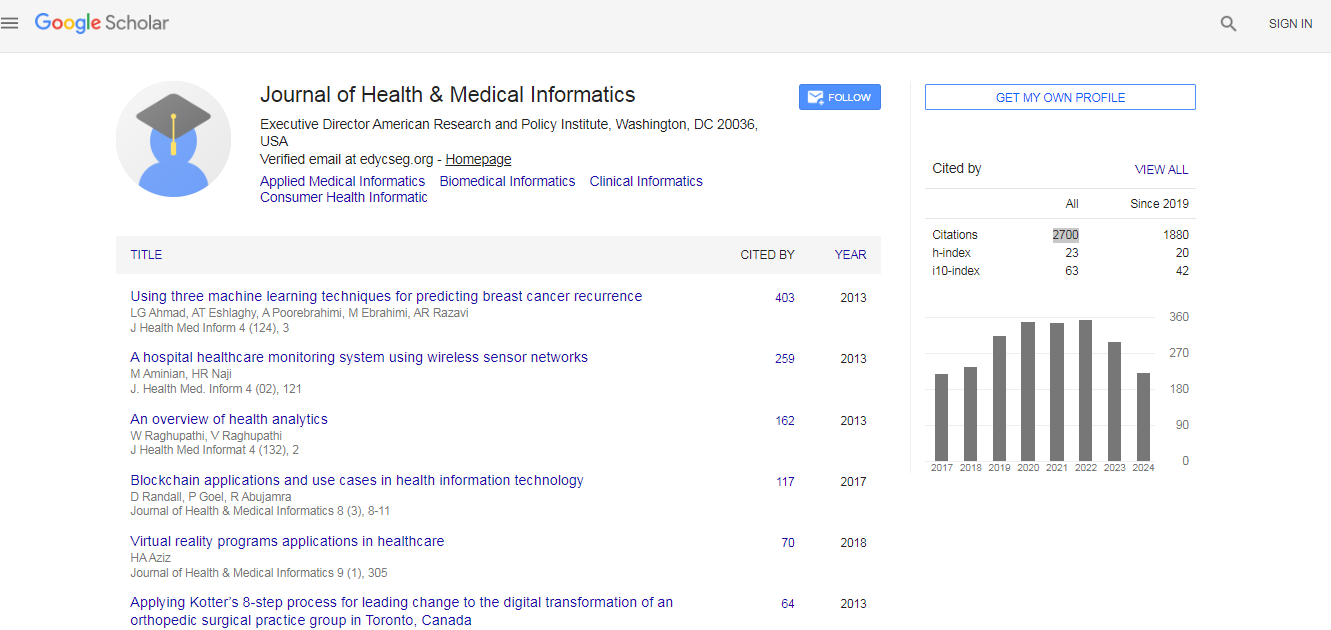
Journal of Health & Medical Informatics received 2700 citations as per Google Scholar report