Opinion - (2025) Volume 13, Issue 5
Received: 01-Oct-2025, Manuscript No. jcdd-25-177667;
Editor assigned: 03-Oct-2025, Pre QC No. P-177667;
Reviewed: 17-Oct-2025, QC No. Q-177667;
Revised: 22-Oct-2025, Manuscript No. R-177667;
Published:
29-Oct-2025
, DOI: 10.37421/2329-9517.2025.13.694
Citation: Grace Thompson. ”ICD: Advancements, Prevention,
and Patient-Centered Care.” J Cardiovasc Dis Diagn 13 (2025):694.
Copyright: © 2025 T. Grace This is an open-access article distributed under the terms of the Creative Commons Attribution License, which permits unrestricted use, distribution
and reproduction in any medium, provided the original author and source are credited.
Implantable cardioverter-defibrillators, commonly known as ICDs, represent a cornerstone in modern cardiology for managing and preventing life-threatening cardiac arrhythmias. The discourse surrounding ICD therapy is multifaceted, encompassing advancements in device technology, patient-specific applications, and the broader impact on patient quality of life. Understanding the current landscape requires a review of several key areas, from fundamental risk stratification to evolving patient management strategies. At its core, the application of ICDs involves a meticulous process of risk assessment for sudden cardiac death (SCD). Research consistently delves into the primary prevention of SCD with ICDs, striving to refine patient selection criteria and optimize outcomes [1].
This involves a deep dive into patient characteristics and disease progression to identify individuals who will most benefit from device implantation. Beyond primary prevention, the critical function of ICDs extends to secondary prevention for patients who have already endured life-threatening arrhythmias [3].
Here, the emphasis shifts to preventing recurrent episodes and managing complex patient profiles to improve long-term survival. The effectiveness of ICDs in these high-risk populations remains a central theme in cardiac electrophysiology. The technological frontier of ICDs is rapidly advancing, introducing innovations designed to improve safety and efficacy while minimizing complications. A significant area of development involves subcutaneous ICDs (S-ICDs), which offer an alternative to traditional transvenous systems by avoiding intracardiac leads [2].
Studies evaluate their performance, patient outcomes, and overall safety profile, providing valuable insights into their comparative benefits. Another promising avenue is leadless pacing and defibrillation technologies [5].
These innovations aim to further reduce lead-related complications, a common concern with conventional devices, and enhance patient comfort and overall quality of life. The evolution of these technologies marks a shift towards less invasive and more patient-friendly solutions. ICD therapy is not a one-size-fits-all solution, and specific patient populations present unique challenges and considerations. For instance, the use of ICDs in pediatric and adolescent populations requires specialized attention [4].
Multicenter studies provide crucial data on device implantation techniques, potential complications specific to younger patients, and their long-term clinical outcomes. Furthermore, the complex decision of ICD implantation in athletes involves balancing the imperative of sudden cardiac death risk mitigation against the potential impact on their athletic participation and overall quality of life [6].
These discussions highlight the nuanced ethical and clinical considerations in diverse patient groups. Effective long-term management of ICD patients increasingly relies on advanced monitoring and support systems. Remote monitoring systems for ICDs are revolutionizing patient care by facilitating the early detection of device issues, identifying significant arrhythmias, and streamlining patient management [7].
These systems offer a proactive approach, potentially reducing hospital visits and improving the timeliness of interventions. However, challenges persist, particularly concerning inappropriate shocks in ICD patients [8].
Understanding their incidence, underlying causes, and developing contemporary strategies for prevention and management are vital for enhancing patient comfort and device efficacy. Additionally, the practical aspects of device maintenance, such as implantable cardioverter-defibrillator generator replacement, require careful clinical and technical consideration, including patient selection and complication management to optimize device longevity [9].
Finally, the growing recognition of shared decision-making in ICD therapy underscores the importance of integrating patient preferences, values, and informed choice into the treatment process [10].
This patient-centered approach ensures that treatment aligns with individual circumstances and priorities. Collectively, these studies offer a panoramic view of ICD therapy, from initial assessment and technological innovation to specialized care and ethical considerations, all contributing to better patient outcomes.
The realm of implantable cardioverter-defibrillators (ICDs) is continuously evolving, marked by advancements in technology, nuanced patient care strategies, and an expanded understanding of their application across diverse populations. One critical area of focus involves the precise identification of patients at risk for sudden cardiac death (SCD) and the strategic deployment of ICDs for primary prevention. This necessitates thorough risk assessment, highlighting areas for improved patient selection to ensure optimal outcomes [1]. These efforts aim to prevent initial cardiac events in vulnerable individuals. Conversely, for patients who have already experienced life-threatening arrhythmias, ICDs play an indispensable role in secondary prevention of SCD. This involves examining their effectiveness in preventing recurrent events and tailoring patient management to their unique clinical needs [3]. Both primary and secondary prevention strategies are foundational to ICD therapy, guiding clinical decisions and patient pathways.
Technological innovations are reshaping the landscape of defibrillation. Subcutaneous implantable cardioverter-defibrillators (S-ICDs) offer a distinct alternative to traditional transvenous systems. A systematic review and meta-analysis confirmed their safety and efficacy, providing crucial insights into their performance and patient outcomes [2]. This development addresses some of the lead-related complications associated with transvenous ICDs. Further pushing the boundaries, leadless pacing and defibrillation technologies are being explored for their potential to revolutionize cardiac rhythm management. These systems aim to further reduce complications related to leads and significantly enhance the patient's quality of life [5]. The progression towards less invasive and more sophisticated devices reflects a broader trend in medical technology to improve patient safety and comfort while maintaining therapeutic efficacy.
The application of ICDs is not uniform across all age groups or lifestyles, requiring specialized considerations for particular demographics. A significant multicenter study has investigated the efficacy and safety of ICDs in pediatric and adolescent populations, generating vital data on device implantation, common complications, and the long-term prognosis for these younger patients [4]. This is particularly important given the unique physiological and psychological needs of children and adolescents. Furthermore, the decision to implant an ICD in athletes presents a complex ethical and clinical dilemma. Discussions center on how to balance the imperative of mitigating the risk of sudden cardiac death with the potential impact of the device on an athlete's ability to participate in sports and their overall quality of life [6]. These specialized areas emphasize the need for tailored approaches to ICD therapy.
Effective management post-implantation is paramount for maximizing the benefits of ICDs. Remote monitoring systems have emerged as a powerful tool in this regard, offering a comprehensive overview of device function and patient cardiac activity. These systems are highly effective in the early detection of device malfunctions and emergent arrhythmias, thus significantly improving patient management and offering promising future outlooks for proactive care [7]. However, a persistent challenge in ICD therapy is the occurrence of inappropriate shocks. Research focuses on detailing their incidence, uncovering underlying causes, and developing contemporary strategies for prevention and management to enhance patient comfort and ensure the intended efficacy of the device [8]. Alongside this, the practical aspects of device longevity are addressed through considerations for implantable cardioverter-defibrillator generator replacement procedures. These procedures require careful attention to patient selection and potential complications, aiming to optimize outcomes and extend the useful life of the device [9].
Finally, a crucial aspect of contemporary medical practice, especially for life-altering therapies like ICD implantation, is shared decision-making. A scoping review highlighted the current landscape of shared decision-making in ICD therapy, emphasizing the fundamental importance of patient preferences, values, and informed choice throughout the treatment process [10]. This approach ensures that patients are active participants in decisions about their health, aligning care with their individual circumstances and goals. The integrated view of these articles underscores the comprehensive nature of ICD research, covering clinical indications, technological advancements, specific population needs, ongoing management challenges, and the ethical dimensions of patient care.
The provided data covers various facets of implantable cardioverter-defibrillators (ICDs) and related technologies, reflecting their critical role in cardiac care. A significant focus lies on risk assessment for sudden cardiac death and the application of ICDs in both primary prevention, enhancing patient selection, and secondary prevention for those who have experienced life-threatening arrhythmias. The evolution of device technology is also explored, including the safety and efficacy of subcutaneous ICDs (S-ICDs) compared to traditional transvenous systems. Furthermore, leadless pacing and defibrillation technologies are highlighted for their potential to reduce complications and improve patient quality of life. The scope extends to specific patient populations, such as pediatric and adolescent individuals, where studies investigate device implantation, potential complications, and long-term outcomes. The data also addresses unique considerations, like the use of ICDs in athletes, balancing sudden cardiac death risk with continued athletic participation. Practical aspects of ICD management are discussed, including the crucial role of remote monitoring systems for early detection of device issues and arrhythmias, thus enhancing patient care. Challenges such as inappropriate shocks are examined, with attention to their incidence, causes, and strategies for prevention. Lastly, the data touches on the technical considerations for ICD generator replacement and the importance of shared decision-making in ICD therapy, emphasizing patient preferences and informed choices in the treatment process. This collection presents a comprehensive view of current ICD research, from foundational applications to advanced technologies and patient-centered care.
Indexed at, Google Scholar, Crossref
Indexed at, Google Scholar, Crossref
Indexed at, Google Scholar, Crossref
Indexed at, Google Scholar, Crossref
Indexed at, Google Scholar, Crossref
Indexed at, Google Scholar, Crossref
Indexed at, Google Scholar, Crossref
Indexed at, Google Scholar, Crossref
Indexed at, Google Scholar, Crossref
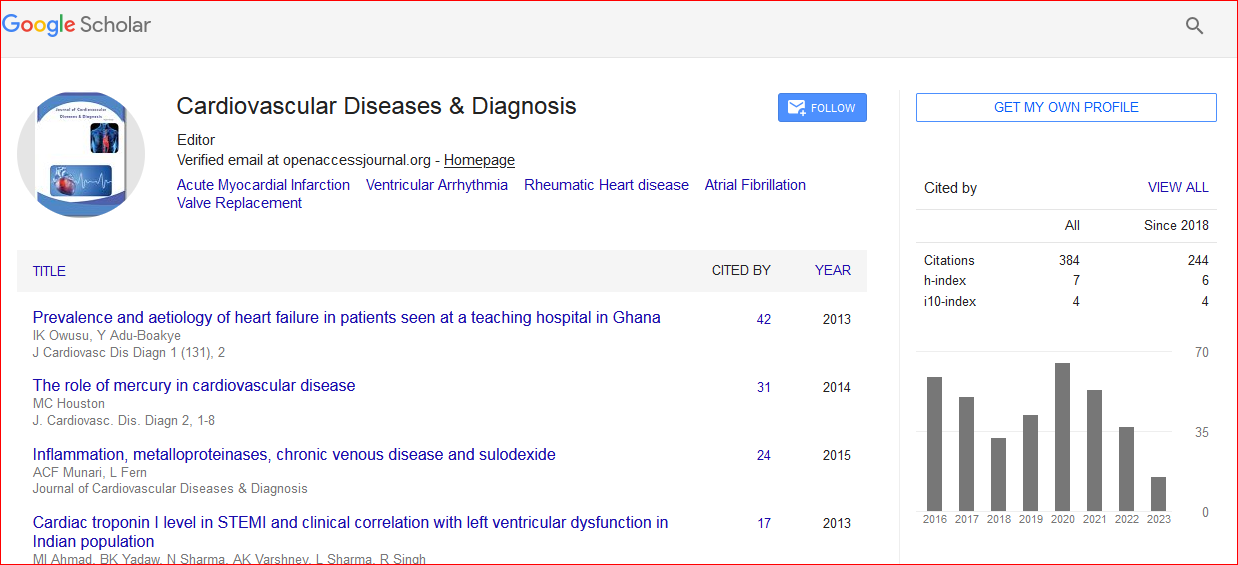
Cardiovascular Diseases & Diagnosis received 427 citations as per Google Scholar report