Brief Report - (2025) Volume 14, Issue 5
Received: 01-Oct-2025, Manuscript No. jhoa-26-187838;
Editor assigned: 03-Oct-2025, Pre QC No. P-187838;
Reviewed: 17-Oct-2025, QC No. Q-187838;
Revised: 22-Oct-2025, Manuscript No. R-187838;
Published:
29-Oct-2025
, DOI: 10.37421/2167-1095.2025.14.538
Citation: Rahman, Abdul. ”Hypertension’s Impact: Improving Quality Of Life.” J Hypertens 14 (2025):538.
Copyright: © 2025 Rahman A. This is an open-access article distributed under the terms of the Creative Commons Attribution License, which permits unrestricted use, distribution and reproduction in any medium, provided the original author and source are credited.
Hypertension, a pervasive global health concern, significantly influences multiple facets of a patient's life, extending beyond mere physiological metrics to encompass their overall quality of life (QoL) [1].
This chronic condition necessitates a comprehensive understanding of its impact, not just on cardiovascular health but on the holistic well-being of individuals affected by it. The intricate relationship between hypertension control and health-related quality of life (HRQoL) has been a subject of considerable research, revealing a strong positive correlation between achieving target blood pressure levels and improved HRQoL [2].
Patients who successfully manage their blood pressure often report better physical and mental health outcomes, highlighting the direct benefits of effective treatment. Furthermore, the psychological dimension of living with hypertension cannot be overstated, with anxiety and depression frequently identified as significant comorbidities that substantially diminish QoL [3].
These mental health challenges can exacerbate hypertensive symptoms and require integrated care strategies. Beyond medical interventions, lifestyle modifications, encompassing diet and exercise, play a crucial role in enhancing the quality of life for hypertensive patients [4].
Adherence to a healthy lifestyle not only aids in blood pressure control but also positively impacts physical functioning and mental well-being. The cornerstone of effective hypertension management, medication adherence, is directly linked to improved QoL [5].
Conversely, poor adherence can lead to uncontrolled hypertension, a greater symptom burden, and a diminished sense of well-being. Research also indicates a gradient effect, where hypertension severity is associated with reduced HRQoL [6].
Patients experiencing more severe forms of the condition, often with additional comorbidities, report lower QoL across various domains, underscoring the importance of early and aggressive management. Navigating the complexities of hypertension management can present individuals with unmet needs, ranging from a lack of information to inadequate support for lifestyle changes [7].
Addressing these specific needs is pivotal for empowering patients and improving their QoL. The impact of hypertension on QoL is not solely an individual struggle; social support plays a vital mediating role [8].
A robust network of family and friends can buffer the negative effects of the condition, fostering better coping mechanisms and reducing psychological distress. Qualitative explorations into the lived experiences of hypertensive patients reveal that while physical challenges are acknowledged, their perception of QoL is profoundly shaped by their ability to maintain independence and engage in meaningful social activities [9].
This highlights the subjective and multidimensional nature of well-being. Finally, the specific choice of antihypertensive drug classes can also influence patient QoL, with some medications potentially having different impacts on side effects such as fatigue or dizziness [10].
Tailoring medication selection to optimize both efficacy and QoL is therefore a key consideration in patient care.
The multifaceted impact of hypertension on patients' quality of life (QoL) has been extensively investigated, revealing that QoL transcends the mere absence of disease, encompassing physical, psychological, and social well-being [1].
Uncontrolled hypertension and its associated symptoms demonstrably impair physical functioning and daily activities, while the psychological burden of managing a chronic condition, including anxiety and depression, negatively affects emotional states. Social isolation further contributes to a reduced QoL, underscoring the need for a holistic management approach that integrates pharmacological treatments with lifestyle modifications and psychosocial support. The exploration of the relationship between hypertension control and health-related quality of life (HRQoL) has consistently shown a strong positive correlation between achieving target blood pressure levels and improved HRQoL [2].
Patients with well-controlled hypertension report significantly better physical and mental health scores compared to those with uncontrolled hypertension, who experience more limitations, fatigue, and depressive symptoms. This emphasizes the critical role of effective antihypertensive therapy in determining patient QoL. Psychological factors, particularly anxiety and depression, have been identified as significant comorbidities in hypertensive patients that not only exacerbate hypertensive symptoms but also substantially diminish QoL [3].
The study highlights the importance of screening for and addressing these mental health issues as an integral part of comprehensive hypertension care, suggesting that effective psychological interventions can lead to substantial improvements in overall well-being. Lifestyle modifications, including adherence to a healthy diet and regular exercise, are crucial for enhancing the quality of life for hypertensive patients [4].
These changes are vital for blood pressure control and significantly improve physical functioning, reduce fatigue, and boost mental well-being, thereby enhancing overall QoL. Patient education and support programs are advocated to promote sustainable lifestyle changes. Adherence to antihypertensive medication is directly linked to better blood pressure control and, consequently, a higher quality of life [5].
Conversely, poor adherence leads to uncontrolled hypertension, an increased symptom burden, and a diminished QoL. The study emphasizes the need for interventions aimed at improving medication adherence, such as patient education and simplified treatment regimens. Research examining the association between hypertension severity and health-related quality of life (HRQoL) indicates that patients with more severe hypertension, characterized by higher blood pressure readings and more comorbidities, tend to report lower HRQoL across physical, psychological, and social domains [6].
This underscores the importance of early diagnosis and aggressive management of hypertension to prevent long-term decrements in QoL. Unmet needs in hypertension management, such as lack of information, inadequate support for lifestyle changes, and difficulty navigating the healthcare system, significantly impact patients' quality of life [7].
Addressing these needs through tailored educational programs and enhanced patient support services can significantly improve patients' self-efficacy and ultimately their QoL. The role of social support in mediating the relationship between hypertension and quality of life is significant [8].
A strong social support network, including family and friends, can buffer the negative effects of hypertension on QoL. Patients with robust social support tend to cope better with their condition, experience less psychological distress, and maintain a higher level of functioning. Qualitative studies exploring the lived experiences of patients with hypertension reveal that their perception of quality of life is profoundly shaped by their ability to maintain independence, engage in meaningful social activities, and feel supported by healthcare providers [9].
These findings highlight the subjective aspects of well-being and the need for patient-centered care. Furthermore, the impact of specific antihypertensive drug classes on patient quality of life is a critical consideration [10].
While all effective treatments improve QoL by controlling blood pressure, differences in side effects like fatigue or dizziness can influence patient experience. Tailoring medication choice based on potential QoL impacts can further optimize patient well-being.
Hypertension significantly impacts patients' quality of life, affecting physical, psychological, and social well-being. Achieving target blood pressure levels through effective antihypertensive therapy is strongly correlated with improved health-related quality of life (HRQoL). Psychological comorbidities like anxiety and depression, along with lifestyle factors such as diet and exercise, play crucial roles in shaping patient well-being. Medication adherence and the severity of hypertension are directly linked to QoL outcomes. Addressing patients' unmet needs, fostering strong social support, and adopting patient-centered care approaches are essential for enhancing the overall quality of life for individuals managing hypertension. The choice of antihypertensive drug class can also influence QoL due to varying side effect profiles.
None
None
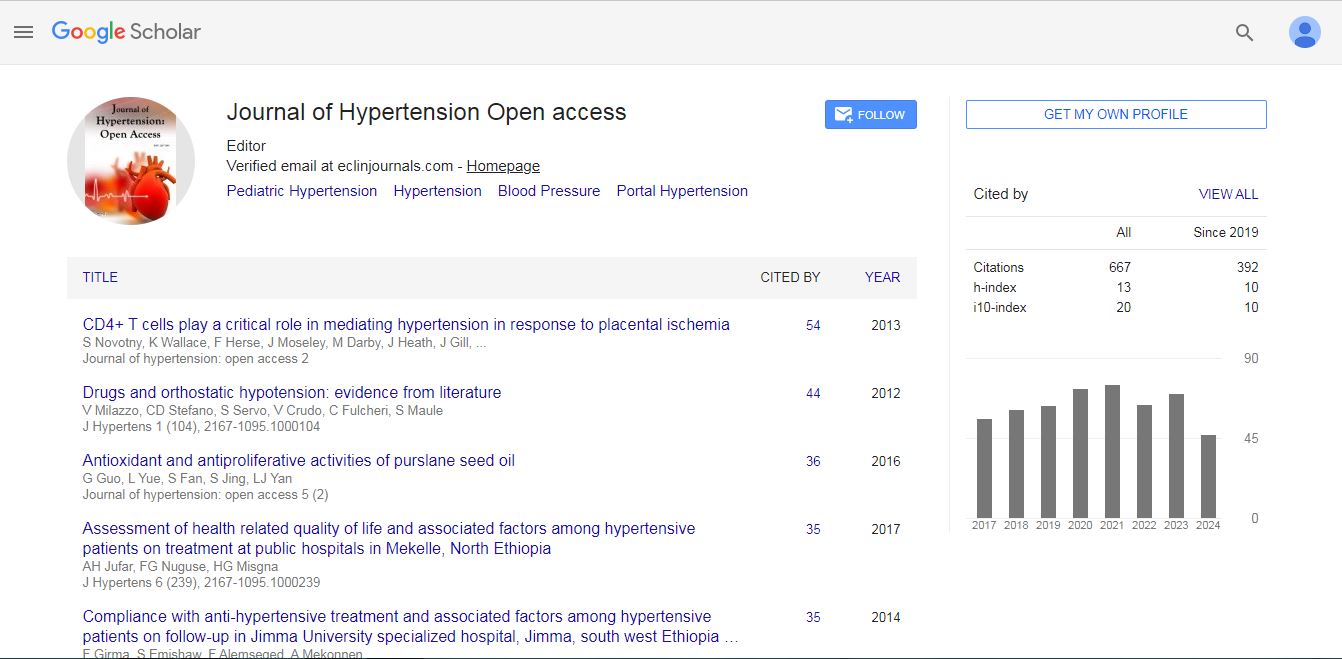
Journal of Hypertension: Open Access received 614 citations as per Google Scholar report