Perspective - (2025) Volume 16, Issue 4
Received: 31-Jul-2025, Manuscript No. gjto-25-176006;
Editor assigned: 04-Aug-2025, Pre QC No. P-176006;
Reviewed: 14-Aug-2025, QC No. QC-176006;
Revised: 21-Aug-2025, Manuscript No. R-176006;
Published:
28-Aug-2025
, DOI: 10.37421/2229-8711.2025.16.458
Citation: Conti, Isabella. ”Human-AI Collaboration: Progress, Ethics, Trust.” Global J Technol Optim 16 (2025):458.
Copyright: © 2025 Conti I. This is an open-access article distributed under the terms of the Creative Commons Attribution License, which permits unrestricted use, distribution and reproduction in any medium, provided the original author and source are credited.
This paper offers a comprehensive look at how humans and machines team up in healthcare. It unpacks the various ways this collaboration is happening, from diagnosis to treatment, and highlights both the benefits like increased efficiency and the inherent challenges that come with integrating Artificial Intelligence (AI) into clinical workflows [1]. When it comes to analyzing medical images, this review dives into the fascinating world of human-Artificial Intelligence (AI) collaboration. It explores how Artificial Intelligence (AI) assists human experts in tasks like lesion detection and disease classification, outlining the architectures and methodologies that make this partnership effective while addressing common hurdles [2]. This article focuses on how we can design Artificial Intelligence (AI) systems to work well with humans, especially in situations where decisions are complex. It talks about principles for building Artificial Intelligence (AI) that truly complements human intelligence, fostering a partnership where both excel and contribute unique strengths to the decision-making process [3].
Understanding why an Artificial Intelligence (AI) makes a particular recommendation is key for humans to trust and effectively collaborate with it. This survey explores Explainable Artificial Intelligence (XAI) techniques, discussing how they enhance transparency and interpretability, which are vital for a strong human-machine partnership, particularly in fields like medicine and finance [4]. Trust is foundational in any collaboration, and this holds true for human-robot teams. This systematic review investigates what builds and breaks trust in human-robot interactions, emphasizing how factors like robot reliability, transparency, and human perception directly impact the effectiveness of their joint efforts [5]. Exploring human-Artificial Intelligence (AI) collaboration in creative domains presents unique challenges and opportunities. This paper delves into how Artificial Intelligence (AI) can augment human creativity, not replace it, in tasks like design, music composition, and writing, identifying the necessary interfaces and interaction paradigms for a truly symbiotic creative process [6]. Human-in-the-loop machine learning is a strategy where human intelligence guides Artificial Intelligence (AI) systems, particularly during data annotation, model training, and error correction. This survey lays out the landscape of these hybrid systems, showing how human oversight improves Artificial Intelligence (AI) performance and ensures more reliable outcomes, especially in critical applications [7].
Augmented Reality (AR) is transforming manufacturing by creating more intuitive and efficient human-machine collaboration. This article examines how Augmented Reality (AR) overlays digital information onto physical environments, enabling workers to perform complex tasks with Artificial Intelligence (AI) guidance, leading to fewer errors and faster production times in industrial settings [8]. As Artificial Intelligence (AI) increasingly assists in decision-making, considering the ethical dimensions of human-Artificial Intelligence (AI) collaboration becomes paramount. This paper discusses key ethical challenges, such as bias, accountability, and privacy, emphasizing the need for robust frameworks and guidelines to ensure these partnerships are fair, transparent, and aligned with human values [9]. A major challenge in human-Artificial Intelligence (AI) collaboration is Artificial Intelligence (AI)'s brittleness and its struggle with uncertainty, which can undermine trust and effectiveness. This work explores strategies to build more resilient human-Artificial Intelligence (AI) teams, focusing on how Artificial Intelligence (AI) can communicate its limitations and uncertainties, enabling humans to compensate and ensuring more robust joint performance in dynamic environments [10].
This work explores how humans and machines collaborate in healthcare, examining ways this partnership improves diagnosis and treatment, while also acknowledging the benefits like increased efficiency and the inherent challenges of integrating Artificial Intelligence (AI) into clinical workflows [1]. Similarly, in medical image analysis, human-Artificial Intelligence (AI) collaboration is crucial. This review looks at how Artificial Intelligence (AI) supports human experts in detecting lesions and classifying diseases, outlining effective methodologies and addressing common obstacles in this partnership [2]. Designing Artificial Intelligence (AI) systems for effective human collaboration, particularly in complex decision-making, requires careful consideration. The focus is on building Artificial Intelligence (AI) that truly complements human intelligence, creating partnerships where both excel and contribute unique strengths [3]. A critical aspect for trust and collaboration is understanding why an Artificial Intelligence (AI) makes a particular recommendation. Explainable Artificial Intelligence (XAI) techniques enhance transparency and interpretability, which are vital for strong human-machine partnerships in fields like medicine and finance [4]. Beyond Artificial Intelligence (AI), trust is foundational in any human-robot team. Factors like robot reliability, transparency, and human perception directly affect the effectiveness of joint efforts, as highlighted by a systematic review on human-robot interactions [5].
Human-Artificial Intelligence (AI) collaboration also opens unique possibilities in creative domains, augmenting rather than replacing human creativity in tasks like design, music, and writing, requiring specific interfaces for a symbiotic process [6]. Another strategy is human-in-the-loop machine learning, where human intelligence guides Artificial Intelligence (AI) systems for data annotation, model training, and error correction. This oversight improves Artificial Intelligence (AI) performance and ensures more reliable outcomes in critical applications [7]. Furthermore, Augmented Reality (AR) transforms manufacturing by creating more intuitive human-machine collaboration, allowing workers to perform complex tasks with Artificial Intelligence (AI) guidance, leading to fewer errors and faster production times [8]. As Artificial Intelligence (AI) increasingly assists in decision-making, ethical dimensions of human-Artificial Intelligence (AI) collaboration become paramount. Discussions focus on challenges such as bias, accountability, and privacy, stressing the need for robust frameworks aligned with human values [9]. Finally, addressing Artificial Intelligence (AI)'s brittleness and struggle with uncertainty is a major challenge. Strategies aim to build resilient human-Artificial Intelligence (AI) teams by having Artificial Intelligence (AI) communicate its limitations, allowing humans to compensate and ensure robust joint performance in dynamic environments [10].
Human-machine collaboration is a rapidly evolving field, integrating Artificial Intelligence (AI) and robotics across diverse sectors. In healthcare, this partnership enhances diagnosis and treatment, improving efficiency despite inherent challenges [1]. Medical image analysis benefits significantly from Artificial Intelligence (AI) assistance, with methodologies designed to overcome common hurdles [2]. Effective collaboration relies on carefully designed Artificial Intelligence (AI) systems that complement human intelligence, particularly in complex decision-making scenarios [3]. Transparency and interpretability, often facilitated by Explainable Artificial Intelligence (XAI) techniques, are crucial for building trust in these partnerships [4]. Trust is also a cornerstone in human-robot teams, influenced by factors like reliability and human perception [5]. Beyond traditional applications, Artificial Intelligence (AI) augments human creativity in fields like design and writing, fostering symbiotic creative processes [6]. The human-in-the-loop approach ensures human oversight in machine learning, improving Artificial Intelligence (AI) performance and reliability [7]. Manufacturing processes are also revolutionized by Augmented Reality (AR), enabling efficient human-machine interaction and reducing errors [8]. However, this widespread adoption brings ethical considerations, including bias, accountability, and privacy, necessitating robust frameworks [9]. A significant challenge remains Artificial Intelligence (AI)'s brittleness and uncertainty; addressing this by enabling Artificial Intelligence (AI) to communicate its limitations is key to building resilient human-Artificial Intelligence (AI) teams and ensuring robust joint performance [10].
None
None
Robert SJ, Catherine AJ, Matthew JW. "Human-machine collaboration in health care: A systematic review".J Biomed Inform 147 (2023):104523.
Indexed at, Google Scholar, Crossref
Ying Z, Qi C, Song L. "Human-AI collaboration for medical image analysis: A review".Med Image Anal 82 (2022):102602.
Indexed at, Google Scholar, Crossref
Christopher AG, Krzysztof AG, Mary AJ. "Designing for effective human-AI collaboration in complex decision-making".ACM Trans Comput-Hum Interact 28 (2021):1-32.
Indexed at, Google Scholar, Crossref
Andreas H, Christian KK, Ruth EK. "Explainable AI for human-machine collaboration: A survey".KI - Künstliche Intelligenz 34 (2020):297-323.
Indexed at, Google Scholar, Crossref
Sung HL, Myung KK, Ji HP. "The role of trust in human-robot collaboration: A systematic review".Int J Soc Robot 14 (2022):121-140.
Indexed at, Google Scholar, Crossref
Robert GS, Laura MJ, David KB. "Human-AI teaming for creative tasks: Challenges and opportunities".AI & Society 38 (2023):49-65.
Indexed at, Google Scholar, Crossref
Steven LW, Jeffrey KZ, Melissa LC. "Human-in-the-loop machine learning: A survey".ACM Comput Surv 53 (2020):1-35.
Indexed at, Google Scholar, Crossref
David MM, Patrick QH, Robert EC. "Enhancing human-machine collaboration in manufacturing with augmented reality".Robot Comput Integr Manuf 67 (2021):101990.
Indexed at, Google Scholar, Crossref
Emily LG, Andrew KH, Brian CW. "Ethical considerations in human-AI collaboration for decision support".AI Ethics 3 (2023):173-191.
Indexed at, Google Scholar, Crossref
John MB, Katherine AD, Laura EM. "Towards robust human-AI collaboration: Addressing brittleness and uncertainty".IEEE Intell Syst 36 (2021):74-81.
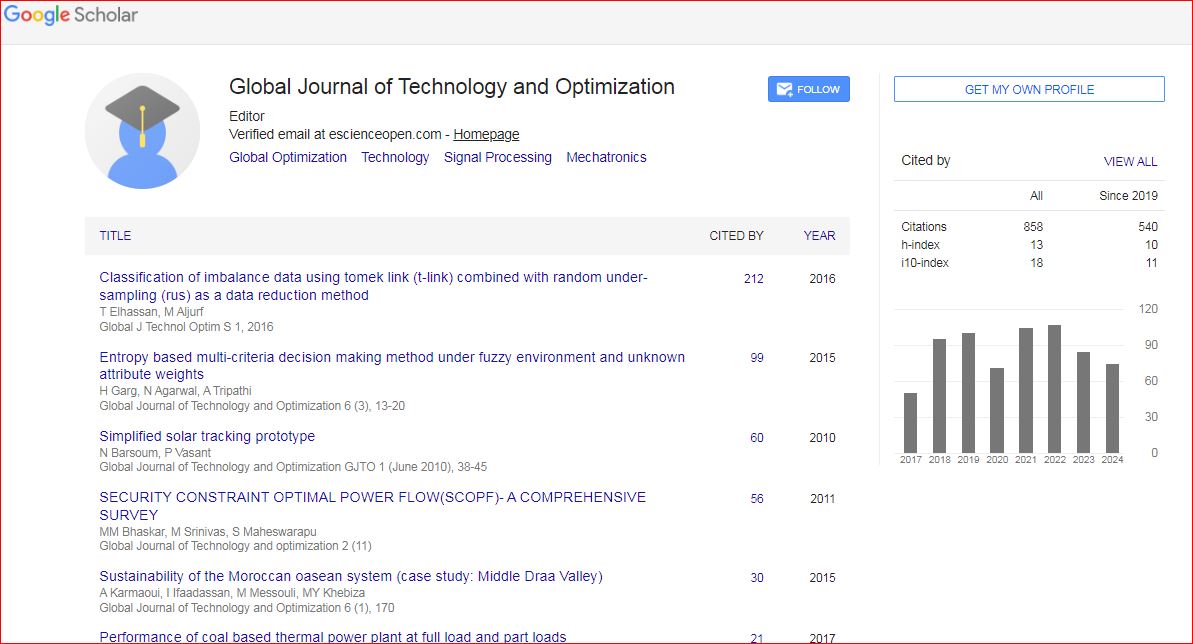
Global Journal of Technology and Optimization received 847 citations as per Google Scholar report