Brief Report - (2025) Volume 16, Issue 2
Received: 28-Mar-2025, Manuscript No. gjto-25-175358;
Editor assigned: 31-Mar-2025, Pre QC No. P-175358;
Reviewed: 14-Apr-2025, QC No. QC-175358;
Revised: 21-Apr-2025, Manuscript No. R-175358;
Published:
28-Apr-2025
, DOI: 10.37421/2229-8711.2025.16.435
Citation: Kaito, Marisa. ”Holistic Strategies for Performance Optimization.”
Global J Technol Optim 16 (2025):435.
Copyright: © 2025 Kaito M. This is an open-access article distributed under the terms of the Creative Commons Attribution License, which permits unrestricted use, distribution
and reproduction in any medium, provided the original author and source are credited.
Individualized coaching is a fundamental strategy for boosting workplace performance. Research confirms that personalized coaching interventions significantly enhance employee effectiveness and promote skill development. Tailored feedback and goal setting are critical in fostering professional growth and achieving superior outcomes [1]. Artificial Intelligence (AI) fundamentally reshapes sports performance. AI tools are increasingly employed for athlete data analysis, precise performance prediction, and personalized training regimens. AI offers a substantial competitive advantage, optimizing athletic potential and leading to improved results [2]. Neurofeedback presents a compelling avenue for enhancing performance in healthy individuals. Systematic reviews reveal that deliberate brain activity training improves attention, cognitive function, and athletic skills. This technique involves learning self-regulation of brain waves to unlock higher mental and physical capabilities [3]. Sleep is an indispensable component for peak athletic performance. Deprivation of quality sleep profoundly impairs training adaptation, slows recovery, and negatively impacts competitive outcomes. Sufficient and restorative sleep is a crucial factor for athletes striving to reach their ultimate physical and mental potential [4].
Mental toughness is a pivotal psychological attribute for elevating performance. It encompasses resilience, unwavering focus, and steadfast determination, empowering individuals to effectively navigate pressure and consistently perform at elite levels. This highlights the profound influence of a strong mind in attaining success [5]. Caffeine supplementation demonstrably influences acute sport performance. Comprehensive reviews confirm that caffeine can acutely improve various facets of athletic prowess, ranging from endurance to strength, across different sports. These findings firmly establish caffeine's utility as a legitimate ergogenic aid when implemented strategically [6]. Optimizing performance in combat sports necessitates specific nutritional strategies. Systematic reviews detail how planned diets and targeted supplementation enhance strength, power output, accelerate recovery, and facilitate effective weight management for athletes in disciplines like boxing or MMA. This approach emphasizes bespoke nutrition to meet unique energy demands [7]. Effective leadership plays an intricate yet crucial role in elevating team performance. Research indicates that strong leadership cultivates trust within a team, and this fostered trust mediates the relationship, ultimately leading to improved collective outcomes. Robust leadership directly translates into superior team functioning and goal attainment [8].
Mindfulness-based interventions are gaining traction as potent tools for performance enhancement. Systematic reviews illustrate how practices like meditation and conscious breathing sharpen focus, mitigate stress, and bolster overall cognitive and emotional regulation. This suggests that cultivating mindfulness offers a powerful strategy for individuals to refine mental acuity and resilience in high-pressure scenarios [9]. Gamification, when implemented thoughtfully, can substantially improve performance in professional training contexts. Systematic reviews reveal that integrating game-like elements boosts engagement and motivation, leading to enhanced skill acquisition and task proficiency, especially among healthcare professionals. This offers a fresh perspective on optimizing training outcomes and fostering continuous development [10].
Achieving peak performance is a pervasive goal, spanning diverse domains from individual professional growth in the workplace to the intense demands of competitive athletics. This pursuit consistently relies on a multifaceted array of strategies that fundamentally address both cognitive and psychological dimensions. At its core, individualized coaching consistently demonstrates a profound positive impact on employee effectiveness and skill development. This success is primarily achieved through the meticulous application of personalized feedback and the establishment of clear, attainable goal settings, which collectively foster sustained professional growth and lead to superior organizational outcomes [1]. Similarly, inherent psychological traits, notably mental toughness, characterized by resilience, focus, and determination, are vital for navigating pressure and maintaining high performance [5]. Cultivating specific brain activity through neurofeedback also shows promise, leading to improvements in attention, cognitive function, and athletic skills by enabling individuals to control their brain waves for enhanced mental and physical capabilities [3].
In the highly demanding world of sports, foundational physiological elements are paramount for success. Adequate, high-quality sleep is indispensable, as its deprivation significantly impairs training adaptation, slows recovery, and negatively affects competition outcomes. This highlights sleep as a critical, non-negotiable factor for athletes striving for their ultimate physical and mental potential [4]. Complementing this, caffeine supplementation has a well-documented impact on acute sport performance. Research confirms that caffeine can acutely enhance various facets of athletic prowess, from endurance to strength, across different sports, establishing its utility as an ergogenic aid when strategically implemented [6]. Furthermore, specialized nutritional strategies are vital, particularly in intense combat sports, where tailored diets and supplementation optimize strength, power, recovery, and weight management to meet unique energy demands [7].
Beyond individual enhancements, modern approaches increasingly leverage sophisticated technology and dynamic organizational principles to drive performance across various sectors. Artificial Intelligence (AI) is rapidly transforming sports, offering advanced tools for athlete data analysis, precise performance prediction, and creating personalized training programs. This suggests AI provides a significant, often unparalleled, competitive edge in optimizing athletic potential and competitive results [2]. In a different but equally impactful vein, effective leadership plays an intricate yet crucial role in elevating team performance. Research indicates that strong leadership cultivates an environment of deep trust within a team, and this fostered trust then mediates the relationship to improved collective outcomes, underscoring how robust leadership directly translates into better team functioning, enhanced cohesion, and more effective goal attainment [8].
The landscape of performance enhancement is also being shaped by innovative methodologies focused on refining learning capabilities and bolstering mental fortitude. Mindfulness-based interventions, through practices such as structured meditation and conscious breathing exercises, are increasingly recognized for their potent ability to sharpen focus, significantly mitigate stress levels, and boost overall cognitive and emotional regulation. This effectively suggests that cultivating mindfulness offers a powerful and accessible strategy for individuals seeking to refine their mental acuity and enhance their resilience when confronted with high-pressure scenarios, enabling clearer thinking and better decision-making under duress [9].
Concurrently, in professional training contexts, particularly noteworthy for healthcare professionals, gamification is proving to be a highly effective approach for engagement and skill development. Systematic reviews reveal that integrating game-like elements into learning and development programs dramatically boosts engagement and motivation among participants. Subsequently, this increased engagement directly leads to enhanced skill acquisition and improved task proficiency. Here's the thing, gamification offers a fresh, innovative perspective on optimizing educational and training outcomes, fostering continuous development, and ensuring more effective knowledge transfer in critical professional fields, making learning more dynamic and impactful [10].
Various strategies are crucial for enhancing performance across diverse domains, from the workplace to athletic competition. Individualized coaching significantly boosts workplace performance through personalized feedback and goal setting. Artificial Intelligence is revolutionizing sports by optimizing athlete data, predicting performance, and tailoring training programs. Neurofeedback offers a way to improve cognitive function, attention, and athletic skills by training brain activity. For athletes, adequate sleep is paramount, as deprivation severely hampers training adaptation, recovery, and competitive results. Mental toughness, characterized by resilience, focus, and determination, is a key psychological trait for coping with pressure and performing at high levels. Caffeine supplementation consistently enhances acute sport performance, improving endurance and strength when used strategically. Specific nutritional strategies are vital for combat sports, optimizing strength, power, recovery, and weight management. Effective leadership is critical for team performance, fostering trust that mediates improved collective outcomes. Mindfulness-based interventions, including meditation, enhance focus, reduce stress, and improve cognitive and emotional regulation. Lastly, gamification in professional training, particularly for healthcare professionals, significantly boosts engagement, motivation, and skill acquisition. Together, these approaches highlight a holistic view of performance optimization, integrating psychological, physiological, technological, and environmental factors.
None
None
Thomas T, Annelies EVV, Marijke AP. "The effects of individualized coaching on performance enhancement in the workplace: A systematic review and meta-analysis.".J Occup Organ Psychol 94 (2021):1-28.
Indexed at, Google Scholar, Crossref
Majid V, Hamid A, Bahram A. "Artificial Intelligence in Sports Performance Enhancement: A Systematic Review.".Front Sports Act Living 5 (2023):1111059.
Indexed at, Google Scholar, Crossref
Hassan M, Hamid RM, Mohsen M. "Neurofeedback for Performance Enhancement in Healthy Individuals: A Systematic Review and Meta-Analysis.".J Neurotherapy 24 (2020):1-17.
Indexed at, Google Scholar, Crossref
Kelly CV, Rachel O, Stephen RH. "Sleep and athletic performance: the effects of sleep deprivation on training adaptation, recovery, and competition.".J Sports Med Phys Fitness 59 (2019):669-679.
Indexed at, Google Scholar, Crossref
Daniel FG, Sheldon H, Stuart G. "The Role of Mental Toughness in Enhancing Performance: A Systematic Review.".J Sport Exerc Psychol 43 (2021):221-236.
Indexed at, Google Scholar, Crossref
Nanci SG, Trisha AV, Michael TN. "Acute Effects of Caffeine Supplementation on Sport Performance: A Systematic Review and Meta-Analysis.".J Int Soc Sports Nutr 18 (2021):1-46.
Indexed at, Google Scholar, Crossref
G. GA, B. G, V. dSP. "Nutritional strategies for performance enhancement in combat sports: A systematic review.".J Sports Sci 38 (2020):409-421.
Indexed at, Google Scholar, Crossref
John MS, Simon KL, Shaochen C. "Leadership, Team Trust, and Performance: A Moderated Mediation Model.".J Appl Psychol 106 (2021):78-90.
Indexed at, Google Scholar, Crossref
Deepak S, Rakesh S, Anurag S. "Mindfulness-based interventions for performance enhancement: A systematic review of the literature.".Mindfulness 14 (2023):227-241.
Indexed at, Google Scholar, Crossref
Hui T, Poh O, Swee MT. "Effectiveness of Gamification in Healthcare Professionals' Training for Performance Enhancement: A Systematic Review.".J Med Syst 48 (2024):7.
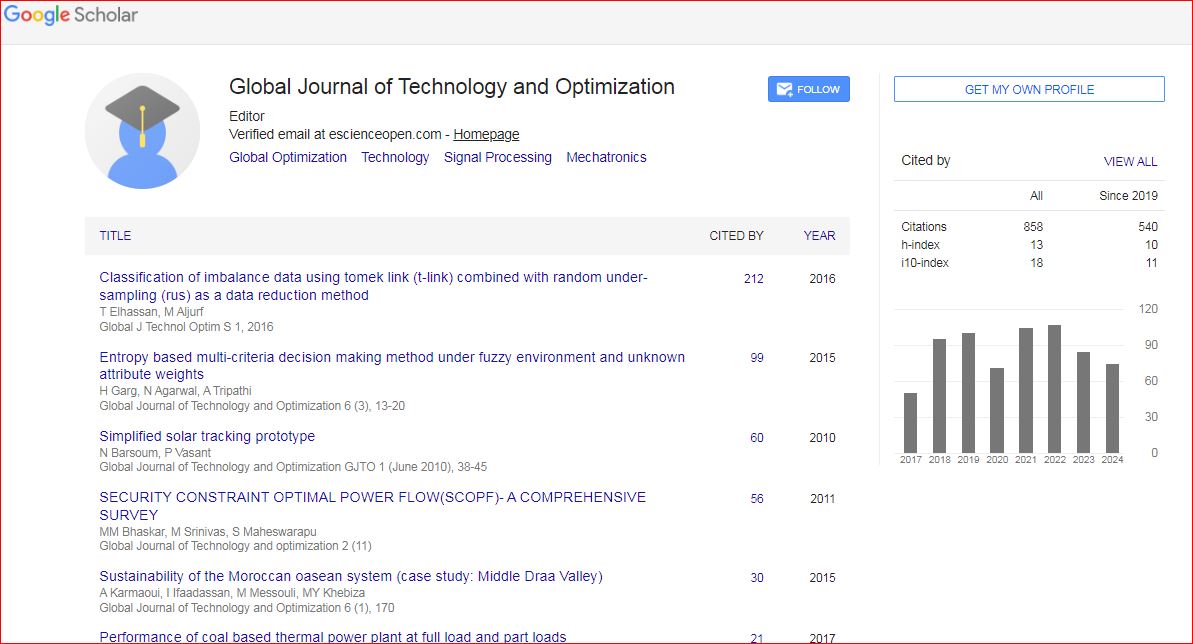
Global Journal of Technology and Optimization received 847 citations as per Google Scholar report