Short Communication - (2025) Volume 14, Issue 6
Received: 01-Dec-2025, Manuscript No. jhoa-26-187876;
Editor assigned: 03-Dec-2025, Pre QC No. P-187876;
Reviewed: 17-Dec-2025, QC No. Q-187876;
Revised: 22-Dec-2025, Manuscript No. R-187876;
Published:
29-Dec-2025
, DOI: 10.37421/2167-1095.2025.14.549
Citation: Morales, Diego. ”Holistic Hypertension Management: Personalized, Integrated, and Optimized Care.” J Hypertens 14 (2025):549.
Copyright: © 2025 Morales D. This is an open-access article distributed under the terms of the Creative Commons Attribution License, which permits unrestricted use, distribution and reproduction in any medium, provided the original author and source are credited.
Effective hypertension management is crucial for enhancing patient outcomes, with a strong emphasis on personalized treatment plans that account for comorbidities, lifestyle, and adherence to therapy [1].
The selection of antihypertensive drug classes plays a significant role in influencing renal outcomes among hypertensive patients, suggesting that certain medication combinations may offer superior protection against chronic kidney disease progression [2].
Telemedicine has emerged as a valuable tool for hypertension management, particularly in rural areas, by improving blood pressure control and patient engagement through remote monitoring and virtual consultations [3].
Integrated management strategies for patients with both hypertension and diabetes have demonstrated improved glycemic and blood pressure control, leading to a reduced risk of microvascular and macrovascular complications [4].
Pharmacogenomics offers a promising avenue for optimizing antihypertensive therapy by identifying specific gene polymorphisms associated with differential responses to various medications [5].
Lifestyle interventions, encompassing diet and exercise, are effective in managing resistant hypertension, especially when combined with optimal pharmacotherapy, leading to significant improvements in blood pressure control [6].
Sustained blood pressure control over the long term is paramount for preventing major adverse cardiovascular events, as evidenced by studies examining long-term cardiovascular outcomes in patients with achieved versus sustained blood pressure control [7].
The complexity of antihypertensive medication regimens significantly impacts patient adherence and subsequent blood pressure control, with simplified dosing schedules and fixed-dose combinations showing potential for better outcomes [8].
Socioeconomic factors play a substantial role in hypertension treatment outcomes, highlighting disparities in access to care and treatment effectiveness, thus necessitating targeted interventions to address health inequities [9].
Advances in the diagnosis and management of secondary hypertension are crucial for achieving definitive control by identifying and treating specific underlying reversible causes of elevated blood pressure [10].
The critical importance of effective hypertension management in improving patient outcomes cannot be overstated, necessitating personalized treatment strategies that comprehensively consider factors such as comorbidities, lifestyle modifications, and patient adherence to prescribed regimens [1].
Exploring the impact of various antihypertensive drug classes on renal outcomes reveals significant variations in nephroprotective effects, indicating that specific medication combinations may provide enhanced protection against the progression of chronic kidney disease in individuals diagnosed with hypertension [2].
The implementation of telemedicine for hypertension management, particularly in underserved rural populations, has proven effective in enhancing blood pressure control and fostering greater patient engagement by overcoming common access barriers through remote monitoring and virtual consultations [3].
Integrated management approaches targeting both hypertension and diabetes have shown considerable success in achieving better control over both glycemic levels and blood pressure, thereby contributing to a significant reduction in the incidence of microvascular and macrovascular complications [4].
A systematic review of pharmacogenomics in antihypertensive drug response has identified specific gene polymorphisms that are associated with differential patient responses to commonly prescribed antihypertensive medications, thereby opening pathways for more individualized and effective therapeutic strategies [5].
Lifestyle interventions, including dietary adjustments and regular exercise programs, have been evaluated for their effectiveness in managing resistant hypertension and have shown that tailored modifications, when integrated with optimal pharmacotherapy, can substantially improve blood pressure control in challenging cases [6].
Observational studies exploring long-term cardiovascular outcomes have reinforced the understanding that consistent and effective hypertension management over extended periods is fundamental for the prevention of major adverse cardiovascular events, differentiating between patients who achieve sustained blood pressure control and those who do not [7].
Research investigating the influence of antihypertensive medication regimen complexity on clinical outcomes suggests that simpler dosing schedules and the use of fixed-dose combination pills are associated with improved patient adherence and, consequently, better overall blood pressure control [8].
The impact of socioeconomic status on hypertension treatment outcomes reveals significant health disparities, including inequities in access to quality care and variations in treatment effectiveness, which underscores the critical need for targeted interventions to address these systemic issues within hypertensive populations [9].
Recent advancements in the diagnosis and management of secondary hypertension emphasize the importance of identifying specific underlying causes and implementing targeted treatment strategies, particularly focusing on reversible etiologies to achieve definitive and sustained control of elevated blood pressure [10].
This collection of research underscores the multifaceted nature of hypertension management. Key themes include the critical role of personalized treatment strategies, considering factors like adherence, comorbidities, and lifestyle modifications. The impact of different antihypertensive drug classes on renal outcomes, the effectiveness of telemedicine in improving access and control, and integrated management of hypertension with other conditions like diabetes are highlighted. Pharmacogenomics, lifestyle interventions for resistant hypertension, and the long-term benefits of sustained blood pressure control are also discussed. Furthermore, the influence of medication regimen complexity on adherence, the impact of socioeconomic determinants on treatment outcomes, and the importance of managing secondary hypertension are explored, emphasizing a comprehensive approach to optimize patient care.
None
None
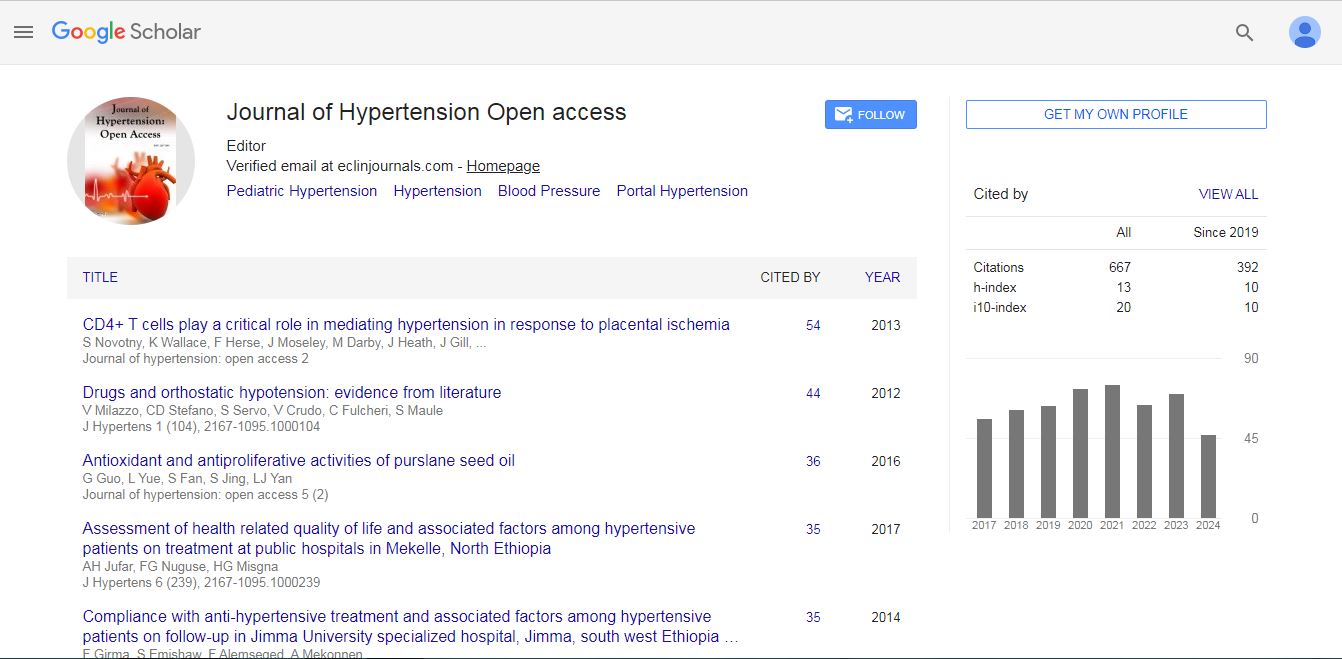
Journal of Hypertension: Open Access received 614 citations as per Google Scholar report