Brief Report - (2025) Volume 16, Issue 4
Received: 02-Jul-2025, Manuscript No. jch-26-178770;
Editor assigned: 04-Jul-2025, Pre QC No. P-178770;
Reviewed: 17-Jul-2025, QC No. Q-178770;
Revised: 23-Jul-2025, Manuscript No. R-178770;
Published:
30-Jul-2025
, DOI: 10.37421/2157-7099.2025.16.804
Citation: Demir, Ayşe K.. ”Histology Revolutionized: New Electron Microscopy Insights.” J Cytol Histol 16 (2025):804.
Copyright: © 2025 Demir K. Ayşe This is an open-access article distributed under the terms of the Creative Commons Attribution License, which permits unrestricted use, distribution and reproduction in any medium, provided the original author and source are credited.
Recent breakthroughs in electron microscopy are revolutionizing histological studies by enabling the visualization of cellular structures at unprecedented molecular detail. Cryo-electron tomography (cryo-ET) and super-resolution imaging are at the forefront of these advancements, allowing for in situ analysis of complex cellular architectures and their relationships with disease pathologies. These powerful techniques offer new insights into fundamental biological processes and potential therapeutic targets, transforming our understanding of cellular organization and function. Super-resolution microscopy techniques, including STORM and PALM, are providing optical resolution below the diffraction limit. This enables the visualization of protein localization and interactions within cells with nanoscale precision, which is crucial for understanding the spatial organization of molecules in organelles and the extracellular matrix. The contribution of these methods to detailed histological analysis is significant, offering a level of detail previously unattainable. The integration of correlative light and electron microscopy (CLEM) represents a powerful approach that leverages the strengths of both light and electron microscopy. CLEM allows researchers to first identify specific cellular features using light microscopy and then examine them at ultrastructural resolution with electron microscopy. This facilitates precise localization and detailed characterization of histological components, bridging the gap between functional and structural insights. Advances in focused ion beam (FIB) milling coupled with scanning electron microscopy (SEM) are enabling high-throughput serial sectioning and three-dimensional reconstruction of large biological volumes. This technique is invaluable for understanding tissue organization and the spatial relationships of cells within their native environment, significantly enhancing histological studies by providing a comprehensive view of tissue architecture. Machine learning and artificial intelligence are increasingly being applied to electron microscopy image analysis. This includes automated segmentation, feature detection, and classification of cellular structures, which greatly accelerates the interpretation of complex histological datasets. The application of these computational tools improves reproducibility and enables quantitative analysis that was previously unfeasible. Developments in electron detector technology and computational imaging are enhancing signal-to-noise ratios and improving resolution in scanning electron microscopy (SEM). This allows for clearer imaging of surface topography and fine details in histological samples, aiding in the identification of subtle morphological changes associated with disease. The improved clarity provides more robust diagnostic information. Cryo-electron tomography (cryo-ET) is rapidly advancing the study of cellular structures in their native, hydrated state. This technique avoids artifacts from chemical fixation and dehydration, providing high-resolution three-dimensional reconstructions of macromolecular complexes and organelles. This is transformative for understanding tissue architecture and function, offering a more accurate representation of cellular environments. The development of advanced sample preparation techniques, such as vitrification and cryo-FIB milling, is crucial for successful cryo-electron microscopy of biological samples. These methods preserve cellular ultrastructure without ice crystal damage, allowing for high-resolution imaging of delicate histological features. Proper sample preparation is foundational to obtaining high-quality data. High-throughput cryo-electron microscopy (HT-cryo-EM) is enabling the rapid acquisition and processing of cryo-EM data from many individual particles or cells. This accelerates the study of heterogeneous biological samples, including diverse cellular populations within histological tissues, and can reveal subtle structural variations. The increased throughput allows for more comprehensive investigations. The development of advanced contrast-enhancing techniques and aberration correctors in transmission electron microscopy (TEM) continues to push the boundaries of resolution. This allows for detailed nanoscale imaging of cellular ultrastructure, including membranes, organelles, and cytoskeletal elements, which are fundamental to histological interpretation. These improvements refine our ability to discern fine structures.
Recent breakthroughs in electron microscopy, particularly in cryo-electron tomography (cryo-ET) and super-resolution imaging, are revolutionizing histological studies by enabling the visualization of cellular structures at unprecedented molecular detail. These advancements allow for in situ analysis of complex cellular architectures and their relationships with disease pathologies, offering new insights into fundamental biological processes and potential therapeutic targets [1].
Super-resolution microscopy techniques, such as STORM and PALM, are providing optical resolution below the diffraction limit, allowing visualization of protein localization and interactions within cells with nanoscale precision. This is crucial for understanding the spatial organization of molecules in organelles and the extracellular matrix, contributing significantly to detailed histological analysis [2].
The integration of correlative light and electron microscopy (CLEM) is a powerful approach that leverages the strengths of both techniques. CLEM allows researchers to first identify specific cellular features using light microscopy and then examine them at ultrastructural resolution with electron microscopy, facilitating precise localization and detailed characterization of histological components [3].
Advances in focused ion beam (FIB) milling coupled with scanning electron microscopy (SEM) are enabling high-throughput serial sectioning and 3D reconstruction of large biological volumes. This technique is invaluable for understanding tissue organization and the spatial relationships of cells within their native environment, significantly enhancing histological studies [4].
Machine learning and artificial intelligence are being increasingly applied to electron microscopy image analysis for automated segmentation, feature detection, and classification of cellular structures. This greatly accelerates the interpretation of complex histological datasets, improving reproducibility and enabling quantitative analysis that was previously unfeasible [5].
Developments in electron detector technology and computational imaging are enhancing signal-to-noise ratios and improving resolution in scanning electron microscopy (SEM). This allows for clearer imaging of surface topography and fine details in histological samples, aiding in the identification of subtle morphological changes associated with disease [6].
Cryo-electron tomography (cryo-ET) is rapidly advancing the study of cellular structures in their native, hydrated state. This technique avoids artifacts from chemical fixation and dehydration, providing high-resolution 3D reconstructions of macromolecular complexes and organelles, which is transformative for understanding tissue architecture and function [7].
The development of advanced sample preparation techniques, such as vitrification and cryo-FIB milling, is crucial for successful cryo-electron microscopy of biological samples. These methods preserve cellular ultrastructure without ice crystal damage, allowing for high-resolution imaging of delicate histological features [8].
High-throughput cryo-electron microscopy (HT-cryo-EM) is enabling the rapid acquisition and processing of cryo-EM data from many individual particles or cells. This accelerates the study of heterogeneous biological samples, including diverse cellular populations within histological tissues, and can reveal subtle structural variations [9].
The development of advanced contrast-enhancing techniques and aberration correctors in transmission electron microscopy (TEM) continues to push the boundaries of resolution. This allows for detailed nanoscale imaging of cellular ultrastructure, including membranes, organelles, and cytoskeletal elements, which are fundamental to histological interpretation [10].
Recent advancements in electron microscopy, including cryo-electron tomography (cryo-ET), super-resolution imaging, and correlative light and electron microscopy (CLEM), are significantly improving histological studies. These techniques offer unprecedented molecular detail and enable in situ analysis of cellular structures and their relation to disease. Innovations in focused ion beam (FIB) milling with SEM allow for high-throughput 3D reconstruction of large biological volumes, enhancing the understanding of tissue organization. Machine learning and AI are accelerating the analysis of complex histological data from electron microscopy, improving efficiency and quantitative insights. Improved detector technology in SEM and advanced aberration correction in TEM are leading to clearer imaging and higher resolution of cellular ultrastructure. Cryo-EM techniques, supported by advanced sample preparation methods like vitrification and cryo-FIB milling, preserve native cellular states for detailed imaging. High-throughput cryo-EM is speeding up the study of heterogeneous biological samples, revealing subtle structural variations. These combined technological advancements are transforming the field of histology by providing deeper insights into cellular architecture, function, and disease.
None
None
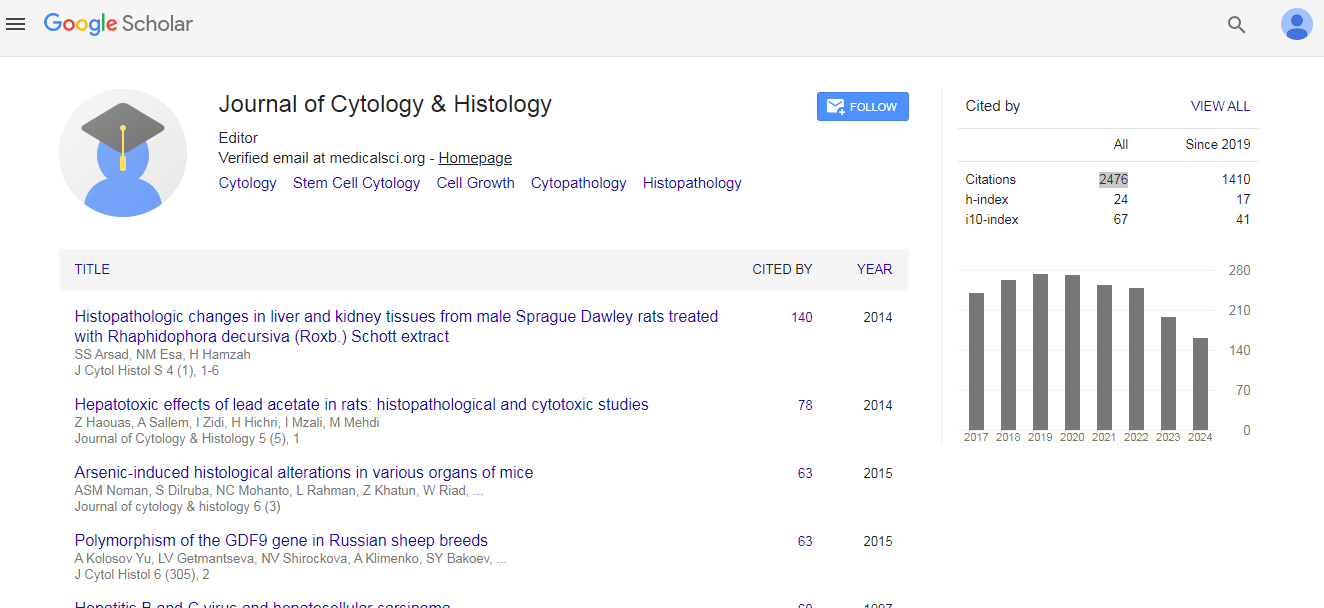
Journal of Cytology & Histology received 2476 citations as per Google Scholar report