Opinion - (2025) Volume 11, Issue 2
Received: 01-Apr-2025, Manuscript No. jssc-26-188256;
Editor assigned: 03-Apr-2025, Pre QC No. P-188256;
Reviewed: 17-Apr-2025, QC No. Q-188256;
Revised: 22-Apr-2025, Manuscript No. R-188256;
Published:
29-Apr-2025
, DOI: 10.37421/2472-0437.2025.11.289
Citation: El-Sayed, Ahmed. ”High-Strength Steel: Construction
Advantages and Challenges.” J Steel Struct Constr 11 (2025):289.
Copyright: © 2025 El-Sayed A. This is an open-access article distributed under the terms of the Creative Commons Attribution License, which permits unrestricted use,
distribution and reproduction in any medium, provided the original author and source are credited.
High-strength steel (HSS) is revolutionizing modern building construction, offering substantial advantages that enable the development of more efficient and slender structural members. Its enhanced mechanical properties, particularly higher yield and tensile strength, are central to these advancements, allowing for reduced material usage and faster erection processes. This paper delves into the structural behavior of HSS, examining its implications for member design, buckling resistance, and connection detailing, underscoring the necessity for specialized design codes and fabrication techniques to fully leverage its potential benefits. Furthermore, it touches upon the economic feasibility and sustainability aspects associated with its application [1].
The seismic performance of building frames constructed with high-strength steel members is a critical area of investigation. Research in this domain analyzes the ductility and energy dissipation capacity of these frames under dynamic loading conditions. The findings suggest that while HSS can contribute to lighter structures, meticulous detailing of connections is paramount to ensure adequate seismic resilience, especially concerning the formation of plastic hinges and the overall stability of the frame [2].
Buckling behavior in slender columns fabricated from high-strength steel is another significant aspect explored. Through numerical simulations and experimental validation, studies assess the critical buckling loads and post-buckling response. These investigations highlight that HSS columns exhibit a more pronounced elastic buckling behavior, which consequently demands precise geometric tolerances and carefully controlled support conditions to avert premature failure [3].
Investigations into the design and behavior of connections for high-strength steel members are crucial for practical implementation. These studies examine various connection types, including bolted and welded joints, and their capacity to effectively transfer high forces. A key takeaway is the inherent challenges associated with HSS connections, such as the elevated risk of brittle fracture and the consequent need for advanced welding procedures and high-strength bolts to guarantee joint integrity [4].
The fatigue life of structural components made from high-strength steel under cyclic loading is a vital consideration for long-term durability. Research addresses the susceptibility of HSS to fatigue cracking and proposes design strategies to mitigate this risk in structures subjected to repeated stress cycles, such as bridges and tall buildings. Emphasis is placed on the importance of surface finish and stress concentration factors in managing fatigue performance [5].
Constructability aspects of buildings utilizing high-strength steel are thoroughly discussed, examining the practical considerations involved in fabrication, transportation, and erection. These analyses highlight enhanced handling requirements due to higher member forces and the potential for increased welding distortion, underscoring the necessity for skilled labor and advanced construction technologies to facilitate efficient project execution [6].
The fire resistance of building structures incorporating high-strength steel is evaluated to understand its behavior under extreme thermal conditions. Studies analyze the performance of HSS members at elevated temperatures and assess the effectiveness of various fire protection systems. The findings indicate that while HSS may possess higher initial strength, its response to prolonged fire exposure necessitates careful thermal analysis and appropriate insulation measures to maintain structural integrity [7].
Corrosion resistance of different grades of high-strength steel used in building construction is examined across diverse environmental conditions. This research evaluates the long-term performance of HSS under atmospheric exposure and in marine environments, offering insights into the selection of suitable protective coatings and surface treatments to enhance durability and extend the service life of structures [8].
The application of high-strength steel in the design of innovative structural systems for tall buildings is explored, focusing on its benefits in reducing superstructure weight, which in turn lowers foundation loads and facilitates more efficient seismic design. The study emphasizes the potential for architecturally expressive designs enabled by the slender sections achievable with HSS, opening new avenues for high-rise construction [9].
A comparative analysis of the performance of conventional steel versus high-strength steel in specific building components, such as beams and columns, quantifies the benefits in terms of load-carrying capacity, stiffness, and material savings. This research underscores that while HSS offers superior mechanical properties, economic considerations and constructability factors remain critical determinants for its widespread adoption in the construction industry [10].
High-strength steel (HSS) presents a paradigm shift in building construction, offering significant advantages such as enabling the use of slenderer members, reducing overall material consumption, and expediting erection processes. This paper meticulously examines the structural behavior of HSS, with a particular focus on its enhanced mechanical properties, including superior yield and tensile strength. Key insights derived from this study pertain to the implications for member design, the assessment of buckling resistance, and the intricate detailing of connections. It underscores the critical need for specialized design codes and advanced fabrication techniques to fully capitalize on the benefits that HSS offers. Moreover, the research extends to encompass the economic feasibility and sustainability aspects of employing HSS in construction projects [1].
This research rigorously investigates the seismic performance of building frames specifically constructed using high-strength steel members. The analysis delves into the ductility characteristics and the energy dissipation capacity of these frames when subjected to dynamic loading. The empirical findings strongly indicate that while the utilization of HSS can lead to the development of lighter structural systems, the meticulous detailing of connections emerges as a crucial factor in ensuring adequate seismic resilience. This is particularly pertinent concerning the predictable formation of plastic hinges and the overall stability of the structural frame under seismic events [2].
The buckling behavior of slender columns fabricated from high-strength steel is a subject of detailed exploration. This study employs advanced numerical simulations alongside experimental validation to precisely assess the critical buckling loads and the post-buckling response of such columns. The findings prominently highlight that HSS columns exhibit a more pronounced elastic buckling behavior compared to conventional steel. Consequently, this necessitates the implementation of precise geometric tolerances and carefully controlled support conditions to effectively prevent premature structural failure [3].
This study focuses its attention on the critical aspects of the design and the resultant behavior of connections intended for high-strength steel members. It undertakes a comprehensive investigation into various types of connection configurations, encompassing both bolted and welded joints, with the objective of evaluating their capacity to reliably transfer high forces. The research emphatically highlights the inherent challenges associated with HSS connections, including a heightened risk of brittle fracture. This underscores the essential requirement for employing advanced welding procedures and high-strength bolts to guarantee the integrity of these crucial structural joints [4].
The research evaluates the fatigue life of structural components meticulously fabricated from high-strength steel when subjected to cyclic loading conditions. It thoroughly addresses the inherent susceptibility of HSS to fatigue cracking and, in response, proposes practical design strategies aimed at mitigating this pervasive risk in structures that are routinely exposed to repeated stress cycles, such as bridges and skyscrapers. A significant emphasis is placed on the crucial role of surface finish and the impact of stress concentration factors in influencing fatigue performance [5].
This paper thoroughly discusses the practical aspects of constructability for buildings that incorporate the use of high-strength steel. It meticulously examines the practical considerations related to the fabrication processes, the logistical challenges of transportation, and the on-site erection of HSS members. Key considerations that emerge include the enhanced handling requirements necessitated by higher member forces and the potential for increased welding distortion, all of which underscore the vital need for skilled labor and the adoption of advanced construction technologies for efficient project execution [6].
The research systematically investigates the fire resistance characteristics of building structures that integrate high-strength steel. It provides a detailed analysis of the behavior of HSS members when exposed to elevated temperatures and evaluates the efficacy of various fire protection systems. The study's conclusions suggest that despite HSS potentially exhibiting higher initial strength, its performance under prolonged fire exposure demands careful thermal analysis and the application of appropriate insulation materials to effectively maintain the structural integrity of the building [7].
This research undertakes an examination of the corrosion resistance exhibited by different grades of high-strength steel commonly employed in building construction. It systematically evaluates the long-term performance of HSS across a spectrum of environmental conditions, taking into account factors such as atmospheric exposure and the challenging conditions found in marine environments. The study offers valuable insights into the selection of appropriate protective coatings and surface treatments that are essential for enhancing the durability and extending the service life of structures constructed with HSS [8].
The paper delves into the application of high-strength steel in the design and development of innovative structural systems specifically tailored for tall buildings. It highlights the significant advantages offered by HSS in terms of reducing the overall weight of superstructures, which consequently leads to decreased foundation loads and enables more efficient seismic design strategies. The study prominently points out the potential for creating architecturally expressive designs, facilitated by the slender sections that can be effectively achieved through the use of HSS [9].
This study presents a comprehensive comparative analysis focusing on the performance differences between conventional steel and high-strength steel when utilized in specific building components, such as beams and columns. It quantifies the distinct benefits in terms of enhanced load-carrying capacity, improved stiffness, and substantial material savings. The research emphatically underscores that while HSS demonstrably offers superior mechanical properties, critical factors such as economic considerations and constructability continue to play a pivotal role in its widespread adoption within the construction industry [10].
High-strength steel (HSS) offers significant advantages in building construction, enabling slenderer members, reduced material usage, and faster erection due to its enhanced mechanical properties like higher yield and tensile strength. Studies examine its structural behavior, focusing on implications for member design, buckling resistance, and connections, highlighting the need for specialized codes and fabrication techniques. Research also addresses seismic performance, showing that while HSS lightens structures, connection detailing is crucial for seismic resilience. Buckling analysis of HSS columns reveals a more pronounced elastic buckling behavior requiring precise tolerances. Connection design for HSS presents challenges like brittle fracture risk, necessitating advanced welding and high-strength bolts. Fatigue life evaluation suggests careful design strategies considering surface finish and stress concentrations. Constructability requires enhanced handling and advanced technologies. Fire resistance studies indicate a need for thermal analysis and insulation, while corrosion resistance research guides the selection of protective coatings. HSS is beneficial for tall buildings by reducing weight and foundation loads, allowing for expressive designs. Comparative analyses show HSS offers superior properties but economic factors and constructability remain crucial for adoption.
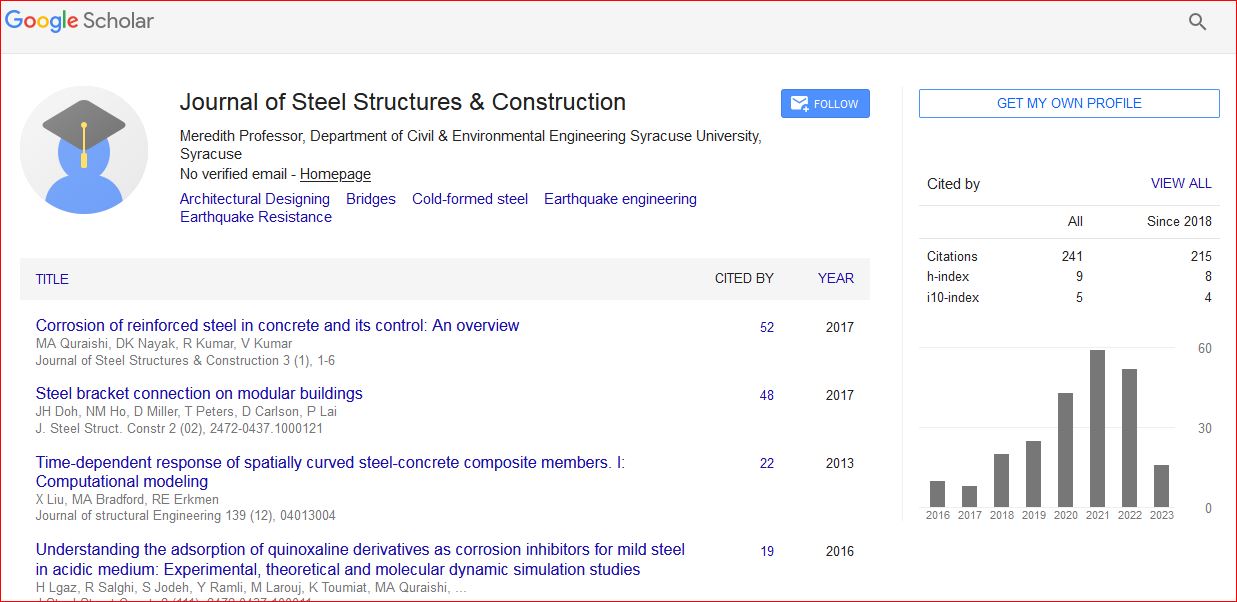
Journal of Steel Structures & Construction received 583 citations as per Google Scholar report