Opinion - (2025) Volume 11, Issue 5
Received: 01-Oct-2025, Manuscript No. jssc-26-188306;
Editor assigned: 03-Oct-2025, Pre QC No. P-188306;
Reviewed: 17-Oct-2025, QC No. Q-188306;
Revised: 22-Oct-2025, Manuscript No. R-188306;
Published:
29-Oct-2025
, DOI: 10.37421/2472-0437.2025.11.318
Citation: Nakamura, Yuki. ”High-Performance Steels: Stronger,
Lighter, Sustainable Structures.” J Steel Struct Constr 11 (2025):318.
Copyright: © 2025 Nakamura Y. This is an open-access article distributed under the terms of the Creative Commons Attribution License, which permits unrestricted use,
distribution and reproduction in any medium, provided the original author and source are credited.
High-performance steels (HPS) are revolutionizing structural engineering with their remarkable strength and ductility, paving the way for more efficient and sustainable designs. These advanced materials enable significant reductions in material usage, leading to lighter structures and enhanced seismic performance in bridges, buildings, and offshore platforms [1].
The ongoing development of HPS is focusing on advanced manufacturing techniques and innovative connection designs to fully harness their potential in various structural applications [1].
The use of high-strength steel (HSS) in bridge construction offers substantial advantages, including reduced dead load, which facilitates the construction of longer spans and improves seismic resilience. Design principles and construction practices for HSS bridges emphasize cost-effectiveness and a reduced environmental footprint, while addressing challenges like welding and fatigue life through experimental and numerical studies [2].
Quenched and tempered (Q&T) high-performance steels are particularly well-suited for seismic-resistant building structures due to their superior yield strength and ductility. This allows for the creation of more slender structural members, resulting in lighter buildings and decreased foundation loads, with detailed design considerations for seismic detailing and connection types [3].
Weathering high-performance steels (WHPS) are being explored for their dual benefits of enhanced corrosion resistance and robust mechanical properties, which contribute to lower maintenance costs and extended structural service life. Research into WHPS delves into their metallurgical aspects and performance in diverse environmental conditions, with case studies showcasing their application in exposed structures [4].
Innovations in connection designs are crucial for realizing the full benefits of high-performance steels in structural applications. This area of research focuses on developing connection details that optimize stress distribution and ensure ductile performance under extreme loading conditions, with validation through numerical simulations and experimental testing [5].
The application of high-performance steel in offshore structures presents significant advantages in weight reduction and increased load-carrying capacity, which are critical for deep-water platforms and floating facilities. This involves addressing material requirements, design codes, and fabrication challenges in harsh marine environments, with a strong emphasis on fatigue and fracture toughness [6].
Advanced high-strength steels (AHSS) with tailored microstructures are being investigated for their enhanced ductility and toughness, particularly for regions prone to earthquakes. The focus is on developing novel alloy compositions and heat treatments to achieve a balance between high yield strength and excellent deformability for effective energy dissipation during seismic events [7].
The sustainability benefits of incorporating high-performance steel into structural engineering are being quantified through life cycle assessment (LCA) methodologies. These benefits include reduced embodied energy, lower transportation emissions due to lighter structures, and extended service life, leading to less frequent replacements compared to traditional materials [8].
Research into the fatigue performance of welded joints in high-performance steels under cyclic loading is critical for ensuring the long-term durability of structures. This includes exploring advanced welding techniques and filler materials to maintain joint integrity, with experimental studies supporting the findings [9].
The potential of high-performance steel in pre-fabricated and modular construction is being examined for its capacity to reduce construction time and costs while simultaneously enhancing structural integrity. This involves evaluating design, fabrication, and erection challenges and benefits within modular building systems [10].
High-performance steels (HPS) are characterized by their enhanced strength and ductility, making them invaluable for creating more efficient and sustainable structural designs. Their application leads to a reduction in the amount of material required, resulting in lighter structures and improved seismic performance, particularly in bridges, buildings, and offshore structures [1].
Key advancements in this field involve sophisticated manufacturing techniques and novel connection designs that fully leverage the unique properties of HPS [1].
In the realm of bridge construction, the utilization of high-strength steel (HSS) significantly reduces the dead load, which in turn enables the design of longer spans and enhances seismic resilience. This approach not only proves cost-effective but also minimizes environmental impact, although challenges related to welding and fatigue life are being addressed through rigorous experimental and numerical investigations [2].
For seismic-resistant building structures, quenched and tempered (Q&T) high-performance steels offer superior yield strength and ductility. These properties allow for the fabrication of more slender and efficient structural members, leading to lighter buildings and reduced foundation loads. The accompanying design considerations encompass seismic detailing and connection types, supported by experimental validation [3].
Weathering high-performance steels (WHPS) are gaining traction due to their combined advantages of enhanced corrosion resistance and superior mechanical properties. This leads to reduced maintenance costs and an extended service life for structures. Research in this area scrutinizes the metallurgical characteristics of WHPS and their performance across various environmental conditions, with practical applications documented in bridges and facades [4].
The development of innovative connection designs is paramount for maximizing the benefits of high-performance steels in structural applications. These designs aim to optimize stress distribution and ensure ductile behavior under extreme loads, with their efficacy confirmed through comprehensive numerical simulations and experimental testing [5].
The application of high-performance steel in the demanding environment of offshore structures offers notable advantages, including substantial weight reduction and increased load-carrying capacity, essential for deep-water platforms and floating facilities. This necessitates careful consideration of material specifications, design codes, and fabrication hurdles, with a particular focus on fatigue and fracture toughness in marine settings [6].
Advanced high-strength steels (AHSS) featuring tailored microstructures are being explored for their improved ductility and toughness, especially in earthquake-prone regions. The objective is to achieve a synergistic balance between high yield strength and excellent deformability through novel alloy compositions and heat treatments, thereby enhancing energy dissipation capabilities during seismic events [7].
Quantifying the sustainability advantages of employing high-performance steel in structural engineering involves comprehensive life cycle assessments (LCA). These analyses highlight benefits such as reduced embodied energy, lower transportation emissions due to lighter structures, and extended service life, ultimately minimizing the need for frequent replacements of structures [8].
Investigating the fatigue performance of welded joints in high-performance steels subjected to cyclic loading is critical for ensuring the long-term reliability of structures. This research explores advanced welding techniques and specialized filler materials to guarantee joint integrity and durability, supported by experimental studies, including S-N curve analysis [9].
The integration of high-performance steel into pre-fabricated and modular construction methodologies is being examined for its potential to accelerate construction timelines and reduce costs, while concurrently bolstering structural integrity. This study addresses the design, fabrication, and erection aspects, as well as the transport and assembly considerations unique to modular building systems [10].
High-performance steels (HPS) offer significant advantages in structural engineering, including enhanced strength, ductility, and sustainability. Their application leads to lighter structures, improved seismic performance, and reduced material usage. Specific types like quenched and tempered (Q&T) steels and weathering steels (WHPS) cater to seismic resistance and corrosion resistance, respectively. Advanced high-strength steels (AHSS) with tailored microstructures are being developed for seismic resilience. Innovations in connection designs are crucial for optimizing performance. HPS finds application in bridges, buildings, offshore structures, and modular construction, offering benefits such as reduced dead load, longer spans, and cost-effectiveness. Research addresses challenges like welding and fatigue, with life cycle assessments quantifying sustainability benefits. The focus remains on maximizing the potential of these advanced materials for robust and environmentally conscious infrastructure.
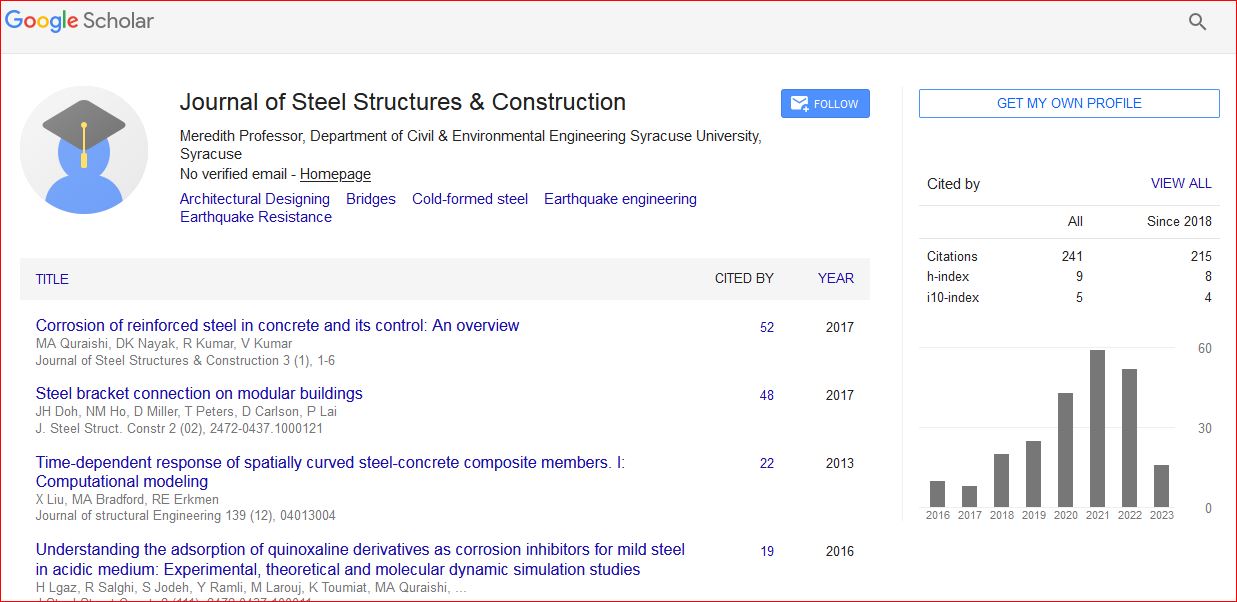
Journal of Steel Structures & Construction received 583 citations as per Google Scholar report