Brief Report - (2025) Volume 15, Issue 6
Received: 01-Dec-2025, Manuscript No. mccr-25-178198;
Editor assigned: 03-Dec-2025, Pre QC No. P-178198;
Reviewed: 17-Dec-2025, QC No. Q-178198;
Revised: 21-Feb-2025, Manuscript No. R-178198;
Published:
29-Dec-2025
, DOI: 10.37421/2161-0444.2025.15.811
Citation: Nandakumar, Priya. ”Heterocycles: Revolutionizing Drug Discovery and Therapeutics.” Med Chem 15 (2025):811.
Copyright: © 2025 Nandakumar P. This is an open-access article distributed under the terms of the Creative Commons Attribution License, which permits unrestricted use, distribution and reproduction in any medium, provided the original author and source are credited.
Heterocyclic compounds represent a cornerstone in the field of drug discovery, owing to their structural diversity and inherent chemical properties that facilitate interactions with biological targets. Recent advancements have significantly focused on developing novel synthetic methodologies to access complex heterocyclic structures and their subsequent incorporation into molecules with potent therapeutic activities across a spectrum of diseases, including oncology, infectious diseases, and neurological disorders. The rational design of these heterocyclic scaffolds, coupled with rigorous structure-activity relationship (SAR) studies, is crucial for optimizing both pharmacokinetic and pharmacodynamic profiles of potential drug candidates [1].
The exploration of 'privileged' heterocyclic scaffolds, which are recurrently identified in drugs targeting various receptors, continues to be a highly productive area of research. Current efforts are directed towards expanding the chemical space surrounding these established scaffolds and leveraging innovative computational approaches, such as AI-driven drug design, to identify novel therapeutic leads that exhibit enhanced efficacy and reduced off-target effects. Furthermore, there is a growing emphasis on developing sustainable and environmentally friendly synthetic routes for these valuable compounds [2].
New synthetic strategies for nitrogen-containing heterocycles, a class of compounds prevalent in pharmaceutical agents, are continuously being developed. These include sophisticated cascade reactions, C-H functionalization techniques, and photocatalytic methods, all of which enable the efficient and stereoselective construction of intricate molecular architectures. The application of these advanced synthetic tools is significantly accelerating the discovery process for drugs with improved therapeutic profiles [3].
The integration of computational chemistry and artificial intelligence is profoundly revolutionizing the landscape of heterocyclic drug discovery. Predictive modeling, virtual screening, and machine learning algorithms are increasingly employed to identify promising heterocyclic scaffolds and to optimize their interactions with specific biological targets. This in silico approach offers substantial reductions in the time and costs typically associated with traditional drug development pipelines [4].
Heterocycles incorporating sulfur and selenium atoms are increasingly recognized for their unique pharmacological properties. Recent investigations are actively exploring the synthesis and therapeutic potential of novel organosulfur and organoselenium heterocycles, which have demonstrated potent activities against a range of diseases, including cancer and microbial infections. Their distinct electronic and steric characteristics render them highly attractive candidates for innovative drug design [5].
The development of novel heterocyclic-based antivirals remains a critical area of research, particularly in the context of emerging infectious diseases. Significant efforts are dedicated to designing and synthesizing heterocycles that can effectively inhibit viral replication, entry, or assembly. Structure-based drug design and high-throughput screening methodologies are instrumental in the identification of potent and selective antiviral agents [6].
Heterocyclic scaffolds are being increasingly utilized in the development of targeted therapies for central nervous system (CNS) disorders. Researchers are actively designing heterocycles capable of efficiently crossing the blood-brain barrier and modulating specific neurotransmitter systems or targeting pathological proteins implicated in neurodegenerative diseases and psychiatric conditions. The precise targeting of these heterocycles is paramount for minimizing unwanted side effects [7].
The application of advanced synthetic technologies such as flow chemistry and microwave-assisted synthesis has significantly streamlined the preparation of complex heterocyclic compounds. These methodologies offer enhanced control over reaction conditions, reduced reaction times, and improved yields, thereby making the synthesis of diverse heterocyclic libraries more efficient and scalable for drug discovery initiatives [8].
Chiral heterocycles play an indispensable role in drug development due to the inherent stereospecificity of biological interactions. Advances in asymmetric synthesis and chiral resolution techniques are enabling the efficient production of enantiomerically pure heterocyclic drugs. This capability leads to improved therapeutic outcomes and a reduction in the incidence of adverse side effects [9].
The field of medicinal chemistry is currently experiencing a substantial surge in the development of heterocyclic compounds specifically for neglected tropical diseases. Researchers are focusing their efforts on designing and synthesizing novel heterocycles that target specific parasitic or bacterial pathways, with the overarching goal of overcoming existing drug resistance and providing accessible treatment options for these often-underserved conditions [10].
Heterocyclic compounds are fundamental to medicinal chemistry, providing diverse structural frameworks that are essential for drug discovery. Recent innovations in synthesis are enabling access to intricate heterocycles, which are then incorporated into molecules demonstrating potent therapeutic effects across various disease areas, including oncology, infectious diseases, and neurological disorders. Optimizing pharmacokinetic and pharmacodynamic properties relies heavily on rational design and structure-activity relationship (SAR) studies of these heterocyclic scaffolds [1].
The ongoing investigation of 'privileged' heterocyclic scaffolds, frequently found in drugs that interact with diverse receptors, remains a highly promising avenue. Current research aims to broaden the chemical diversity around these scaffolds and to implement cutting-edge computational methods, such as AI-driven drug design, for the identification of novel therapeutic leads with improved efficacy and fewer off-target effects. Concurrently, the development of sustainable and green synthetic routes for these crucial compounds is gaining significant momentum [2].
Continuous advancements are being made in the development of new strategies for synthesizing nitrogen-containing heterocycles, which are widely present in pharmaceuticals. These advancements include cascade reactions, C-H functionalization techniques, and photocatalytic methods, all facilitating the efficient and stereoselective creation of complex molecular structures. The adoption of these novel synthetic tools is accelerating the discovery of drugs exhibiting enhanced therapeutic characteristics [3].
The convergence of computational chemistry and artificial intelligence is dramatically transforming heterocyclic drug discovery. Predictive modeling, virtual screening, and machine learning algorithms are being utilized to pinpoint promising heterocyclic scaffolds and refine their interactions with biological targets. This in silico approach significantly curtails the time and financial investment required in conventional drug development processes [4].
Heterocycles that contain sulfur and selenium atoms are increasingly recognized for their unique pharmacological activities. Recent research efforts are focused on the synthesis and therapeutic evaluation of novel organosulfur and organoselenium heterocycles, which have shown significant promise against diseases such as cancer and microbial infections. Their distinctive electronic and steric attributes make them valuable targets for drug design [5].
The creation of new heterocyclic-based antiviral agents is a vital research endeavor, especially given the emergence of new infectious diseases. Efforts are concentrated on the design and synthesis of heterocycles capable of effectively inhibiting viral replication, entry, or assembly. Structure-based drug design and high-throughput screening are key methodologies for identifying potent and selective antiviral compounds [6].
Heterocyclic scaffolds are progressively being employed in the development of targeted treatments for central nervous system (CNS) disorders. Scientists are designing heterocycles that can effectively penetrate the blood-brain barrier and influence specific neurotransmitter systems or target aberrant proteins associated with neurodegenerative diseases and psychiatric conditions. Precise targeting is essential for minimizing adverse effects [7].
The implementation of flow chemistry and microwave-assisted synthesis techniques has substantially improved the efficiency of preparing complex heterocyclic compounds. These technologies provide better reaction control, shorter reaction times, and higher yields, thereby enhancing the scalability and efficiency of diverse heterocyclic library synthesis for drug discovery purposes [8].
Chiral heterocycles are critically important in drug development because biological interactions are often stereospecific. Progress in asymmetric synthesis and chiral resolution techniques allows for the efficient production of enantiomerically pure heterocyclic drugs, leading to superior therapeutic outcomes and a reduction in side effects [9].
The medicinal chemistry domain is witnessing a substantial increase in the development of heterocyclic compounds aimed at combating neglected tropical diseases. Research is concentrating on the design and synthesis of novel heterocycles that specifically target parasitic or bacterial pathways, with the objective of overcoming drug resistance and providing affordable treatment options for these diseases [10].
Heterocyclic compounds are central to drug discovery due to their structural versatility and chemical properties. Recent advances focus on novel synthetic methods for complex heterocycles, leading to potent therapeutic agents for oncology, infectious diseases, and neurological disorders. The field increasingly utilizes 'privileged' scaffolds, computational approaches like AI, and sustainable synthesis routes. Nitrogen-containing heterocycles are being efficiently synthesized via cascade reactions and C-H functionalization. Computational chemistry and AI are revolutionizing lead identification and optimization. Organosulfur and organoselenium heterocycles show promise in treating cancer and infections. Development of heterocyclic antivirals remains crucial, with structure-based design and high-throughput screening being key. Heterocycles are also vital for CNS disorder treatments, requiring blood-brain barrier penetration and precise targeting. Flow chemistry and microwave-assisted synthesis accelerate the preparation of diverse heterocyclic libraries. Chiral heterocycles are important for stereospecific interactions, with asymmetric synthesis enabling enantiomerically pure drug production. A growing focus is on heterocyclic compounds for neglected tropical diseases, addressing drug resistance and affordability.
None
None
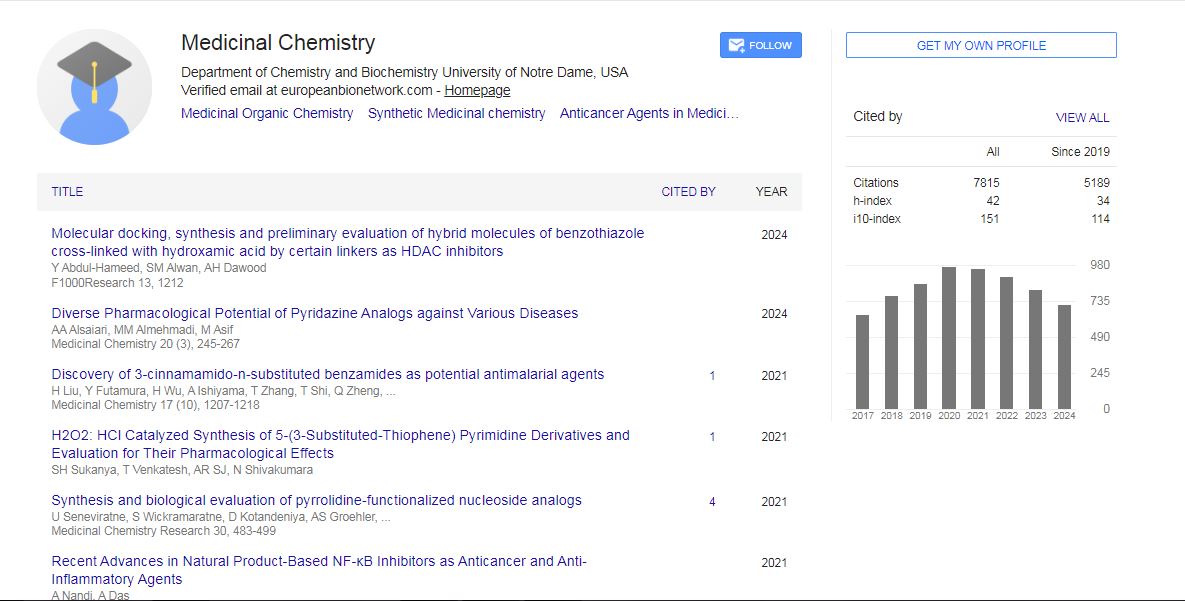
Medicinal Chemistry received 6627 citations as per Google Scholar report