Opinion - (2025) Volume 10, Issue 2
Received: 02-Mar-2025, Manuscript No. PE-26-179249;
Editor assigned: 04-Mar-2025, Pre QC No. P-179249;
Reviewed: 18-Mar-2025, QC No. Q-179249;
Revised: 24-Mar-2025, Manuscript No. R-179249;
Published:
31-Mar-2025
, DOI: 10.37421/2472-1042.2025.10.274
Citation: Malhotra, Priya. ”Health Technology Assessment: Innovation, Data, and Access.” Pharmacoeconomics 10 (2025):274.
Copyright: © 2025 Malhotra P. This is an open-access article distributed under the terms of the Creative Commons Attribution License, which permits unrestricted use, distribution and reproduction in any medium, provided the original author and source are credited.
Health technology assessment (HTA) stands as a cornerstone in the evaluation of innovative medicines, scrutinizing their clinical effectiveness, safety, and cost-effectiveness. This rigorous process is instrumental in informing critical reimbursement decisions and shaping the adoption pathways for novel therapies within healthcare systems. The dynamic nature of medical innovation, characterized by the rapid emergence of new treatment modalities and the inherent complexity of their mechanisms, presents significant challenges to traditional HTA frameworks. Ensuring that these advancements deliver genuine value for money and demonstrable patient benefit necessitates the generation and meticulous interpretation of robust data, a task that requires continuous adaptation and refinement of assessment methodologies [1].
Assessing advanced therapeutics, such as gene and cell therapies, introduces a unique set of hurdles for HTA. These cutting-edge treatments often involve long-term outcomes that are not immediately apparent, limited real-world evidence at the point of launch, and substantial upfront costs. To navigate these uncertainties and facilitate earlier patient access, adaptive pathways and managed entry agreements are increasingly being employed as strategic tools. These approaches aim to generate further evidence on the real-world value of these therapies over time, thereby balancing innovation with evidence-based decision-making [2].
The integration of real-world data (RWD) and the subsequent generation of real-world evidence (RWE) are becoming indispensable components of HTA for innovative medicines. This is particularly true in scenarios where clinical trial data are scarce or do not adequately represent the diverse patient populations encountered in routine clinical practice. To ensure that RWD/RWE reliably informs HTA decisions and supports effective post-market surveillance, a high degree of methodological rigor and unwavering attention to data quality are paramount. The integrity of these data sources is fundamental to their utility in guiding healthcare policy and clinical practice [3].
Economic modeling plays a crucial role in the HTA of innovative medicines, demanding careful consideration of inherent uncertainties and the long-term consequences of treatment. Sophisticated modeling techniques, including partitioned survival analysis and agent-based modeling, are frequently utilized to accurately capture the complexities of disease progression and treatment effects over extended periods. The selection of an appropriate economic model should always be rigorously justified by the specific clinical and epidemiological characteristics of the innovative medicine under evaluation, ensuring that the model reflects the nuances of the therapeutic intervention [4].
Patient perspectives are increasingly recognized as an indispensable element in the HTA of innovative medicines. Actively incorporating patient input ensures that assessments consider outcomes that are truly meaningful to individuals, taking into account treatment burden and personal preferences. This patient-centered approach is vital for making healthcare decisions that align with the lived experiences and priorities of those who will ultimately receive these therapies. Methods such as patient preference studies and qualitative research are essential for gathering this crucial information [5].
The ethical considerations that surround the HTA of innovative medicines are multifaceted, especially when these therapies are associated with high price tags and the potential for significant health gains. Striking a balance between equity, access to care, and the long-term sustainability of healthcare systems requires careful deliberation and the implementation of transparent decision-making processes. Ongoing discussions surrounding value frameworks and the principles of fair pricing are critical for navigating these ethical complexities and ensuring responsible innovation [6].
The global landscape of HTA for innovative medicines is undergoing a significant transformation, marked by an increase in international collaboration and efforts towards harmonizing assessment methodologies. Despite these advancements, substantial variations persist in the assessment processes and decision-making criteria employed by different countries. These discrepancies can have a considerable impact on the timely access of new drugs for patients worldwide, highlighting the need for greater international alignment [7].
The development of companion diagnostics alongside innovative medicines is fundamentally critical for enabling personalized treatment strategies. HTA bodies are increasingly being tasked with evaluating the value of these diagnostics in conjunction with the therapeutic agents they are designed to complement. This necessitates the development and application of integrated assessment frameworks capable of evaluating both the drug and its associated diagnostic tool comprehensively [8].
The rapid evolution of digital health technologies, including their application to innovative medicines through remote monitoring and AI-driven diagnostics, introduces novel dimensions to the HTA process. Assessing the clinical utility, data privacy, security, and cost-effectiveness of these digital components, in parallel with pharmaceutical interventions, represents a growing and important area of focus for HTA bodies worldwide [9].
The sustainability of healthcare systems presents a significant concern when evaluating the value of innovative medicines. HTA frameworks are increasingly challenged to meticulously balance incremental clinical benefits against affordability and the potential budget impact of new therapies. This often leads to complex trade-offs and necessitates nuanced policy discussions regarding resource allocation, ensuring that the adoption of innovations does not compromise the overall viability of healthcare provision [10].
Health technology assessment (HTA) plays a pivotal role in appraising the clinical efficacy, safety, and cost-effectiveness of newly developed medicines. This systematic evaluation process provides essential evidence to inform reimbursement policies and guide the integration of innovative therapies into clinical practice. The rapid pace of pharmaceutical innovation, the intricate nature of novel treatment modalities, and the imperative for robust data to demonstrate value for money and patient benefit pose ongoing challenges for HTA agencies [1].
Assessing cutting-edge therapeutic interventions, particularly gene and cell therapies, presents a unique set of challenges for HTA. These advanced treatments are often characterized by long-term outcome expectations, limited availability of real-world evidence at the time of market entry, and substantial initial investment. Strategies such as adaptive licensing pathways and managed entry agreements are emerging as valuable tools to address these uncertainties, facilitating earlier patient access while simultaneously enabling the collection of further evidence to confirm their value proposition [2].
The incorporation of real-world data (RWD) and the subsequent generation of real-world evidence (RWE) are becoming increasingly vital for the HTA of innovative medicines, especially when evidence from randomized controlled trials is limited or fails to capture the heterogeneity of patient populations encountered in clinical settings. To ensure that RWD/RWE can reliably inform HTA decisions and support post-market surveillance, adherence to rigorous methodological standards and a strong emphasis on data quality are crucial [3].
Economic evaluations within HTA for innovative medicines necessitate a thorough consideration of uncertainty and the long-term implications of treatment. Advanced modeling techniques, such as partitioned survival analysis and agent-based modeling, are frequently employed to accurately represent the complexities of disease progression and the enduring effects of therapeutic interventions. The choice of the most appropriate model must be carefully justified based on the specific characteristics of the innovative medicine being assessed [4].
The integration of patient perspectives into the HTA of innovative medicines is gaining increasing recognition as a critical component. Ensuring that HTA processes consider outcomes that are meaningful to patients, the burden of treatment, and individual preferences contributes to the development of more patient-centered healthcare decisions. Methodologies like patient preference studies and qualitative research are instrumental in gathering this essential information [5].
Ethical considerations are complex when evaluating innovative medicines, particularly those with high acquisition costs and the potential for substantial health improvements. Balancing the principles of equity, access to care, and the long-term financial sustainability of healthcare systems requires careful deliberation and the establishment of transparent decision-making frameworks. Discussions concerning value-based frameworks and fair pricing mechanisms are ongoing and essential for navigating these ethical dilemmas [6].
The global landscape of HTA for innovative medicines is evolving, with growing trends toward international collaboration and the harmonization of assessment methodologies. Nevertheless, significant disparities remain in the assessment procedures and decision-making criteria adopted by different countries, which can influence the timely availability of new drugs to patients worldwide. Addressing these variations is crucial for equitable global access [7].
The development of companion diagnostics in tandem with innovative medicines is essential for realizing the potential of personalized medicine. HTA bodies are increasingly expected to evaluate the value of these diagnostics in conjunction with the therapeutic agents they are designed to be used with. This requires the development of integrated assessment frameworks capable of evaluating both the drug and its associated diagnostic tool [8].
The burgeoning field of digital health technologies and their integration with innovative medicines, such as those involving remote patient monitoring and AI-driven diagnostic tools, introduces new dimensions to HTA. The assessment of clinical utility, data privacy, security, and cost-effectiveness of these digital components, alongside traditional pharmaceutical interventions, is becoming a significant area of focus for HTA [9].
The long-term sustainability of healthcare systems is a paramount consideration in the value assessment of innovative medicines. HTA frameworks are increasingly challenged to weigh incremental clinical benefits against affordability and budget impact, often resulting in complex trade-offs and policy debates regarding the allocation of limited healthcare resources. Ensuring value for money and system sustainability are key objectives [10].
Health technology assessment (HTA) is crucial for evaluating the clinical, safety, and cost-effectiveness of innovative medicines, guiding reimbursement and adoption decisions. Advanced therapies like gene and cell therapies present unique HTA challenges due to long-term outcomes and limited initial real-world data, leading to strategies like adaptive pathways. Real-world data and evidence (RWD/RWE) are increasingly vital for HTA, especially when clinical trial data are insufficient, necessitating rigorous methodology and data quality. Economic modeling employs advanced techniques to capture long-term effects and uncertainties. Patient perspectives are essential for patient-centered decisions, gathered through preference studies. Ethical considerations involve balancing equity, access, and healthcare system sustainability, with ongoing debates on value and pricing. Global HTA is moving towards collaboration but still faces country-specific variations. Companion diagnostics are increasingly assessed alongside drugs, requiring integrated frameworks. Digital health technologies introduce new HTA dimensions concerning utility, privacy, and cost-effectiveness. Ultimately, HTA must balance innovation with the long-term sustainability of healthcare systems.
None
None
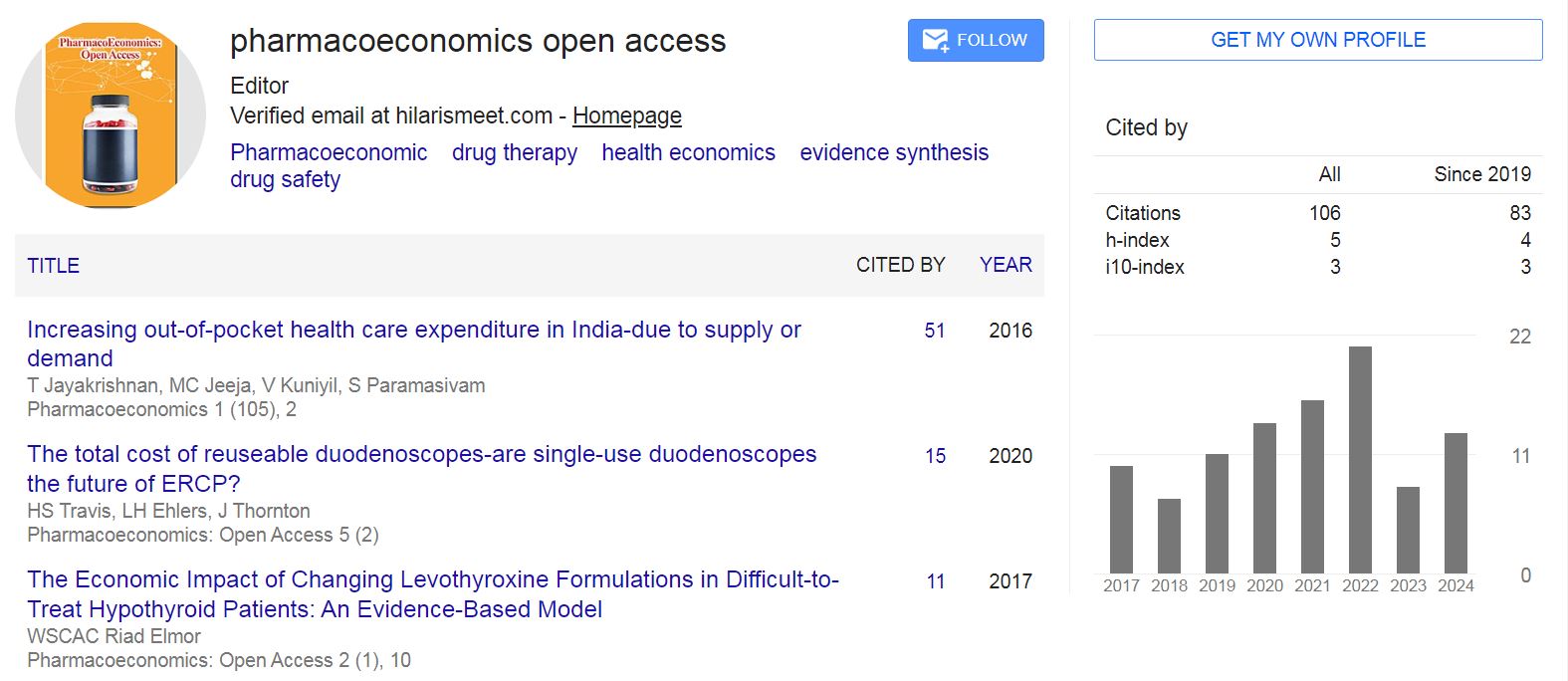
Pharmacoeconomics: Open Access received 106 citations as per Google Scholar report