Brief Report - (2025) Volume 16, Issue 3
Received: 02-May-2025, Manuscript No. jhmi-26-178833;
Editor assigned: 05-May-2025, Pre QC No. P-178833;
Reviewed: 19-May-2025, QC No. Q-178833;
Revised: 23-May-2025, Manuscript No. R-178833;
Published:
30-May-2025
, DOI: 10.37421/2157-7420.2025.16.590
Citation: Dubois, Marie-Claire. ”mHealth Revolutionizes Chronic Disease Management: Benefits and Challenges.” J Health Med Informat 16 (2025):590.
Copyright: © 2025 Dubois M. This is an open-access article distributed under the terms of the Creative Commons Attribution License, which permits unrestricted use, distribution and reproduction in any medium, provided the original author and source are credited.
Mobile health applications are revolutionizing chronic disease management, offering unprecedented opportunities for personalized care and improved patient outcomes. These digital tools are becoming indispensable in providing continuous support, facilitating remote monitoring, and fostering greater patient engagement, thereby empowering individuals to take an active role in their health journeys. The adoption of mHealth solutions is particularly impactful for those managing long-term conditions, as it enhances adherence to treatment plans and leads to demonstrably better health results. The integration of mHealth into healthcare systems promises to extend the reach and efficiency of medical services, benefiting individuals residing in remote areas or those with limited mobility. However, the successful implementation of these technologies hinges on addressing critical challenges such as ensuring robust data security and achieving seamless interoperability with existing healthcare infrastructures. Furthermore, it is imperative to guarantee equitable access to these digital health tools for all patient populations, irrespective of their socioeconomic or geographical background. The effectiveness of specific mHealth interventions is being rigorously evaluated through scientific studies. For instance, research has explored the impact of a dedicated mobile application designed to aid individuals in managing diabetes. This application leverages real-time glucose monitoring and personalized feedback mechanisms to promote better adherence to dietary plans and medication schedules, ultimately contributing to improved glycemic control among users. Such targeted interventions highlight the significant potential of mHealth to address specific chronic conditions. Beyond diabetes, mHealth applications are also making significant strides in the management of cardiovascular diseases. The integration of wearable devices with mobile health platforms enables continuous monitoring of vital signs, offering a powerful tool for early detection of adverse events and encouraging positive lifestyle modifications. Studies in this area suggest high levels of user satisfaction and a potential reduction in hospital readmissions, underscoring the value of these integrated systems. A crucial aspect of chronic disease management is understanding the patient's lived experience. Mobile applications are proving to be effective tools for capturing and analyzing patient-reported outcomes (PROs). By enhancing the collection and analysis of PRO data, mHealth platforms provide invaluable insights for both patients and healthcare providers, paving the way for more personalized and responsive care strategies. As mHealth solutions become more prevalent, the paramount importance of data security and privacy cannot be overstated. A comprehensive review of data protection regulations and best practices is essential for both app developers and users. This includes emphasizing the need for strong security measures and transparent data handling policies to foster trust and ensure the safe utilization of these technologies. Enhancing patient engagement is another key area where mHealth applications are demonstrating significant impact. The incorporation of gamification elements, such as rewards and challenges, has been shown to increase adherence to health-related tasks and sustain user motivation. This approach can make the often-burdensome process of chronic disease management more interactive and engaging. Achieving seamless data flow and integrated care necessitates robust interoperability between mobile health applications and electronic health records (EHRs). Addressing the challenges associated with interoperability, through standardized data formats and communication protocols, is critical for informed clinical decisions and improved care coordination. This ensures that all stakeholders have access to comprehensive patient information. Considering the diverse needs of patient populations, the accessibility and usability of mHealth applications for elderly individuals managing chronic diseases are of particular concern. Specialized design considerations are required to accommodate challenges such as digital literacy and physical limitations, emphasizing the importance of user-centered design for successful adoption by older adults. The application of advanced technologies like artificial intelligence (AI) and machine learning (ML) within mHealth platforms holds immense promise for personalized chronic disease management. AI/ML algorithms can analyze extensive patient data to predict disease progression, identify potential risks, and deliver tailored interventions, enabling a more proactive and predictive approach to healthcare. Finally, the economic implications of mHealth are increasingly being scrutinized. Studies examining the cost-effectiveness of these applications analyze reductions in healthcare utilization, such as hospital visits, in conjunction with app development and maintenance costs. These analyses consistently demonstrate the potential for mHealth to serve as a cost-saving strategy for both healthcare systems and individuals managing chronic conditions.
Mobile health applications are fundamentally transforming the landscape of chronic disease management, offering a sophisticated suite of tools designed to personalize patient care and elevate health outcomes. These digital platforms are integral to providing ongoing patient support, enabling remote monitoring of health metrics, and significantly enhancing patient engagement in their own treatment regimens. The empowerment derived from these tools allows individuals with chronic conditions to become more active participants in their care, leading to improved adherence to prescribed treatment plans and consequently, superior health outcomes. The strategic integration of mHealth into the broader framework of chronic disease management is poised to make healthcare services more accessible and efficient, particularly benefiting those who live in geographically isolated areas or face mobility challenges. Nevertheless, the widespread adoption and efficacy of these applications are contingent upon overcoming substantial hurdles, including the stringent requirements for data security and the complexities of interoperability with existing healthcare information systems. Ensuring that these advanced tools are accessible to all patient demographics, thereby promoting health equity, remains a critical objective. Furthermore, the tangible impact of specific mHealth interventions is consistently being validated through rigorous scientific research. A notable example includes the investigation into the effectiveness of a specialized mobile application tailored for diabetes self-management. This particular application facilitates real-time monitoring of glucose levels and implements personalized feedback loops, which have been instrumental in fostering enhanced adherence to dietary guidelines and medication regimens. The research findings consistently indicate a significant improvement in glycemic control among individuals utilizing the application, thereby substantiating the immense potential of precisely targeted mHealth interventions in managing specific chronic diseases. Expanding beyond the domain of diabetes, the application of mHealth solutions is proving highly beneficial in the management of cardiovascular diseases. The convergence of wearable devices with mobile health applications provides a potent mechanism for the continuous surveillance of vital physiological signs in patients diagnosed with cardiovascular conditions. This research diligently examines both the usability and the overall effectiveness of such integrated systems, focusing on their capacity for the early identification of adverse health events and their role in promoting beneficial lifestyle modifications. The outcomes reported consistently reveal a high degree of user satisfaction and suggest a promising potential for these technologies to contribute to a reduction in hospital readmission rates, thereby underscoring the clinical value of these integrated systems. An essential facet of comprehensive chronic disease management involves a deep understanding of the subjective patient experience. Mobile applications are emerging as exceptionally effective instruments for the systematic collection and sophisticated analysis of patient-reported outcomes (PROs). By refining the processes for gathering and interpreting PRO data, mHealth platforms offer invaluable qualitative insights that inform both patients and their healthcare providers. This data-driven approach facilitates the development and implementation of care strategies that are far more personalized and responsive to individual patient needs. As mobile health applications become more deeply embedded within the healthcare ecosystem, the imperative to uphold the highest standards of data security and privacy is paramount. A thorough and ongoing review of current data protection regulations, coupled with the adherence to established best practices, is indispensable for both mHealth app developers and end-users. This necessitates a strong emphasis on the implementation of robust security protocols and the adoption of transparent data handling policies to cultivate trust and ensure the safe and ethical use of these transformative technologies in the context of chronic disease management. Another critical dimension where mHealth applications are demonstrating significant utility is in the enhancement of patient engagement. The strategic incorporation of gamification principles, such as the integration of reward systems and interactive challenges, has been demonstrably linked to increased adherence to health-related tasks and the sustained motivation of users. These findings strongly suggest that gamification represents a highly effective strategy for rendering the ongoing management of chronic diseases a more interactive, less burdensome, and ultimately more rewarding experience for patients. To facilitate seamless data exchange and promote truly integrated patient care, achieving robust interoperability between mobile health applications and electronic health records (EHRs) is an absolute necessity. Addressing the multifaceted challenges associated with interoperability, through the adoption of standardized data formats and universally accepted communication protocols, is vital. Successful integration of these systems can lead to more informed clinical decision-making and significantly improved care coordination for individuals grappling with chronic conditions. Recognizing the diverse needs and potential barriers faced by different patient demographics, the accessibility and usability of mobile health applications for elderly individuals managing chronic diseases warrant specific attention. This demographic often encounters unique challenges, including varying levels of digital literacy and potential physical limitations. Consequently, the development of mHealth tools must incorporate thoughtful design considerations specifically aimed at enhancing the user experience for older adults, highlighting the critical importance of user-centered design principles for successful adoption. The integration of cutting-edge technologies such as artificial intelligence (AI) and machine learning (ML) into mobile health applications holds profound potential for the advancement of personalized chronic disease management. These advanced algorithms are capable of analyzing vast quantities of patient data to predict disease trajectories, identify emergent risks with greater accuracy, and deliver highly tailored therapeutic interventions. The capacity for proactive and predictive healthcare enabled by mHealth, augmented by AI/ML, represents a substantial leap forward. Lastly, the examination of the economic viability of mobile health applications in the realm of chronic disease management is gaining increasing attention. Through meticulous analysis of factors such as the reduction in healthcare utilizationâ??including fewer hospital admissions and emergency room visitsâ??alongside the costs associated with the development and ongoing maintenance of these applications, research consistently indicates that mHealth offers a compelling potential for cost savings. This benefit extends to both healthcare systems seeking to optimize resource allocation and patients aiming to mitigate personal healthcare expenditures.
Mobile health (mHealth) applications are revolutionizing chronic disease management by offering personalized support, remote monitoring, and improved patient engagement. These tools empower individuals with chronic conditions to actively participate in their care, leading to better adherence and enhanced health outcomes. Specific mHealth interventions have shown effectiveness in managing conditions like diabetes and cardiovascular diseases through real-time monitoring and integrated systems. Applications are also valuable for collecting patient-reported outcomes, facilitating personalized care strategies. However, data security, privacy, and interoperability with existing healthcare systems are critical challenges. Gamification is being used to boost patient engagement, while user-centered design is essential for accessibility, especially for older adults. The integration of AI and ML promises further personalization and proactive care. Studies also highlight the cost-effectiveness of mHealth in reducing healthcare utilization. Addressing challenges like equitable access and robust security will be key to maximizing the benefits of mHealth in chronic disease management.
None
None
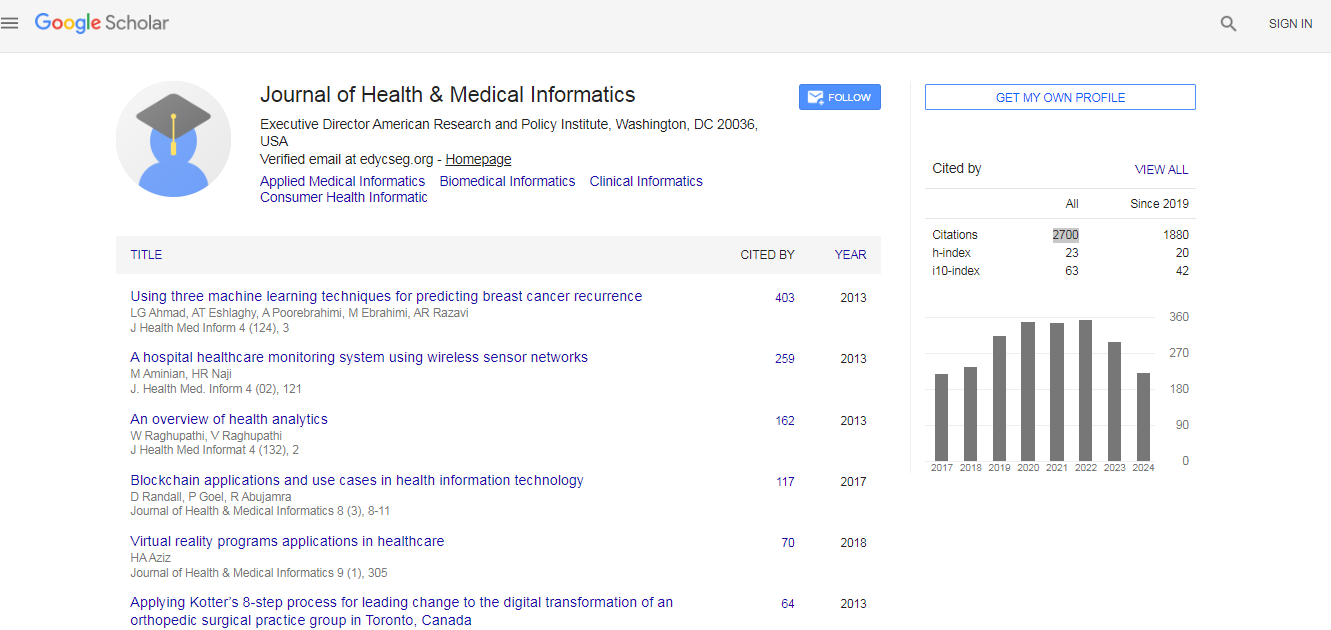
Journal of Health & Medical Informatics received 2700 citations as per Google Scholar report