Commentary - (2025) Volume 16, Issue 5
Received: 01-Sep-2025, Manuscript No. jhmi-26-178866;
Editor assigned: 03-Sep-2025, Pre QC No. P-178866;
Reviewed: 17-Sep-2025, QC No. Q-178866;
Revised: 22-Sep-2025, Manuscript No. R-178866;
Published:
29-Sep-2025
, DOI: 10.37421/2157-7420.2025.16.609
Citation: Hansen, Ingrid L.. ”Health Informatics: Transforming Healthcare for Value.” J Health Med Informat 16 (2025):609.
Copyright: © 2025 Hansen L. Ingrid This is an open-access article distributed under the terms of the Creative Commons Attribution License, which permits unrestricted use,distribution and
reproduction in any medium, provided the original author and source are credited.
The landscape of healthcare is undergoing a profound transformation, shifting from traditional fee-for-service models to value-based care systems that prioritize patient outcomes and cost-effectiveness. Central to this paradigm shift is the strategic implementation of health informatics, a discipline that leverages data, technology, and analytical tools to improve healthcare delivery and patient well-being. This evolving field is instrumental in driving the necessary changes to achieve better health outcomes for individuals and populations alike, while simultaneously managing healthcare costs more efficiently. The ability to collect, analyze, and act upon vast amounts of health-related data is foundational to the success of value-based care initiatives, enabling providers to make more informed decisions and tailor interventions to individual patient needs. [1] Advancements in artificial intelligence (AI) and machine learning (ML) are further amplifying the capabilities of health informatics in supporting value-based care. These sophisticated technologies offer powerful means to enhance diagnostic accuracy, personalize treatment plans, and optimize the allocation of healthcare resources. By identifying patterns and predicting future events with greater precision, AI and ML contribute significantly to achieving superior patient outcomes and reducing overall healthcare expenditures. The ethical considerations and the rigorous validation of these algorithms are paramount to ensuring their safe and effective integration into clinical practice. [2] Interoperability stands as a critical pillar for the successful implementation of value-based healthcare, empowered by health informatics. Seamless data exchange between disparate healthcare systems and providers is essential for a comprehensive understanding of a patient's journey and for the accurate measurement of care outcomes. Without robust interoperability, the coordination of care, the tracking of patient progress, and the overall effectiveness of value-based initiatives are severely impeded, hindering the ability to achieve truly integrated care. [3] The increasing availability of patient-generated health data (PGHD) presents new avenues for health informatics to drive value in healthcare. Data from wearables and mobile health applications offer real-time insights into patient health status, facilitating proactive interventions and personalized care management. While challenges related to data quality, security, and ethical usage must be addressed, PGHD holds significant potential to enhance patient engagement and improve treatment adherence, contributing to a more holistic view of patient well-being. [4] Big data analytics, a core component of health informatics, plays a pivotal role in supporting value-based healthcare models by enabling the analysis of extensive datasets. These analyses can uncover trends within patient populations, predict disease outbreaks, and rigorously evaluate the effectiveness of various care pathways. The insights derived from big data are indispensable for optimizing care delivery, managing resources efficiently, and driving continuous improvement in healthcare quality and value. [5] Clinical decision support systems (CDSS) are another vital application of health informatics in the pursuit of value-based care. By providing clinicians with evidence-based recommendations at the point of care, CDSS promotes consistent, high-quality treatment decisions. Integration with electronic health records (EHRs) further enhances patient safety, elevates the quality of care, and contributes to cost reduction efforts, aligning clinical practice with best-practice guidelines and reducing unwarranted variations in care delivery. [6] Navigating the ethical and privacy considerations inherent in health informatics is crucial for the success of value-based healthcare. Protecting sensitive patient data while facilitating its use for population health management and quality improvement requires careful attention to regulatory frameworks and robust data security measures. Maintaining public trust through responsible data stewardship and transparent practices is essential for the sustainable adoption of these technologies. [7] The impact of health informatics on patient engagement and shared decision-making is a key determinant of value-based care effectiveness. Digital tools, patient portals, and telehealth platforms empower patients to become active participants in their care journeys. By enhancing health literacy and providing accessible, understandable health information, informatics can foster greater adherence to treatment plans and lead to improved health outcomes and higher patient satisfaction. [8] Health informatics is indispensable for the accurate measurement and reporting of quality metrics that define value-based healthcare. The development and implementation of sophisticated performance dashboards, coupled with the aggregation of data from diverse sources, are essential for demonstrating value and identifying areas for continuous improvement. Effective informatics infrastructure underpins payment models that increasingly reward positive patient outcomes. [9] Finally, the integration of telehealth and remote patient monitoring within health informatics strategies expands the reach and accessibility of value-based care. These technologies enable continuous monitoring of chronic conditions, improve access for remote or underserved populations, and offer significant potential to reduce hospitalizations. Addressing the associated data management, security, and workflow integration challenges is key to realizing their full value in patient care. [10]
The foundational principles of value-based healthcare necessitate a robust framework of health informatics to drive meaningful change. Strategies encompassing integrated data systems for comprehensive patient views, predictive analytics for risk stratification, and digital tools for patient empowerment are crucial. These informatics-driven approaches facilitate better decision-making, enhance care coordination, and ultimately elevate the value delivered to patients by focusing on quality outcomes and cost-effectiveness. [1] The application of artificial intelligence and machine learning within health informatics is revolutionizing the support for value-based care initiatives. AI algorithms can significantly improve diagnostic accuracy, tailor treatment regimens to individual patients, and optimize resource allocation, thereby directly contributing to enhanced patient outcomes and a reduction in healthcare costs. The careful consideration of ethical implications and the rigorous validation of AI models are critical for their reliable deployment in clinical settings. [2] Interoperability in health informatics systems is paramount for enabling value-based care. Without the ability for seamless data exchange across different healthcare providers and systems, the critical tasks of tracking patient trajectories, quantifying outcomes, and coordinating care are severely compromised. The adoption of common standards and frameworks is essential to overcome these challenges and foster a unified patient record, which is fundamental to value-based care delivery. [3] Patient-generated health data (PGHD), collected through devices like wearables and mobile health apps, offers a significant opportunity for health informatics to enhance value-based care. This real-time data provides valuable insights into patient health status, enabling proactive interventions and personalized care plans. Addressing concerns about data quality, security, and ethical use is vital to harnessing the power of PGHD for improved patient engagement and adherence. [4] Big data analytics within health informatics provides the analytical power needed to support value-based healthcare models. By examining large datasets, healthcare organizations can identify population-level trends, anticipate disease outbreaks, and assess the efficacy of various care interventions. Effective utilization of big data requires appropriate technical infrastructure, advanced analytical techniques, and stringent data governance to optimize care delivery and resource management. [5] Clinical decision support systems (CDSS) represent a vital tool in health informatics for advancing value-based care. CDSS offers clinicians real-time, evidence-based recommendations, leading to more standardized and effective treatment decisions. Integrating CDSS with electronic health records (EHRs) improves patient safety, elevates care quality, and contributes to cost savings by promoting adherence to best practices and reducing unwarranted variations in care. [6] Ethical and privacy considerations are central to the effective implementation of health informatics in value-based healthcare. The challenge lies in safeguarding sensitive patient information while enabling its use for population health management and quality improvement initiatives. Adherence to regulations such as HIPAA and GDPR, along with robust data security protocols and transparent patient consent processes, are essential for maintaining trust. [7] Health informatics plays a crucial role in enhancing patient engagement and facilitating shared decision-making within value-based care frameworks. Through the use of patient portals, telehealth platforms, and other digital tools, patients are empowered to take a more active role in their health management. Improving health literacy and ensuring access to clear, actionable information are key to fostering patient involvement, which correlates with better outcomes and satisfaction. [8] The measurement and reporting of quality metrics are fundamental to value-based healthcare, and health informatics provides the necessary infrastructure for this. Developing and deploying performance dashboards, aggregating data from diverse sources, and ensuring data accuracy are critical steps. Robust informatics capabilities enable organizations to demonstrate value, drive continuous quality improvement, and align with outcome-based payment models. [9] Telehealth and remote patient monitoring are increasingly integrated into health informatics strategies to broaden the scope of value-based care. These technologies enhance access to care, particularly for remote or underserved populations, and allow for continuous monitoring of patients with chronic conditions. Successfully managing the data, security, and workflow integration associated with these modalities is key to their effectiveness in reducing hospitalizations and improving patient outcomes. [10]
This collection of articles examines the multifaceted role of health informatics in transforming healthcare towards value-based models. Key themes include the strategic use of data analytics, AI/ML, and interoperability to improve patient outcomes and cost-effectiveness. The integration of patient-generated health data, clinical decision support systems, and telehealth solutions are highlighted as critical components. Furthermore, the importance of ethical considerations, privacy protection, patient engagement, and robust quality measurement is emphasized. Collectively, these informatics-driven approaches are reshaping healthcare delivery to prioritize value and patient well-being.
None
None
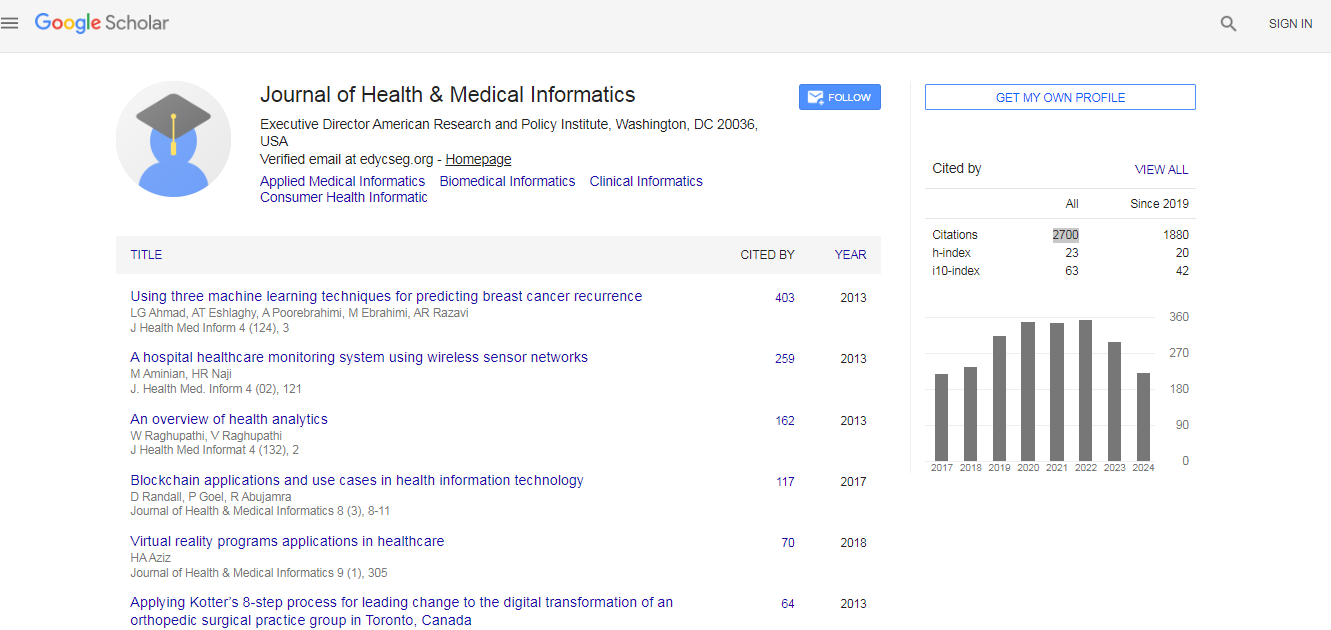
Journal of Health & Medical Informatics received 2700 citations as per Google Scholar report