Perspective - (2025) Volume 16, Issue 3
Received: 02-May-2025, Manuscript No. jhmi-26-178843;
Editor assigned: 05-May-2025, Pre QC No. P-178843;
Reviewed: 19-May-2025, QC No. Q-178843;
Revised: 23-May-2025, Manuscript No. R-178843;
Published:
30-May-2025
, DOI: 10.37421/2157-7420.2025.16.594
Citation: Grant, Oliver J.. ”Health Informatics Revolutionizing Population Health Outcomes.” J Health Med Informat 16 (2025):594.
Copyright: © 2025 Grant J. Oliver This is an open-access article distributed under the terms of the Creative Commons Attribution License, which permits unrestricted use, distribution and reproduction in any medium, provided the original author and source are credited.
The landscape of healthcare is undergoing a profound transformation, driven by the increasing imperative to manage the health of populations rather than solely focusing on individual patient care. This shift necessitates the adoption and sophisticated utilization of health informatics tools, which are instrumental in identifying trends, predicting outcomes, and implementing targeted interventions across communities [1].
The effective management of population health hinges on the ability to aggregate, analyze, and interpret vast datasets, moving beyond the confines of a single patient's medical record to encompass broader health patterns and social determinants that influence community well-being [2].
Electronic health records (EHRs) serve as a foundational pillar in this endeavor, providing a rich source of clinical data that, when aggregated and analyzed, can illuminate population-level health trends and inform quality improvement initiatives [3].
Beyond EHRs, patient registries play a crucial role in managing specific chronic diseases and patient cohorts, enabling proactive outreach and the evaluation of treatment effectiveness at a population scale [4].
A critical advancement in population health informatics involves the integration of social determinants of health (SDOH) data, which acknowledges that factors beyond direct medical care significantly impact health outcomes and drive health disparities [5].
To effectively communicate these complex health insights, the development of population health dashboards and visualization tools is paramount, transforming raw data into understandable indicators for stakeholders [6].
The potential of artificial intelligence (AI) and machine learning (ML) is also being increasingly recognized for their ability to enhance predictive modeling, optimize interventions, and automate data analysis within population health management [7].
A significant hurdle that must be overcome to realize the full potential of these informatics tools is data interoperability, ensuring that different health information systems can seamlessly exchange and utilize data for comprehensive population health insights [8].
Geospatial information systems (GIS) offer a unique perspective, enabling the mapping of disease prevalence and the analysis of environmental factors that impact health outcomes at a geographic level [9].
However, the ethical and privacy implications of collecting and utilizing sensitive health data for population health management cannot be overstated, demanding robust governance frameworks and transparency to maintain public trust [10].
The advancement of population health management is intrinsically linked to the strategic deployment of health informatics tools designed to analyze health at a community level [1].
These tools enable healthcare providers and public health officials to move beyond individual patient care, facilitating the identification of emerging health trends, the prediction of disease outbreaks, and the implementation of precise, evidence-based interventions [1].
The application of big data analytics within this domain is transformative, allowing for the examination of extensive datasets from diverse sources, including electronic health records (EHRs), claims data, and social determinants of health, to reveal critical patterns and disparities [2].
EHRs themselves are indispensable, acting as a cornerstone for population health management by enabling the aggregation of clinical data for disease surveillance, quality improvement initiatives, and the understanding of population-level health trends [3].
Patient registries further contribute by providing a focused mechanism for collecting detailed clinical data on specific patient populations, particularly those with chronic diseases, thereby facilitating proactive patient outreach and the evaluation of treatment effectiveness at scale [4].
A crucial development in the field is the integration of social determinants of health (SDOH) data, which acknowledges the profound influence of socioeconomic status, education, and environmental factors on health outcomes and necessitates their inclusion in population health strategies [5].
To make complex health data accessible and actionable, the creation of population health dashboards and visualization tools is essential, presenting key performance indicators and trends in an understandable format for diverse stakeholders [6].
The growing role of artificial intelligence (AI) and machine learning (ML) in population health management is notable, with these technologies offering enhanced capabilities for predictive modeling, identifying optimal intervention strategies, and automating data analysis processes [7].
A fundamental prerequisite for the effective functioning of these advanced informatics systems is data interoperability, ensuring that diverse health information systems can seamlessly exchange and utilize data to provide a comprehensive view of population health [8].
Geospatial information systems (GIS) offer a powerful spatial analytical approach, allowing for the mapping of disease prevalence, the analysis of environmental influences on health, and the identification of geographic disparities in healthcare access [9].
Nevertheless, the utilization of health informatics for population health management is accompanied by significant ethical and privacy considerations, underscoring the need for stringent data security, patient consent, and transparent governance to ensure responsible data stewardship [10].
Population health management is being revolutionized by health informatics tools that analyze community-level data to identify trends, predict outbreaks, and implement interventions. Electronic health records (EHRs) and patient registries are foundational, providing clinical data for surveillance and chronic disease management. Big data analytics and the integration of social determinants of health (SDOH) data are crucial for uncovering disparities and designing equitable programs. Visualization tools and dashboards make complex data accessible for informed decision-making. Artificial intelligence (AI) and machine learning (ML) are enhancing predictive capabilities and automation. However, challenges related to data interoperability, ethical considerations, and privacy remain critical. Addressing these aspects is vital for leveraging informatics effectively to improve population health outcomes.
None
None
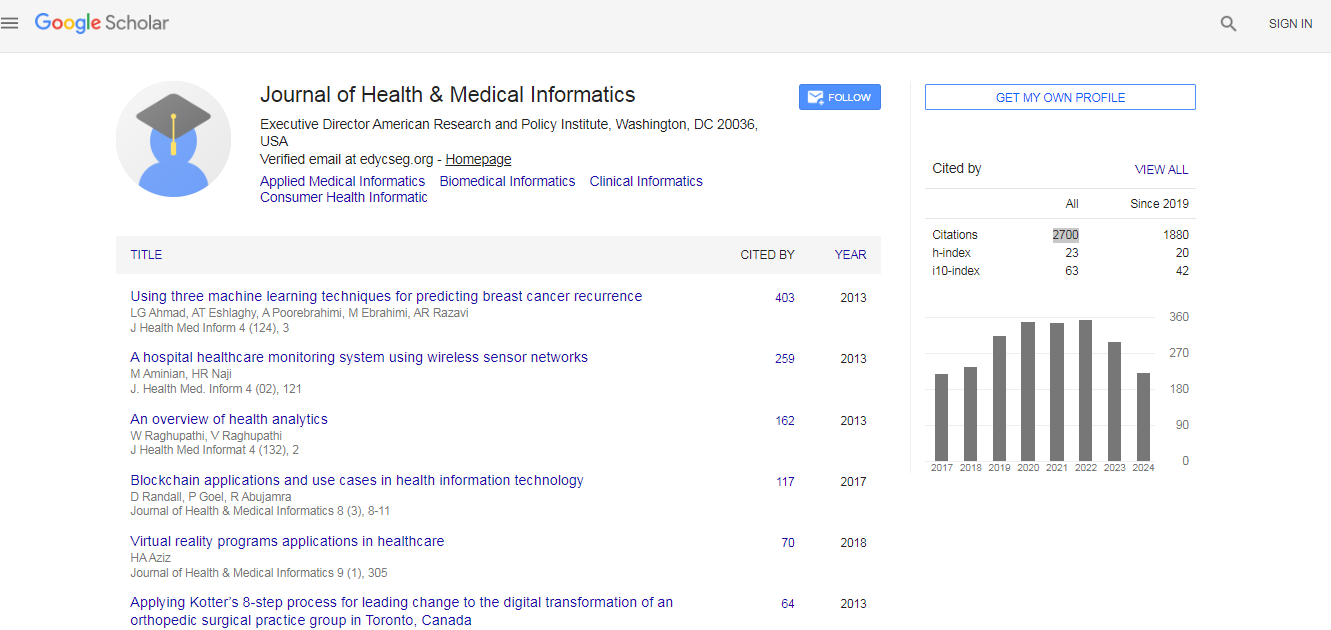
Journal of Health & Medical Informatics received 2700 citations as per Google Scholar report