Brief Report - (2025) Volume 16, Issue 6
Received: 01-Nov-2025, Manuscript No. jhmi-26-178891;
Editor assigned: 03-Nov-2025, Pre QC No. P-178891;
Reviewed: 17-Nov-2025, QC No. Q-178891;
Revised: 24-Nov-2025, Manuscript No. R-178891;
Published:
29-Nov-2025
, DOI: 10.37421/2157-7420.2025.16.620
Citation: Weber, Markus T.. ”Health Informatics: Enhancing Pandemic Preparedness And Response.” J Health Med Informat 16 (2025):620.
Copyright: © 2025 Weber T. Markus This is an open-access article distributed under the terms of the Creative Commons Attribution License, which permits unrestricted use, distribution and reproduction in any medium, provided the original author and source are credited.
The global landscape of public health has been irrevocably altered by the recurrent threat of infectious disease outbreaks, necessitating a profound re-evaluation of our preparedness and response mechanisms. Health informatics, a multidisciplinary field, has emerged as a pivotal discipline in fortifying these defenses against pandemics. By harnessing the power of data analytics, artificial intelligence, and digital surveillance systems, it offers unprecedented capabilities for early detection and tracking of disease spread, thereby informing crucial public health interventions. The seamless exchange of information across disparate systems, supported by robust data governance frameworks, is paramount for orchestrating effective response strategies, as highlighted by advancements in this area [1].
Recognizing the potential of novel technologies, the integration of artificial intelligence (AI) into infectious disease surveillance presents a transformative opportunity. AI algorithms can process vast and diverse data sources, including the often-overlooked streams of social media and news reports, to identify anomalies indicative of emerging health threats. However, the deployment of AI-driven surveillance systems is not without its complexities, requiring careful consideration of ethical implications and potential challenges in public health contexts [2].
In parallel, the application of big data analytics has become indispensable for the real-time monitoring and prediction of disease outbreaks. The accuracy and efficacy of these predictive models hinge on the quality and standardization of data, as well as the development of sophisticated analytical tools. Such capabilities are essential for guiding public health decision-making during critical periods of a pandemic and require substantial investment in technical infrastructure [3].
Electronic health records (EHRs) represent a rich repository of patient information that can be strategically leveraged during public health emergencies. The utilization of EHR data facilitates critical functions such as patient tracking, detailed outbreak analysis, and the identification of disease trends at both local and national scales. Nevertheless, the effective use of EHRs is contingent upon addressing significant challenges related to data privacy, security protocols, and the interoperability of these complex systems [4].
The development and implementation of sophisticated public health information systems are fundamental to effective disease surveillance. These systems are most impactful when designed with the end-user in mind, integrating diverse data streams and employing intuitive data visualization techniques to monitor public health threats. The ongoing maintenance and updating of such systems present ongoing operational challenges that must be proactively managed [5].
In the face of rapidly spreading infections, mobile health (mHealth) applications offer a promising avenue for rapid communication and intervention. Their potential lies in facilitating swift contact tracing and disseminating vital public health messages to affected populations. By enabling the rapid tracking of individuals exposed to infectious diseases, mHealth tools can significantly curtail transmission, though ethical considerations and user adoption remain key factors for success [6].
Interoperability within health information systems stands as a cornerstone of effective pandemic preparedness. Standardized data formats and communication protocols are indispensable for enabling the seamless exchange of information between diverse systems. This interconnectedness is crucial for comprehensive surveillance efforts and the coordination of timely, impactful interventions. Policy recommendations aimed at promoting such interoperability are vital for strengthening national health security [7].
The power of data visualization in communicating complex public health information during pandemics cannot be overstated. Clear and comprehensible visualizations enable policymakers and the public alike to grasp intricate data, track evolving trends, and make informed decisions. Adherence to best practices in designing effective public health dashboards is essential for maximizing their utility [8].
The ethical dimensions surrounding the application of health informatics in pandemic preparedness warrant careful examination. Issues of data privacy, the potential for algorithmic bias, ensuring equitable access to health information, and the responsible deployment of AI and surveillance technologies are paramount. The establishment of robust ethical frameworks is essential to guide the development and utilization of these powerful tools [9].
Emerging technologies like blockchain offer novel solutions for enhancing the security and integrity of health data during public health crises. Its potential to create secure and transparent ledgers for patient information, supply chain management, and clinical trial data can significantly bolster trust and accountability in pandemic response efforts [10].
Health informatics plays a crucial role in bolstering pandemic preparedness by enabling advanced data analytics, artificial intelligence, and digital surveillance systems. These tools are vital for early disease detection, tracking the spread of infections, and informing public health interventions. The effectiveness of these systems relies heavily on interoperable data platforms and well-defined data governance frameworks, ensuring a coordinated and efficient response [1].
Artificial intelligence (AI) is increasingly integrated into infectious disease surveillance, offering the capability to analyze a wide array of data sources, including social media and news outlets, for early anomaly detection. While AI holds significant promise, its application necessitates a thorough understanding of the ethical considerations and inherent challenges within public health surveillance frameworks [2].
Big data analytics are instrumental in the real-time monitoring and predictive modeling of disease outbreaks. The success of these initiatives depends on high-quality, standardized data and the development of robust predictive models that can guide public health decision-making. Furthermore, the underlying technical infrastructure must be adequately developed to support these intensive data processing demands [3].
Electronic health records (EHRs) provide a critical data resource for pandemic response, facilitating patient tracking, outbreak analysis, and the understanding of disease trends. However, realizing the full potential of EHR data requires overcoming obstacles related to data privacy, security concerns, and the need for enhanced system interoperability [4].
Public health information systems are central to effective disease surveillance, emphasizing user-centered design, efficient data visualization, and the integration of diverse data streams. These systems are designed to monitor public health threats, though their ongoing maintenance and adaptation pose significant operational challenges [5].
Mobile health (mHealth) applications are being utilized for critical functions such as contact tracing and disseminating public health messages during pandemics. Their ability to rapidly inform and track individuals exposed to infectious agents can significantly impact containment efforts, provided that user adoption and ethical considerations are adequately addressed [6].
Interoperability is a fundamental requirement for health information systems to effectively support pandemic response. Standardized data formats and communication protocols allow for the seamless exchange of information between different systems, which is essential for comprehensive surveillance and coordinated public health actions. Policy initiatives promoting interoperability are key to strengthening these capabilities [7].
Data visualization tools are essential for communicating complex public health information during pandemics. Effective visualizations help stakeholders, including policymakers and the public, understand trends and make informed decisions. The design of public health dashboards requires adherence to best practices to ensure clarity and impact [8].
The ethical implications of using health informatics in pandemic preparedness are multifaceted, encompassing data privacy, algorithmic bias, equitable access to information, and the responsible use of AI and surveillance technologies. The development and implementation of ethical frameworks are crucial for guiding the appropriate use of these technologies [9].
Blockchain technology offers a promising approach to enhancing the security and integrity of health data during public health emergencies. Its application can provide a secure and transparent record for patient data, supply chain logistics, and clinical trial information, thereby fostering greater trust and accountability in pandemic response operations [10].
The provided content explores the critical role of health informatics in enhancing pandemic preparedness and response. It details how technologies such as data analytics, artificial intelligence, big data, electronic health records, mobile health applications, and blockchain can be leveraged for early detection, disease tracking, and effective interventions. Key themes include the importance of interoperability, data quality, ethical considerations, and data visualization for informed decision-making. The papers collectively advocate for robust systems and frameworks to manage public health threats.
None
None
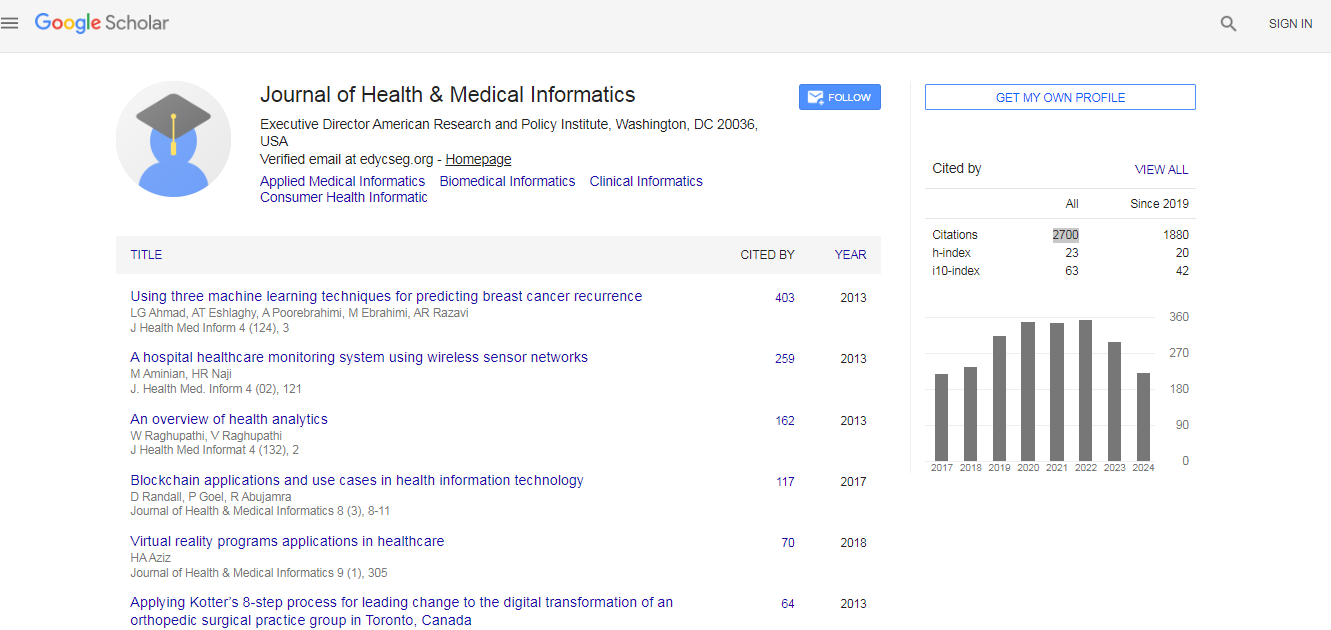
Journal of Health & Medical Informatics received 2700 citations as per Google Scholar report