Brief Report - (2025) Volume 16, Issue 3
Received: 01-Aug-2025, Manuscript No. hgec-25-174737;
Editor assigned: 04-Aug-2025, Pre QC No. P-174737;
Reviewed: 18-Aug-2025, QC No. Q-174737;
Revised: 22-Aug-2025, Manuscript No. R-174737;
Published:
29-Aug-2025
, DOI: 10.37421/2161-0436.2025.16.291
Citation: Holtzmann, Viktor S.. ”GWAS: Advancing Clinical Applications and Personalized Medicine.” Human Genet Embryol 16 (2025):291.
Copyright: © 2025 Holtzmann S. Viktor This is an open-access article distributed under the terms of the Creative Commons Attribution License, which permits unrestricted use, distribution and reproduction in any medium, provided the original author and source are credited.
Genome-Wide Association Studies (GWAS) have profoundly transformed our understanding of the genetic architecture of complex diseases, leading to unprecedented insights into human health and susceptibility. Initially focused on simply identifying broad genetic associations, the field of GWAS has progressed significantly to understanding the functional implications of these often-subtle findings. Modern approaches now delve into sophisticated methods like fine-mapping, which pinpoint specific causative variants, and the crucial integration of multi-omics data, effectively bridging the gap between statistically associated loci and the underlying causative variants. What this really means is that GWAS is no longer just about finding broad correlations; it actively aims to uncover the precise biological mechanisms at play and, critically, translate those insights into practical clinical applications for patient benefit[1].
These continuous advancements offer a truly comprehensive look at how GWAS has become increasingly sophisticated in identifying complex disease susceptibility across a wide range of human conditions. Yet, important challenges undeniably remain, particularly concerning the effective handling of rare variants and deciphering complex gene-environment interactions. These persistent hurdles continue to push researchers to develop innovative new statistical and computational tools and methodologies to improve discovery power[2].
For instance, here's the thing about GWAS: statistical power and achieving an adequate sample size are absolutely critical. Reviews in the field dive deep into these considerations, explaining how crucial it is to have large enough cohorts to reliably detect genetic variants that may individually have only small effects. What this really means is that careful, well-thought-out study design is fundamental to avoiding false negatives and ensuring the generation of robust, reproducible findings in genetic research[3].
A truly significant development stemming directly from GWAS is the concept of polygenic risk scores (PRS). These scores are now considered a critical tool for predicting an individual's disease risk across various complex traits. The takeaway is that PRS moves GWAS findings closer to the realization of personalized medicine, offering a tangible way to estimate an individual's genetic predisposition for common conditions such as heart disease, type 2 diabetes, or even certain psychiatric disorders[4].
Furthermore, researchers are actively exploring the exciting intersection of functional genomics and GWAS. This work highlights how integrating diverse data from experiments like ATAC-seq or Hi-C, which reveal chromatin accessibility and 3D genome structure, with traditional GWAS findings, helps move beyond mere statistical associations. The goal is to uncover the actual regulatory mechanisms underlying disease. Basically, it's about connecting the dots between a specific genetic variant and its precise biological consequence[5].
While GWAS has traditionally focused on common variants, this paper shifts significant attention to rare variants, which can sometimes have substantial, even Mendelian-like, effects on disease phenotypes. It details advanced methods for detecting these rarer genetic associations within vast, large-scale sequencing data. Let's break it down: finding these rare signals is inherently complex due to their low frequency, but it's utterly crucial for understanding conditions where common variants explain only a small fraction of the observed heritability[6].
Another critically important consideration is that GWAS has largely focused on populations of European descent, leading to an acknowledged bias in genetic insights. This paper strongly argues for increasing diversity in genetic studies, highlighting how such expansion significantly improves the transferability of findings across populations and works to reduce existing health disparities. What this really means is that including more diverse populations makes GWAS results far more generalizable and ultimately more equitable for everyone, irrespective of their ancestral background[7].
This article provides a robust overview of the current landscape of GWAS, meticulously mapping out its significant achievements over the past decades while also candidly pointing towards future hurdles that need to be overcome. It touches upon crucial methodological refinements and the necessity of integrating diverse data types â?? from clinical records to environmental exposures â?? needed to unlock the full potential of these powerful studies. Itâ??s clear that while GWAS has revolutionized genetics and disease understanding, there's still considerable work to be done in fully understanding the complex architecture of human traits and diseases[8].
Beyond genetics, there's a crucial need to integrate epigenomic data with GWAS findings. This integration explains how epigenetic modifications, such as DNA methylation or histone modifications, can effectively mediate the effects of genetic variants, offering a richer and more nuanced understanding of disease etiology beyond just the basic DNA sequence. This really means combining these two powerful fields provides a more complete picture of how genes and the environment interact dynamically to influence health and disease[9].
Ultimately, the perspective is now robustly shifting from the initial discovery phase of GWAS to its practical and impactful application in the clinical setting. This vital paper discusses how these invaluable genetic insights are actively beginning to inform personalized medicine, ranging from more accurate risk prediction for common diseases to guiding pharmacogenomics, which optimizes drug choice and dosage based on an individual's genetic makeup. What this really means is bridging the critical gap between raw genetic findings and tangible patient benefits, thereby firmly establishing GWAS as an indispensable tool for the future of healthcare and precision medicine[10].
Genome-Wide Association Studies (GWAS) have evolved dramatically, moving beyond simple correlation to deeply understand the functional implications of genetic variants. Modern GWAS utilizes sophisticated techniques like fine-mapping to narrow candidate regions and integrates multi-omics data, including proteomics and metabolomics, to pinpoint causative variants and their mechanisms. This means we're not just identifying genetic links, but actively deciphering the underlying biological pathways. The ultimate goal is to translate these mechanistic insights into tangible clinical applications, improving diagnostics, prognostics, and therapeutic strategies[1].
Despite significant progress, the field faces ongoing challenges, especially in effectively handling rare variants, which individually have low frequencies but can collectively influence disease risk. Researchers also grapple with the complexities of gene-environment interactions. Overcoming these hurdles necessitates developing innovative statistical and computational tools[2]. Here's the thing about effective GWAS: statistical power and adequate sample size are paramount. Careful consideration must be given to enrolling sufficiently large cohorts to detect genetic variants with small individual effects. Without rigorous study design, there's a heightened risk of false negatives, undermining reproducibility and reliability[3].
A significant practical application emerging from GWAS is polygenic risk scores (PRS). PRS synthesizes information from many genetic variants to provide a personalized estimate of an individual's predisposition to complex diseases. Their expanding utility is transforming how we predict disease risk for conditions like type 2 diabetes, cardiovascular disease, and psychiatric disorders, pushing us closer to true personalized medicine[4]. Beyond statistical associations, functional genomics plays a crucial role. Integrating data from experiments such as ATAC-seq or Hi-C with GWAS results helps connect a genetic variant to its precise regulatory impact. Basically, this approach illuminates the biological consequences of genetic variations[5].
While common variants have been the traditional focus, the importance of rare variants in complex disease etiology is gaining recognition. These variants, though infrequent, can have profound effects. Advanced methods are now being developed and applied to large-scale sequencing data to accurately identify these rarer genetic signals. Let's break it down: finding these rare signals is complex, but it's crucial for explaining 'missing heritability' where common variants offer limited insights[6]. Furthermore, addressing the historical underrepresentation of diverse populations in genetic studies is critical. A strong argument exists for increasing diversity in GWAS cohorts, as this not only improves transferability across different ancestral groups but also actively works to reduce health disparities. What this really means is that more inclusive genetic research leads to more generalizable and equitable health benefits for all[7].
The current status of GWAS highlights its achievements and ongoing evolution. Methodological refinements and the seamless integration of diverse data types, from environmental exposures to clinical phenotypes, are continuously being pursued for a more holistic understanding of complex trait architecture[8]. Another essential integrative approach combines epigenomic data with GWAS findings. Epigenetic modifications, like DNA methylation, can mediate effects of genetic variants without altering DNA sequence. This integration offers a richer understanding of how genes and environmental factors dynamically interact to influence health and disease etiology[9]. The shift from purely academic discovery to practical clinical implementation is a pivotal phase for GWAS. These genetic insights are increasingly informing personalized medicine, impacting areas from improved disease risk prediction to optimizing drug therapies through pharmacogenomics. What this really means is bridging the gap between genetic findings and tangible patient benefits, firmly establishing GWAS as an indispensable tool for the future of healthcare[10].
Genome-Wide Association Studies (GWAS) have profoundly advanced, transitioning from identifying genetic associations to understanding their functional implications through methods like fine-mapping and multi-omics data integration. This means GWAS now uncovers biological mechanisms and translates insights into clinical applications. Key challenges involve handling rare variants, addressing complex gene-environment interactions, and ensuring adequate statistical power and sample size. Polygenic Risk Scores (PRS) represent a critical development, bringing personalized medicine closer by predicting disease risk. Integrating functional genomics and epigenomics further enriches our understanding of regulatory mechanisms and disease etiology. Addressing historical biases by increasing diversity in genetic studies is vital for improving result transferability and reducing health disparities, making findings more generalizable and equitable. While GWAS has revolutionized genetics, future work focuses on methodological refinements and integrating diverse data types to fully understand complex trait architecture. The shift towards practical clinical application, encompassing risk prediction and pharmacogenomics, solidifies GWAS as an indispensable tool for the future of healthcare.
None
None
Indexed at, Google Scholar, Crossref
Indexed at, Google Scholar, Crossref
Indexed at, Google Scholar, Crossref
Indexed at, Google Scholar, Crossref
Indexed at, Google Scholar, Crossref
Indexed at, Google Scholar, Crossref
Indexed at, Google Scholar, Crossref
Indexed at, Google Scholar, Crossref
Indexed at, Google Scholar, Crossref
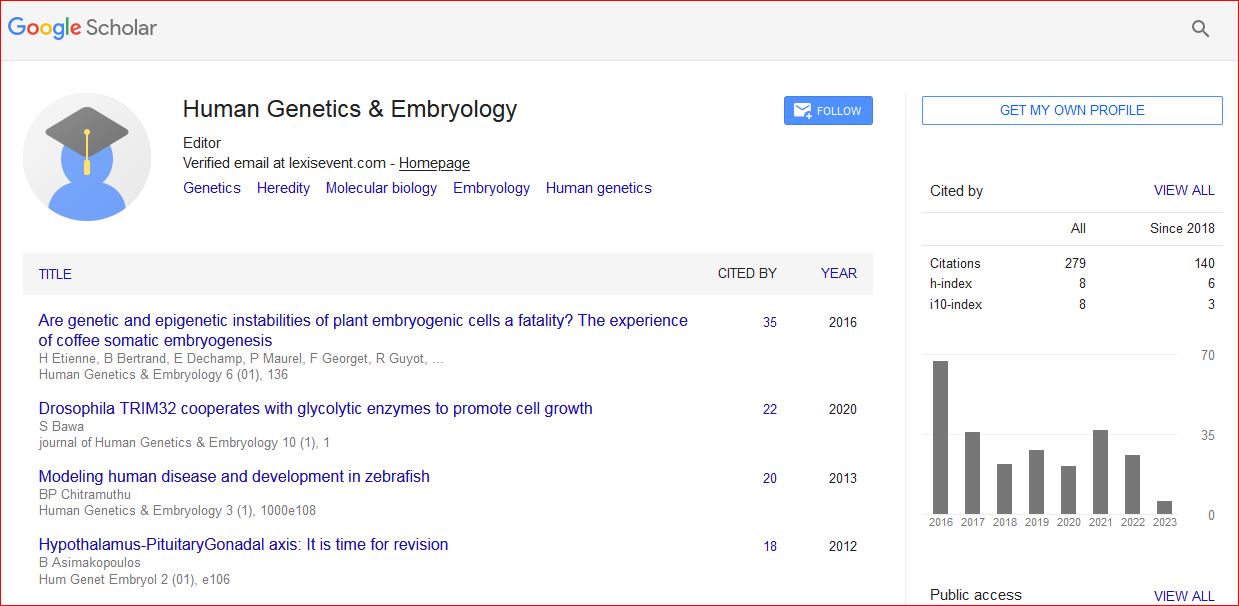
Human Genetics & Embryology received 309 citations as per Google Scholar report