Commentary - (2025) Volume 14, Issue 2
Received: 01-Apr-2025, Manuscript No. jbfa-25-174131;
Editor assigned: 03-Apr-2025, Pre QC No. P-174131;
Reviewed: 17-Apr-2025, QC No. Q-174131;
Revised: 22-Apr-2025, Manuscript No. R-174131;
Published:
29-Apr-2025
, DOI: 10.37421/2167-0234.2025.14.521
Citation: Almeida, Sofia. ”Governance: Shaping Performance, ESG, and Integrity.” J Bus Fin Aff 14 (2025):521.
Copyright: © 2025 Almeida S. This is an open-access article distributed under the terms of the Creative Commons Attribution License, which permits unrestricted use, distribution and reproduction in any medium, provided the original author and source are credited.
Corporate governance plays a multifaceted and critical role in modern organizational success, encompassing everything from ethical conduct to financial performance and stakeholder relations. Understanding its various dimensions reveals how effective governance structures can drive positive outcomes across different business contexts. For example, corporate governance structures directly influence Environmental, Social, and Governance (ESG) performance, particularly through the quality of financial and non-financial disclosures. Transparent and robust disclosure practices, when backed by effective governance mechanisms, significantly enhance a firm's ESG standing, contributing to sustainable value creation. [1] Further, the composition of a company's board is a key governance aspect. Board diversity, encompassing gender, age, and professional backgrounds, has been shown to correlate with a firm's Corporate Social Responsibility (CSR) initiatives. Diverse boards often lead to more comprehensive and effective CSR strategies, advocating for a broader understanding of diversityâ??s impact on sustainable corporate practices. [2] External forces also exert considerable influence on corporate governance. Shareholder activism, for instance, actively shapes governance and impacts firm performance across European markets. Activist campaigns frequently result in significant governance reforms, such as board changes or strategic shifts, which in turn can positively or negatively affect financial outcomes, underscoring the complex role of active ownership. [3] In the digital age, corporate governance responsibilities have expanded to include oversight of cybersecurity risks. Studies indicate that audit committees with greater financial expertise and independence are more effective in mitigating cybersecurity breaches and their financial consequences, highlighting the critical need for specialized oversight in the digital age. [4] Beyond risk management, governance also impacts transparency. Various board characteristics, like independence and gender diversity, and different ownership structures, influence the quality and depth of corporate sustainability reporting. Well-governed firms with diverse boards and concentrated ownership are more likely to provide comprehensive sustainability disclosures, promoting transparency and accountability. [5] Another critical function of corporate governance is to prevent financial misconduct. Effective governance mechanisms can act as a significant deterrent to financial fraud. Strong board independence, active audit committees, and dispersed ownership structures significantly reduce the likelihood and severity of fraudulent activities, underscoring governance's role in maintaining financial integrity, particularly evident in analyses of Chinese listed firms. [6] The ongoing digital transformation also necessitates evolving governance frameworks. A systematic review highlights the shifting relationship between digitalization and corporate governance, identifying key areas where technological advancements impact board oversight, decision-making, and transparency. This evolution calls for adaptive governance structures to address new risks and opportunities presented by digital transformation, setting a future research agenda. [7] Specific organizational contexts, such as family firms, introduce unique governance considerations. Factors like family involvement, succession planning, and altruistic motives influence governance decisions in these entities, often leading to distinct advantages or disadvantages compared to non-family businesses. [8] Institutional investors are powerful agents in the governance landscape. Their complex interplay with corporate governance practices shows how institutional ownership influences firm behavior, board structure, and accountability. This often happens through active monitoring and engagement, thereby shaping governance effectiveness and long-term shareholder value. [9] Finally, the impact of gender diversity on corporate boards is a recurring theme in governance discussions. A meta-analysis consolidates research showing a generally positive, albeit complex, association between gender diversity on boards and various dimensions of firm performance. This suggests that diverse boards can enhance strategic decision-making, innovation, and stakeholder relations, ultimately contributing to better governance and organizational outcomes. [10]
Corporate governance structures are foundational to a firm's overall performance, extending significantly into Environmental, Social, and Governance (ESG) aspects. Effective governance mechanisms, coupled with transparent financial and non-financial disclosures, are pivotal in enhancing a company's ESG standing, contributing directly to sustainable value creation by fostering accountability and trust among stakeholders [1]. Beyond this, board characteristics, including independence and gender diversity, and the existing ownership structures, play a critical role in determining the quality and comprehensiveness of corporate sustainability reporting. Firms with robust governance frameworks and diverse boards are more inclined to offer thorough sustainability disclosures, thereby promoting greater transparency [5].
The composition of a corporate board is a powerful determinant of a firmâ??s commitment to social responsibility and overall performance. Research systematically reviews the relationship between board diversityâ??considering gender, age, and professional backgroundsâ??and Corporate Social Responsibility (CSR) initiatives, showing that diverse boards often lead to more comprehensive and effective CSR strategies. This highlights the importance of a broader understanding of diversityâ??s far-reaching impact on sustainable corporate practices [2]. Specifically, gender diversity on corporate boards has been subject to extensive meta-analysis, finding a generally positive, though intricate, association with various dimensions of firm performance. Diverse boards can enhance strategic decision-making, foster innovation, and improve stakeholder relations, collectively leading to superior organizational outcomes and better governance [10].
Corporate governance also acts as a vital safeguard against various forms of risk and misconduct. For instance, the role of corporate governance, particularly through its audit committees, is crucial in overseeing cybersecurity risks. Studies confirm that audit committees possessing greater financial expertise and independence are demonstrably more effective in mitigating cybersecurity breaches and their subsequent financial consequences, emphasizing the urgent need for specialized oversight in our increasingly digital world [4]. Furthermore, effective governance mechanisms are instrumental in deterring financial fraud. Strong board independence, active audit committees, and dispersed ownership structures significantly reduce the likelihood and severity of fraudulent activities, underscoring governanceâ??s indispensable role in maintaining financial integrity, a phenomenon particularly observed in Chinese listed firms [6].
External pressures and unique corporate environments profoundly shape governance practices. Shareholder activism provides a clear example, demonstrating how active ownership can instigate significant governance reforms, such as board changes or strategic shifts, which in turn can impact financial outcomes, showcasing the complex dynamics of corporate power [3]. Similarly, institutional investors wield considerable influence, engaging in active monitoring and engagement that shapes firm behavior, board structure, and accountability. This interaction ultimately influences governance effectiveness and long-term shareholder value [9]. Distinct governance challenges are also prevalent in family firms, where factors like family involvement, succession planning, and altruistic motives uniquely shape governance decisions, sometimes leading to specific advantages or disadvantages compared to non-family businesses [8].
Finally, the landscape of corporate governance is continually evolving, notably in response to digitalization. A systematic review highlights the intricate and evolving relationship between digitalization and corporate governance. It pinpoints key areas where technological advancements impact board oversight, decision-making processes, and transparency. This evolution necessitates adaptive governance frameworks capable of addressing both the new risks and the opportunities presented by digital transformation, thereby setting a critical agenda for future research and practical implementation [7].
Corporate governance structures are crucial for influencing Environmental, Social, and Governance (ESG) performance, with transparent financial and non-financial disclosures and effective governance mechanisms significantly enhancing a firm's ESG standing and contributing to sustainable value creation. Board diversity, encompassing gender, age, and professional backgrounds, proves instrumental in developing comprehensive and effective Corporate Social Responsibility (CSR) strategies, highlighting diversityâ??s broad impact on sustainable corporate practices. Shareholder activism actively shapes corporate governance and firm performance, particularly in European markets, where campaigns lead to governance reforms and affect financial outcomes. Beyond traditional oversight, corporate governance is vital in managing emerging risks like cybersecurity. Audit committees with strong financial expertise and independence are more effective in mitigating cybersecurity breaches and their associated financial consequences. Board characteristics, including independence and gender diversity, alongside ownership structures, directly influence the quality and depth of corporate sustainability reporting. Well-governed firms, characterized by diverse boards and concentrated ownership, tend to offer more comprehensive disclosures, fostering transparency. Governance mechanisms also serve as a deterrent to financial fraud. Robust board independence, active audit committees, and dispersed ownership structures have been shown to reduce fraudulent activities, upholding financial integrity. The ongoing digitalization trend necessitates adaptive corporate governance frameworks to address new technological risks and opportunities, impacting board oversight, decision-making, and transparency. Unique governance challenges exist within family firms, where family involvement, succession planning, and altruistic motives distinctly influence decisions, sometimes leading to advantages or disadvantages. Institutional investors also significantly shape corporate governance through active monitoring and engagement, influencing firm behavior, board structure, and accountability to create long-term shareholder value. Finally, gender diversity on corporate boards shows a generally positive association with firm performance, enhancing strategic decision-making, innovation, and stakeholder relations, ultimately contributing to better organizational outcomes.
None
None
Indexed at, Google Scholar, Crossref
Indexed at, Google Scholar, Crossref
Indexed at, Google Scholar, Crossref
Indexed at, Google Scholar, Crossref
Indexed at, Google Scholar, Crossref
Indexed at, Google Scholar, Crossref
Indexed at, Google Scholar, Crossref
Indexed at, Google Scholar, Crossref
Indexed at, Google Scholar, Crossref
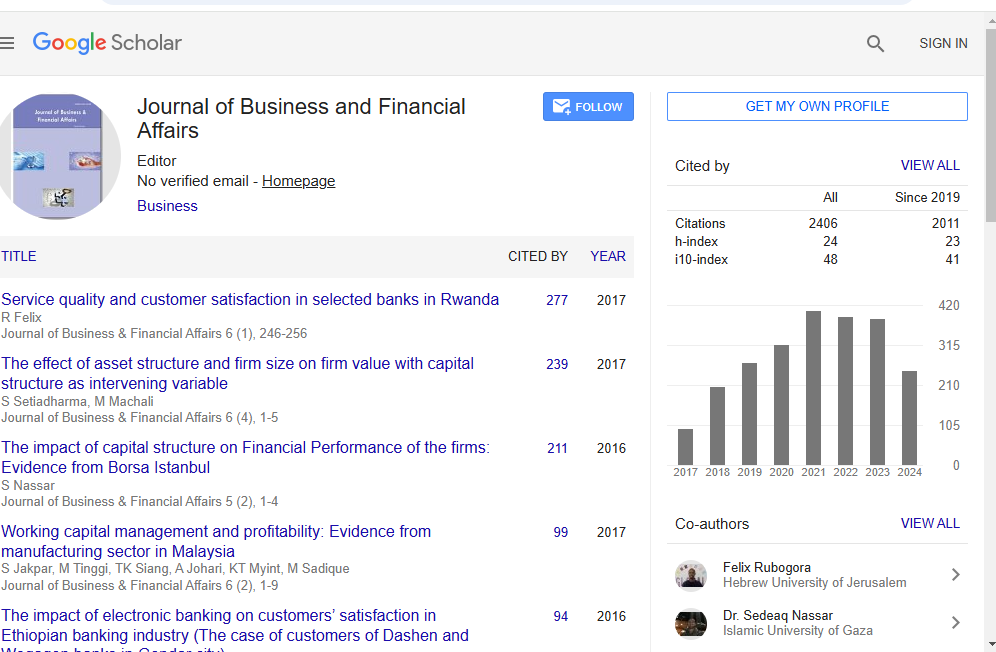
Journal of Business & Financial Affairs received 1726 citations as per Google Scholar report