Brief Report - (2025) Volume 13, Issue 6
Received: 03-Nov-2025, Manuscript No. economics-26-186077;
Editor assigned: 05-Nov-2025, Pre QC No. P-186077;
Reviewed: 19-Nov-2025, QC No. Q-186077;
Revised: 24-Nov-2025, Manuscript No. R-186077;
Published:
01-Dec-2025
, DOI: 10.37421/2375-4389.2025.13.551
Citation: Fauzi, Ahmad. ”Global Value Chains: Growth, Risks,
and Resilience Strategies.” J Glob Econ 13 (2025):551.
Copyright: © 2025 Fauzi A. This is an open-access article distributed under the terms of the Creative Commons Attribution License, which permits unrestricted use, distribution
and reproduction in any medium, provided the original author and source are credited.
Developing economies can strategically integrate into Global Value Chains (GVCs) to foster economic growth and industrial upgrading. This integration often involves attracting foreign direct investment (FDI) and participating in export-oriented manufacturing. However, the benefits are not automatic and depend on domestic absorptive capacities, infrastructure, and supportive policy frameworks. Effectively managing these GVC linkages can lead to technology transfer, skill development, and increased employment opportunities, but also poses risks related to dependence on external markets and vulnerability to global shocks [1].
The participation of developing countries in Global Value Chains (GVCs) presents a dual-edged sword. While it offers avenues for export-led growth and integration into the global economy, it can also lead to concerns about uneven distribution of benefits, limited technological spillovers, and the potential for 'locking in' developing countries to low-value-added activities. The role of domestic policies in capturing higher value segments of GVCs is crucial [2].
Developing economies' integration into GVCs is a complex process influenced by various factors, including trade policies, institutional quality, and the specific industry characteristics. The ability to move up the value chain, from simple assembly to more complex production and design, is a critical determinant of long-term developmental gains. This often requires significant investments in human capital and R&D [3].
The literature increasingly emphasizes the importance of institutional frameworks in enabling developing economies to harness the benefits of GVC participation. Strong institutions, including effective governance, rule of law, and protection of property rights, are essential for attracting and retaining foreign investment and fostering domestic capabilities that allow for upgrading within GVCs [4].
For developing economies, the sustainability of their integration into GVCs is paramount. This involves considering not only economic gains but also social and environmental impacts. Policies aimed at promoting fair labor practices, reducing environmental footprints, and ensuring equitable distribution of benefits across different segments of society are crucial for long-term development and social stability [5].
The digital transformation is profoundly reshaping Global Value Chains. For developing economies, embracing digital technologies offers new opportunities for participation, such as through e-commerce platforms and digital services. However, it also necessitates significant investments in digital infrastructure, skills, and regulatory frameworks to bridge the digital divide and ensure inclusive benefits [6].
Small and Medium Enterprises (SMEs) in developing economies face unique challenges and opportunities in integrating into GVCs. Access to finance, technology, and market information are often more constrained for SMEs than for larger firms. Policies that facilitate SME participation can unlock significant potential for job creation and inclusive growth within GVCs [7].
The impact of GVCs on income inequality within developing economies is a critical area of study. While GVC participation can lead to overall economic growth, it can also exacerbate inequality if the benefits are not equitably distributed. Policies aimed at improving education, skills training, and social safety nets are important for mitigating potential negative impacts on inequality [8].
Trade facilitation measures are vital for developing economies to effectively participate in Global Value Chains. Streamlining customs procedures, improving logistics infrastructure, and reducing trade transaction costs can significantly enhance a country's attractiveness as a production location and its ability to move goods efficiently along GVCs [9].
The fragmentation of production across countries, characteristic of GVCs, offers developing economies opportunities for specialization and skill acquisition. However, it also exposes them to risks associated with global demand fluctuations and the need for robust domestic policies to support diversified production capabilities and enhance resilience [10].
Developing economies can strategically integrate into Global Value Chains (GVCs) to foster economic growth and industrial upgrading. This integration often involves attracting foreign direct investment (FDI) and participating in export-oriented manufacturing. However, the benefits are not automatic and depend on domestic absorptive capacities, infrastructure, and supportive policy frameworks. Effectively managing these GVC linkages can lead to technology transfer, skill development, and increased employment opportunities, but also poses risks related to dependence on external markets and vulnerability to global shocks [1].
The participation of developing countries in Global Value Chains (GVCs) presents a dual-edged sword. While it offers avenues for export-led growth and integration into the global economy, it can also lead to concerns about uneven distribution of benefits, limited technological spillovers, and the potential for 'locking in' developing countries to low-value-added activities. The role of domestic policies in capturing higher value segments of GVCs is crucial [2].
Developing economies' integration into GVCs is a complex process influenced by various factors, including trade policies, institutional quality, and the specific industry characteristics. The ability to move up the value chain, from simple assembly to more complex production and design, is a critical determinant of long-term developmental gains. This often requires significant investments in human capital and R&D [3].
The literature increasingly emphasizes the importance of institutional frameworks in enabling developing economies to harness the benefits of GVC participation. Strong institutions, including effective governance, rule of law, and protection of property rights, are essential for attracting and retaining foreign investment and fostering domestic capabilities that allow for upgrading within GVCs [4].
For developing economies, the sustainability of their integration into GVCs is paramount. This involves considering not only economic gains but also social and environmental impacts. Policies aimed at promoting fair labor practices, reducing environmental footprints, and ensuring equitable distribution of benefits across different segments of society are crucial for long-term development and social stability [5].
The digital transformation is profoundly reshaping Global Value Chains. For developing economies, embracing digital technologies offers new opportunities for participation, such as through e-commerce platforms and digital services. However, it also necessitates significant investments in digital infrastructure, skills, and regulatory frameworks to bridge the digital divide and ensure inclusive benefits [6].
Small and Medium Enterprises (SMEs) in developing economies face unique challenges and opportunities in integrating into GVCs. Access to finance, technology, and market information are often more constrained for SMEs than for larger firms. Policies that facilitate SME participation can unlock significant potential for job creation and inclusive growth within GVCs [7].
The impact of GVCs on income inequality within developing economies is a critical area of study. While GVC participation can lead to overall economic growth, it can also exacerbate inequality if the benefits are not equitably distributed. Policies aimed at improving education, skills training, and social safety nets are important for mitigating potential negative impacts on inequality [8].
Trade facilitation measures are vital for developing economies to effectively participate in Global Value Chains. Streamlining customs procedures, improving logistics infrastructure, and reducing trade transaction costs can significantly enhance a country's attractiveness as a production location and its ability to move goods efficiently along GVCs [9].
The fragmentation of production across countries, characteristic of GVCs, offers developing economies opportunities for specialization and skill acquisition. However, it also exposes them to risks associated with global demand fluctuations and the need for robust domestic policies to support diversified production capabilities and enhance resilience [10].
Developing economies can leverage integration into Global Value Chains (GVCs) for economic growth and industrial advancement, often through foreign direct investment and export-oriented manufacturing. Success hinges on domestic capacities, infrastructure, and supportive policies, which can lead to technology transfer and job creation, but also entail risks of market dependence and global shocks. While GVC participation offers export-led growth and global integration, it may result in uneven benefit distribution and limited technological spillovers, necessitating policies to capture higher value segments. Moving up the value chain requires investment in human capital and R&D, and strong institutions are crucial for attracting investment and fostering domestic capabilities. Sustainability in GVCs involves addressing social and environmental impacts, alongside economic gains. Digital transformation presents new participation avenues but demands investment in infrastructure and skills. SMEs face unique challenges in GVC integration, requiring supportive policies for their growth. GVCs can impact income inequality, necessitating policies for equitable benefit distribution, education, and social safety nets. Trade facilitation measures, such as streamlined customs and improved logistics, are vital for efficient participation. Production fragmentation in GVCs offers specialization opportunities but exposes economies to demand fluctuations, requiring resilient domestic policies.
None
None
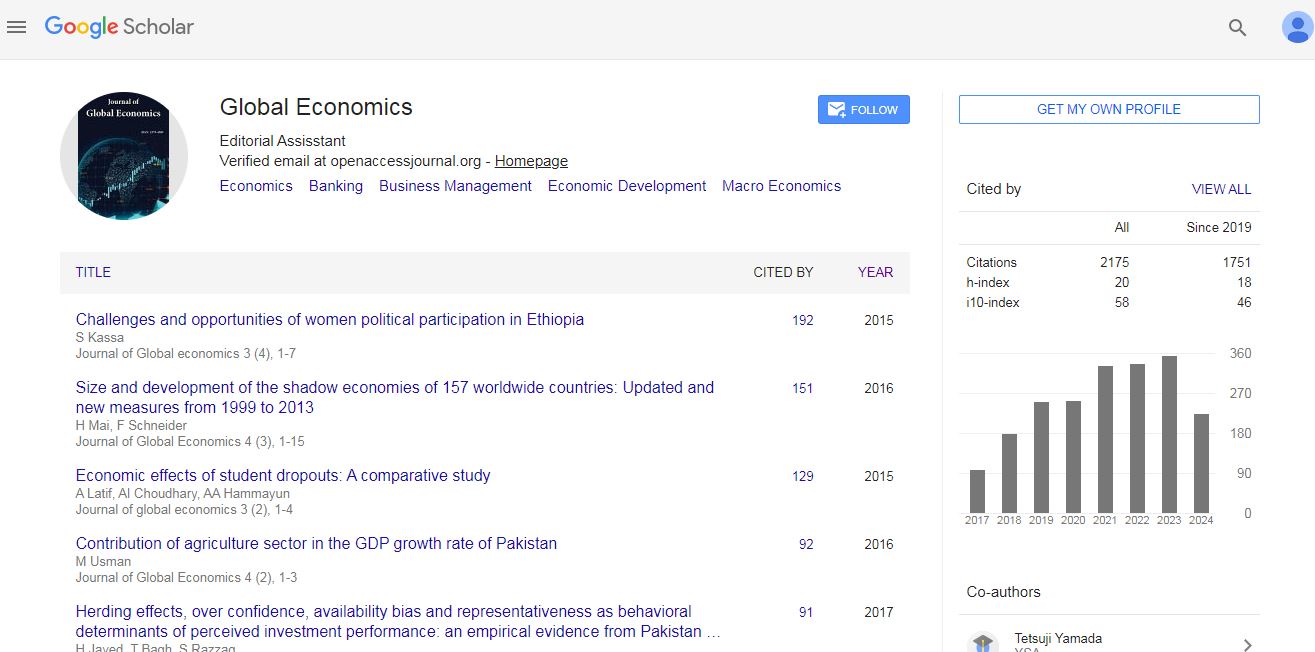
Journal of Global Economics received 2175 citations as per Google Scholar report