Perspective - (2025) Volume 13, Issue 6
Received: 03-Nov-2025, Manuscript No. economics-26-186084;
Editor assigned: 05-Nov-2025, Pre QC No. P-186084;
Reviewed: 19-Nov-2025, QC No. Q-186084;
Revised: 24-Nov-2025, Manuscript No. R-186084;
Published:
01-Dec-2025
, DOI: 10.37421/2375-4389.2025.13.557
Citation: Reed, Jonathan. ”Global Trade Imbalances: Policy,
Politics, and Cooperation.” J Glob Econ 13 (2025):557.
Copyright: © 2025 Reed J. This is an open-access article distributed under the terms of the Creative Commons Attribution License, which permits unrestricted use, distribution
and reproduction in any medium, provided the original author and source are credited.
Global trade imbalances represent a significant challenge in the contemporary economic landscape, prompting a diverse array of policy responses from national governments seeking to mitigate potential vulnerabilities. The complexities of persistent trade deficits and surpluses necessitate a nuanced understanding of the economic forces at play and the tools available for intervention. This article endeavors to explore these intricacies by synthesizing insights from various scholarly works, offering a comprehensive overview of the subject matter. The first piece examines the multifaceted nature of global trade imbalances and the various economic policy approaches governments adopt to address them, highlighting the interconnectedness of the global economy and the need for tailored strategies [1].
Further investigation into the direct impact of exchange rate policies on trade imbalances reveals their crucial role in rebalancing trade flows. The assertion is made that currency appreciation can widen trade deficits by making exports more expensive and imports cheaper, while depreciation can serve as a corrective mechanism. This study analyzes the effectiveness of different exchange rate management systems, including managed floating rates and direct interventions, in rectifying persistent imbalances, acknowledging the potential for unintended consequences [2].
The realm of fiscal policy also plays a pivotal role in mitigating trade imbalances, with government spending and taxation emerging as key levers. Research indicates that fiscal consolidation, through reduced government spending or increased taxation, can curtail import demand and consequently improve the trade balance. However, the magnitude of this effect is contingent upon the specific composition of fiscal adjustments and a nation's degree of economic openness. Furthermore, the paper touches upon the inherent coordination challenges that arise when multiple countries attempt to align their fiscal policies [3].
In contrast to more direct policy measures, trade protectionism, characterized by tariffs and quotas, presents a more controversial strategy for addressing trade imbalances. While appearing as straightforward solutions, these protectionist measures often trigger retaliatory actions from trading partners, disrupt established supply chains, and ultimately contribute to a less efficient global economic system. The authors advocate for the robust implementation of multilateral trade agreements and effective dispute resolution mechanisms as more constructive avenues for managing trade frictions [4].
Beyond immediate policy interventions, structural reforms are presented as a vital component for achieving sustainable solutions to persistent trade imbalances. Policies designed to enhance national productivity, promote greater labor market flexibility, and foster a climate of innovation can significantly bolster export competitiveness and moderate import demand. Illustrative case studies are provided to demonstrate how sustained structural reforms have historically contributed to the achievement of more balanced trade positions over the long term [5].
The intricate dynamics of global supply chains also exert a considerable influence on the measurement and management of trade imbalances. The increasing fragmentation of production processes across different countries can lead to statistical discrepancies in reported trade figures, thereby affecting the perceived scale of these imbalances. Consequently, policy responses must be designed with a thorough understanding of the complexities inherent in modern global value chains [6].
International capital flows emerge as another critical factor intertwined with trade imbalances. Large and often volatile inflows of capital can exert upward pressure on a country's currency, leading to appreciation and a subsequent worsening of trade deficits. The paper deliberates on policy options available for managing such capital flows, including the implementation of capital controls and the adoption of macroprudential policies, to effectively mitigate their impact on trade dynamics [7].
The political economy surrounding trade imbalances and the resulting policy responses presents a unique set of challenges. Domestic political considerations, such as the influence of lobbying by various interest groups and the dynamics of electoral cycles, can significantly shape the selection and ultimate effectiveness of trade adjustment policies. The authors underscore the inherent difficulty in implementing politically unpopular yet economically essential reforms [8].
In the digital age, the impact of digital trade policies on global trade imbalances warrants careful examination. Research suggests that policies designed to promote digital trade can unlock new export opportunities and potentially narrow trade deficits, particularly for nations with robust digital economies. The authors employ modeling techniques to assess the effects of different digital trade regulations on overall trade flows [9].
Finally, the effectiveness of international cooperation and coordinated actions in managing global trade imbalances cannot be overstated. Unilateral policy decisions can often prove counterproductive, whereas collaborative efforts among major economic powers are indispensable for achieving sustainable global rebalancing. The article emphasizes the crucial role played by international institutions such as the International Monetary Fund (IMF) and the World Trade Organization (WTO) in facilitating such cooperation [10].
The article comprehensively examines the multifaceted issue of global trade imbalances, detailing the diverse economic policy responses that governments implement to address potential vulnerabilities arising from persistent trade deficits or surpluses. It underscores the necessity of tailored policy approaches, acknowledging a nation's specific economic context and the inherent interconnectedness of the global economy, advocating for strategies that range from currency adjustments and trade barriers to fiscal stimulus and structural reforms [1].
The significant impact of exchange rate policies on trade imbalances is a focal point of discussion. The assertion is made that currency appreciation can exacerbate trade deficits by making exports less competitive and imports more attractive, whereas currency depreciation can serve as a corrective measure. The effectiveness of managed floating exchange rates and direct interventions in addressing these imbalances is analyzed, with a particular emphasis on the potential for unintended consequences stemming from such policies [2].
Fiscal policies, specifically government spending and taxation measures, are explored for their efficacy in mitigating trade imbalances. Empirical analysis suggests that fiscal consolidation, achieved through reductions in government expenditure or increases in tax revenue, can effectively decrease import demand and improve the trade balance. However, the magnitude of this impact is influenced by the composition of fiscal adjustments and the degree of a country's economic openness. The challenges associated with coordinating fiscal policies across different nations are also highlighted [3].
The role of trade protectionism in influencing global trade imbalances is critically assessed. While measures such as tariffs and quotas may appear as direct solutions, they often lead to retaliatory trade actions, disrupt global supply chains, and ultimately result in a less efficient global economic environment. The authors advocate for the strengthening of multilateral trade agreements and dispute resolution mechanisms as more constructive means of managing trade frictions [4].
Structural reforms are presented as a long-term solution for addressing persistent trade imbalances. Policies aimed at enhancing national productivity, improving labor market flexibility, and fostering innovation are crucial for boosting export competitiveness and moderating import demand. The paper includes case studies illustrating how sustained structural reforms have historically contributed to more balanced trade positions for nations [5].
The intricate relationship between global supply chains and trade imbalances is another area of investigation. The increasing fragmentation of production across borders can lead to statistical discrepancies in trade figures, thereby affecting the perceived scale of imbalances. Policy responses must therefore account for the complexities inherent in modern global value chains to be effective [6].
The influence of international capital flows on trade imbalances is examined, with findings suggesting that large and volatile capital inflows can lead to currency appreciation and worsen trade deficits. The paper discusses policy options for managing these flows, including capital controls and macroprudential policies, to mitigate their impact on trade dynamics [7].
The political economy surrounding trade imbalances and policy responses is a critical consideration. Domestic political factors, such as the influence of lobbying groups and electoral cycles, can significantly shape the choice and effectiveness of trade adjustment policies. The authors emphasize the challenges of implementing politically difficult but economically necessary reforms [8].
In the digital era, the impact of digital trade policies on trade imbalances is gaining prominence. Policies that promote digital trade can foster new export opportunities and potentially reduce trade deficits for countries with strong digital sectors. The authors model the effects of various digital trade regulations on international trade flows [9].
Finally, the importance of international cooperation and coordination in managing global trade imbalances is stressed. Unilateral policy actions can be counterproductive, and coordinated efforts among major economies are essential for achieving sustainable global rebalancing. The article highlights the significant role of international institutions like the IMF and WTO in this regard [10].
This collection of research explores the multifaceted nature of global trade imbalances and the diverse policy responses governments employ. It delves into the impact of exchange rate policies, fiscal measures, and trade protectionism, while also highlighting the long-term significance of structural reforms and the complexities introduced by global supply chains and international capital flows. The political economy of these imbalances and the role of digital trade policies are also examined. Ultimately, the research emphasizes the importance of international cooperation and tailored strategies for effectively managing and rebalancing global trade.
None
None
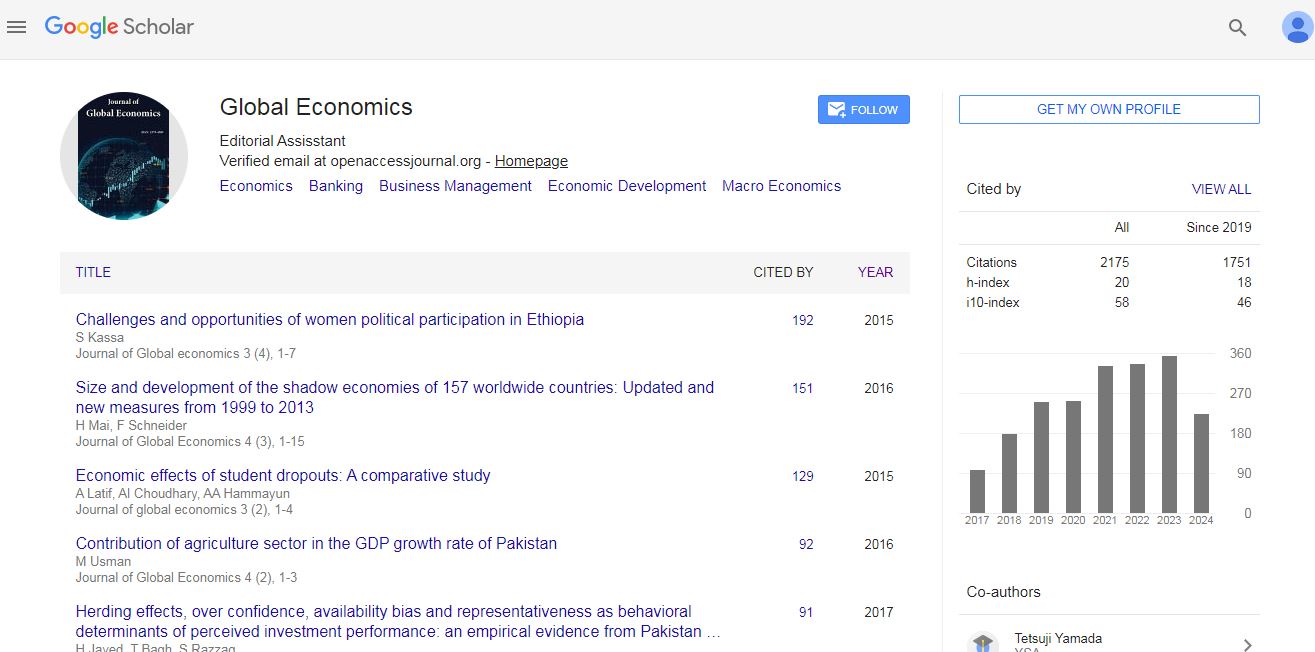
Journal of Global Economics received 2175 citations as per Google Scholar report