Brief Report - (2025) Volume 13, Issue 6
Received: 03-Nov-2025, Manuscript No. economics-26-186078;
Editor assigned: 05-Nov-2025, Pre QC No. P-186078;
Reviewed: 19-Nov-2025, QC No. Q-186078;
Revised: 24-Nov-2025, Manuscript No. R-186078;
Published:
01-Dec-2025
, DOI: 10.37421/2375-4389.2025.13.552
Citation: Kowalczyk, Marta. ”Global Trade Dynamics: Policies,
Technology, and Future.” J Glob Econ 13 (2025):552.
Copyright: © 2025 Kowalczyk M. This is an open-access article distributed under the terms of the Creative Commons Attribution License, which permits unrestricted use,
distribution and reproduction in any medium, provided the original author and source are credited.
The intricate landscape of global trade policy is undergoing significant transformation in the 21st century, marked by the strategic deployment of tariffs and the evolving dynamics of market access. This shift is fundamentally reshaping international commerce and the trajectory of economic development worldwide [1].
Protectionist measures, often subtly framed as necessary for national security or to ensure fair trade practices, are increasingly influencing global economic interactions and creating new challenges for businesses operating across borders [1].
Simultaneously, the digital realm has introduced a new frontier for trade, with digital trade agreements playing a crucial role in defining market access and influencing how firms engage internationally [2].
These agreements address novel aspects such as data localization and cross-border data flow regulations, presenting both opportunities and hurdles, especially for small and medium-sized enterprises seeking to thrive in the digital economy [2].
The proliferation of regional trade agreements (RTAs) further complicates the global trade architecture, creating intricate webs of rules and affecting non-member countries in various ways [3].
While RTAs can foster trade creation, they also carry the potential for trade diversion and the erection of new barriers for those outside these preferential blocs [3].
The economic repercussions of escalating protectionism, particularly through the widespread imposition of tariffs, are a growing concern, impacting import costs, consumer prices, and the competitiveness of domestic industries [4].
Such measures can trigger retaliatory actions from trading partners, leading to escalating trade disputes and pervasive economic uncertainty [4].
Beyond tariffs, non-tariff barriers (NTBs) are emerging as significant impediments to market access, especially for developing countries [5].
These barriers, ranging from technical regulations to sanitary and phytosanitary measures, can differentially impact trade flows and require targeted interventions and capacity building for developing nations to overcome [5].
The political economy of trade policy decisions also plays a pivotal role, with domestic lobbying and interest groups exerting considerable influence on tariff impositions and market access negotiations [6].
This can lead to policy choices driven by political motivations rather than purely economic efficiency, resulting in suboptimal trade outcomes [6].
Global value chains (GVCs), the complex networks of production spanning multiple countries, are particularly vulnerable to contemporary trade policies like tariffs and market access restrictions [7].
Tariffs can disrupt these intricate chains, increasing costs and diminishing efficiency, prompting countries to reconfigure their GVC participation in response to evolving trade environments [7].
The effectiveness of dispute settlement mechanisms within international trade frameworks, such as the World Trade Organization (WTO) and regional trade agreements, is critical for resolving conflicts related to tariffs and market access [8].
Analyzing these mechanisms reveals strengths and weaknesses and suggests avenues for reform to enhance efficiency and enforceability [8].
Emerging technologies, including artificial intelligence and blockchain, hold significant promise for transforming trade facilitation and enhancing market access by streamlining customs procedures and increasing transparency [9].
However, their integration into global trade frameworks also presents challenges and necessitates careful policy consideration [9].
International organizations like the WTO are central to governing trade policy and ensuring fair market access, but they face considerable challenges in adapting to new trade realities and the rise of unilateral measures [10].
Reforming these multilateral systems is crucial to strengthen their ability to promote inclusive global trade in a fragmented world [10].
The analysis of global trade policy in the 21st century highlights the complex interplay between strategic tariff implementation and the dynamic nature of market access. This dynamic is significantly influencing international commerce and the overall trajectory of economic development [1].
Protectionist strategies, often presented under the guise of national security or fair trade, are increasingly impacting global economic activities and posing considerable challenges for businesses engaged in international markets [1].
In parallel, the advent of digital trade agreements is redefining market access in the digital sphere, with regulations concerning data localization and cross-border data flows shaping the operational landscape for firms operating internationally [2].
These agreements present both significant opportunities and substantial challenges, particularly for small and medium-sized enterprises striving to navigate the digital economy [2].
The growing number of regional trade agreements (RTAs) further contributes to the complexity of global trade governance, establishing intricate rule frameworks that can affect both member and non-member countries [3].
While RTAs can facilitate trade creation, they also carry the inherent risk of trade diversion and the imposition of new barriers for entities not part of these preferential arrangements [3].
The economic ramifications of escalating protectionism, primarily through the imposition of tariffs, are a subject of considerable research, with significant impacts on import costs, consumer prices, and the competitive standing of domestic industries [4].
The retaliatory measures often enacted by trading partners can lead to escalating trade disputes and a climate of broad economic uncertainty [4].
Beyond direct tariffs, non-tariff barriers (NTBs) are becoming increasingly significant obstacles to market access, particularly for developing nations [5].
These barriers encompass a wide range of measures, including technical regulations and sanitary and phytosanitary standards, and their differential impact on trade flows necessitates targeted support and capacity-building initiatives for developing economies [5].
The political dimensions of trade policy formulation are also critically important, with domestic lobbying efforts and the influence of various interest groups impacting decisions on tariffs and market access provisions [6].
This influence can sometimes lead to trade policy choices that prioritize political expediency over economic efficiency, resulting in less than optimal trade outcomes [6].
Global value chains (GVCs), which represent integrated production processes across national borders, are particularly susceptible to the effects of contemporary trade policies, including tariffs and market access restrictions [7].
Tariffs can disrupt these intricate chains, leading to increased operational costs and reduced efficiency, prompting countries to adapt and reconfigure their participation in GVCs in response to evolving trade environments [7].
The effectiveness of dispute settlement mechanisms within both the WTO and regional trade agreements is crucial for resolving trade-related conflicts concerning tariffs and market access [8].
Comparative analyses of these mechanisms highlight their respective strengths and weaknesses, informing proposals for reforms aimed at enhancing their efficiency and enforceability [8].
Emerging technologies, such as artificial intelligence and blockchain, are poised to significantly impact trade facilitation and market access by streamlining customs procedures and improving transparency [9].
However, the integration of these technologies into global trade frameworks also presents unique challenges that require careful policy consideration and strategic planning [9].
The role of international organizations, particularly the WTO, in managing global trade policy and ensuring equitable market access is under scrutiny, especially in the context of rising protectionism [10].
The WTO faces significant challenges in adapting to new trade realities and the prevalence of unilateral measures, prompting discussions on reforms to strengthen the multilateral trading system and promote more inclusive global trade [10].
This collection of research explores the multifaceted dynamics of global trade in the 21st century, focusing on the interplay of trade policies, tariffs, market access, and technological advancements. It examines how protectionist measures and non-tariff barriers impact international commerce, particularly for developing economies. The role of regional trade agreements and the effectiveness of dispute resolution mechanisms are also analyzed. Furthermore, the research delves into the influence of digital trade agreements and emerging technologies on market access, alongside the political drivers behind trade policy decisions. The impact on global value chains and the challenges faced by international organizations like the WTO in a fragmented world are also key themes. Overall, the studies underscore the need for equitable and predictable global trading systems.
None
None
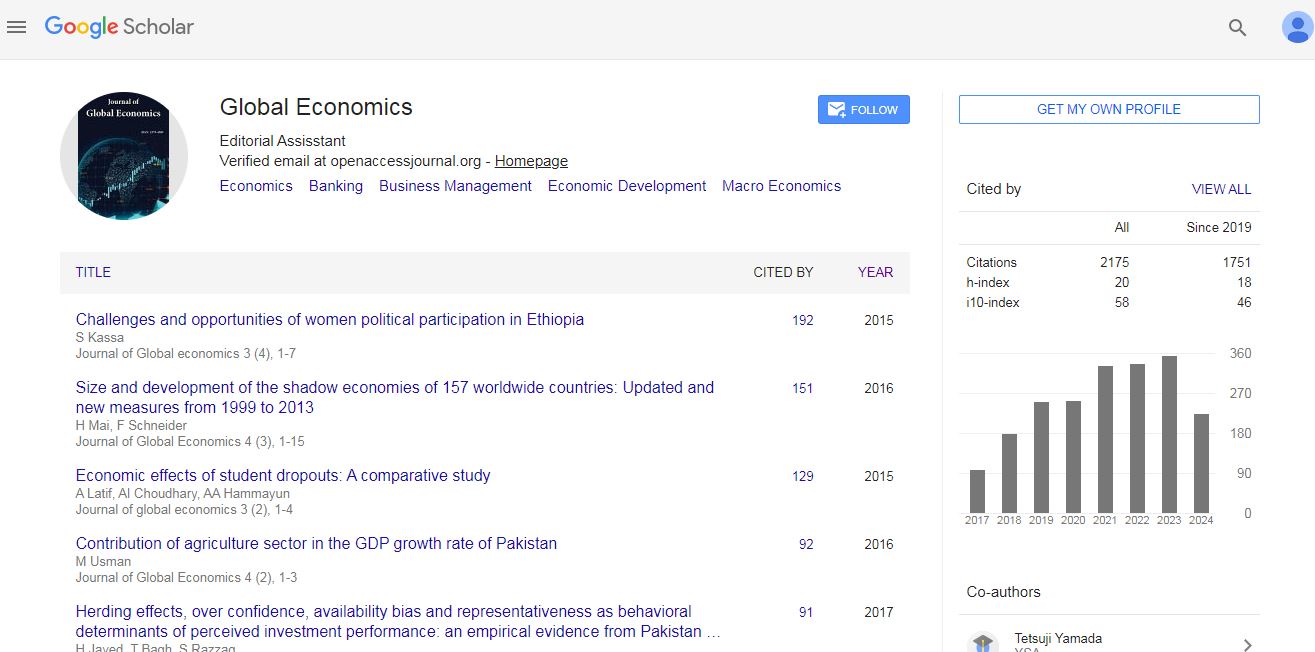
Journal of Global Economics received 2175 citations as per Google Scholar report